
Key Takeaways
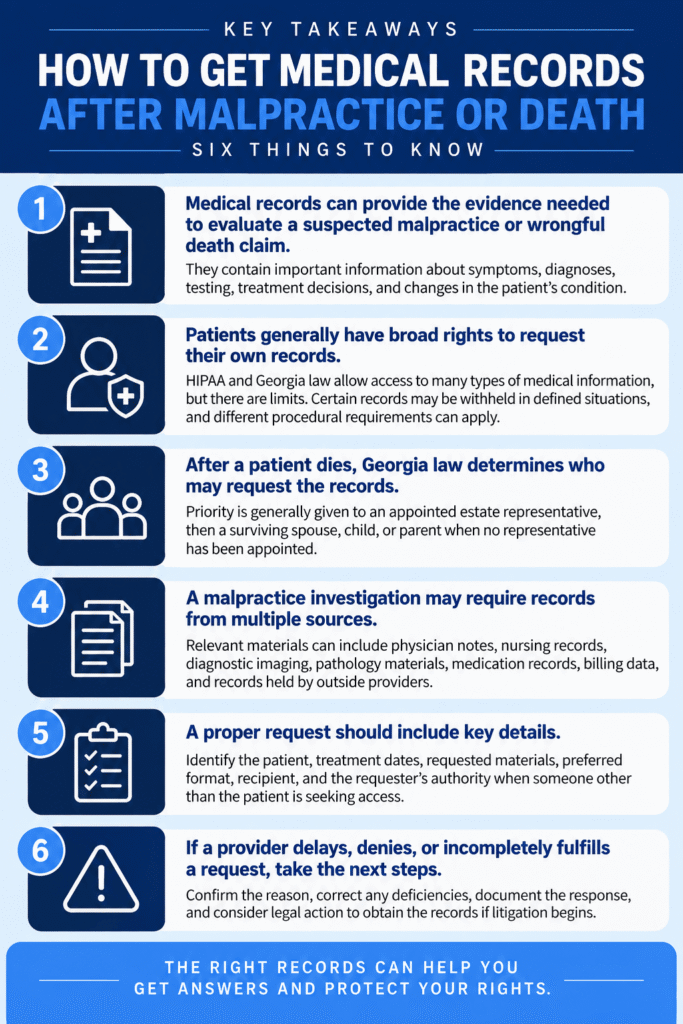
- Medical records can provide the evidence needed to evaluate a suspected malpractice or wrongful death claim.
- Patients generally have broad rights to request their own records, but HIPAA and Georgia law can limit access in defined situations and impose different procedural requirements.
- After a patient dies, Georgia law determines who may request the records, with priority generally given to an appointed estate representative, then a surviving spouse, child, or parent when no representative has been appointed.
- A malpractice investigation may require records from multiple sources, including physician notes, nursing records, diagnostic imaging, pathology materials, medication records, billing data, and records held by outside providers.
- A proper request should identify the patient, treatment dates, requested materials, preferred format, recipient, and the requester’s authority when someone other than the patient is seeking access.
- If a provider delays, denies, or incompletely fulfills a request, the requester should confirm the reason, correct any deficiencies, document the response, and consider legal action to obtain the records if litigation begins.
When you believe that medical malpractice left you injured or contributed to a loved one’s death, medical records are an important source of evidence. They contain information such as:
- What symptoms were reported
- What diagnoses were considered
- Which tests were ordered
- How healthcare providers interpreted the results
- What medical treatment was recommended
- How the patient responded
- When changes in condition were documented
In a malpractice investigation, those records may be reviewed alongside expert testimony to determine if the treatment in question met the applicable standard of care and whether a departure from that standard caused further injury.
Access is more complicated when the patient has died. A surviving relative doesn’t automatically have unrestricted access to a deceased patient’s protected health information. Federal HIPAA rules continue to protect a patient’s health information after death, while Georgia law determines who may request the records when an estate representative hasn’t been appointed.
At The Champion Firm, Personal Injury Attorneys, P.C., we use medical records to prove potential medical malpractice or wrongful death claims. This article explains who may access these records after suspected malpractice or death, and what options may be available if your request is incomplete, delayed, or denied.
Why Medical Records Can Be Important After Suspected Malpractice
Medical records allow personal injury attorneys and reviewing physicians to evaluate your care and determine whether it met the accepted medical standard. They can answer important questions like:
- When did you first report your symptoms?
- What were the results of any tests run?
- How quickly were any abnormal findings addressed?
A poor outcome by itself doesn’t necessarily establish malpractice. The central questions are whether the provider failed to meet the applicable standard of care and whether that failure caused your illness or injuries. For example, a chart in your medical records may contain entries indicating the following:
- Delayed testing
- Missed abnormal results
- Medication errors
- Failure to refer the patient for further evaluation
- Delayed treatment
- Inadequate monitoring
- Other physicians, nurses, laboratories, imaging providers, or entities whose involvement should be reviewed separately
These records are also important because malpractice claims frequently hinge on causation. A provider can make an error without becoming legally responsible for every later complication. Personal injury attorneys and medical reviewers must examine the patient’s condition before the alleged negligence, the timing of the disputed care, the progression of symptoms, later diagnoses, and subsequent treatment to determine if the provider’s conduct caused a new injury or worsened an existing condition.
Under O.C.G.A. § 9-11-9.1, anyone alleging professional malpractice generally must file an affidavit from an expert competent to testify. This affidavit must identify at least one negligent act or omission and state the factual basis for each allegation. Thorough medical documentation helps the reviewing expert determine if the evidence supports a malpractice claim and which acts or omissions can be identified in the affidavit.
Can You Get Your Own Medical Records After Suspected Malpractice?
Yes. If you’re the patient, federal law gives you broad access to medical information maintained about you by a HIPAA-covered provider or health plan. That right extends beyond documents traditionally viewed as part of a medical chart. Under the HIPAA Privacy Rule, you can request protected health information contained in a designated record set, which may include:
- Medical records
- Billing records
- Laboratory reports
- Diagnostic imaging
- Claims information
- Treatment consent forms
Under O.C.G.A. § 31-33-2, a provider that has custody and control of a patient’s record must furnish a complete and current copy after receiving a qualifying written request. The statute also permits access by a person authorized through an advance directive for health care, psychiatric advance directive, or durable power of attorney for health care.
It is important to note that HIPAA access rights are broad, but they aren’t unlimited. Federal law recognizes limited grounds for denying access to certain protected health information. Georgia law also permits a provider to refuse direct disclosure to a patient if the provider reasonably determines that releasing the record would be detrimental to the patient’s physical or mental health. In that situation, the record must be furnished to another provider designated by the patient after a written request.
In addition:
- Under O.C.G.A. § 31-33-2, a provider must furnish qualifying records within 30 days after receiving the request.
- HIPAA requires a covered entity to act on an access request no later than 30 calendar days after receipt.
- Federal rules permit one extension of up to 30 additional calendar days if the covered entity provides written notice (within the initial period) explaining the reason for the delay and stating when the request will be completed.
Keeping a dated copy of your request and proof of delivery can help document when the response period began.
Who Can Get Medical Records After a Patient Dies in Georgia?
HIPAA continues to protect a deceased person’s identifiable health information for 50 years after death, but federal law looks to state law to determine who can act as the deceased patient’s personal representative. In Georgia, O.C.G.A. § 31-33-2 identifies who may request the records and establishes an order of priority.
- If an executor, administrator, or temporary administrator has been appointed for the estate, that person has authority to request the records.
- If no estate representative has been appointed, Georgia law permits the surviving spouse to make the request.
- If there is no surviving spouse, any surviving child may request the records.
- If there is no surviving child, either parent may do so.
HIPAA contains a separate rule that sometimes permits disclosure to a family member or another person involved in the patient’s health care or payment for care before death. That disclosure is limited to information relevant to the person’s prior involvement and can’t conflict with a preference the patient expressed before death. It’s therefore different from the broader access rights available to a legally authorized personal representative.
Note: A provider may need documentation sufficient to verify both the requester’s identity and legal authority. Depending on the requester’s status, that documentation may include letters testamentary, letters of administration, proof of appointment as temporary administrator, a death certificate, or records establishing the qualifying family relationship.
What Medical Records Should You Request After Suspected Malpractice?
The records you request will depend on the type of care involved, but they may include:
- Emergency department records
- Admission and discharge summaries
- Physician progress notes
- Nursing notes
- Consultation reports
- Operative reports
- Procedure notes
- Anesthesia records
- Medication administration records
- Physician orders
- Laboratory results
- Pathology reports
- Biopsy results and related pathology materials
- Radiology reports
- CT, MRI, X-ray, ultrasound, and other diagnostic images
- Vital-sign records and flow sheets
- Fetal monitoring strips in birth injury cases
- Consent forms
- Discharge instructions
- Referral records
- Rehabilitation and therapy notes
- Billing and coding records
Diagnostic imaging deserves separate attention. A written radiology report reflects the radiologist’s interpretation, but it isn’t the same as the underlying image. In a claim involving a missed diagnosis, delayed diagnosis, surgical planning issue, or other imaging-related question, the original study may need to be reviewed independently. That can include the digital image files themselves rather than only the written report.
How Do You Request Medical Records in Georgia?
Hospitals and larger medical practices usually direct requests through a Health Information Management or Release of Information department. Smaller practices may handle them through the office administrator or medical records custodian. Many providers accept requests through secure online portals, while others use mailed, faxed, or electronic forms.
Ask where the request should be sent and which form the provider uses for patient access requests. This can reduce delays caused by sending the request to the wrong department or submitting an incomplete form.
Submit the Request Under the Appropriate Access Rule
A records request may proceed under Georgia law, HIPAA, or both, depending on who is requesting the information and the legal basis for access.
- As we mentioned earlier, under O.C.G.A. § 31-33-2, a qualifying request for medical records must be made in writing and must include the authorizations required by that statute.
- HIPAA provides a separate federal right of access. When a patient exercises that right under 45 C.F.R. § 164.524, the patient generally isn’t obliged to sign the type of HIPAA authorization used for disclosures under 45 C.F.R. § 164.508. The provider may still ask for the request to be in writing and take reasonable steps to verify the identity and authority of the person making it.
The request should identify:
- The patient’s full name and date of birth
- The dates of treatment involved
- The provider or facility that supplied the care
- The categories of records being requested
- The requested format, such as electronic or paper copies
- Where the records should be sent
- The requester’s name and contact information
- The requester’s legal authority if the patient isn’t making the request
If you’re requesting records for a deceased patient, include the documentation needed to establish your authority.
State What You Want the Provider to Produce
Avoid submitting a request that says only “all records” when the malpractice investigation may call for materials maintained separately. Identify the clinical records you need and request diagnostic images, billing information, pathology materials, or other items separately when they are relevant.
Under HIPAA, a covered entity must provide records in the form and format requested if they are readily producible that way. If the requested format isn’t readily producible, the provider and patient may agree on another readable version. When protected health information is maintained electronically, federal rules can require production in a readable electronic form if the exact requested electronic format isn’t available.
Direct Records to Another Recipient When Appropriate
A patient may ask a covered entity to send records to another person or organization, subject to the applicable HIPAA requirements. The request should clearly identify the intended recipient and where the information should be sent.
For a malpractice investigation, these specifications may allow records to be transmitted to an attorney, another physician, or another recipient selected by the patient. The applicable rules can differ depending on how the request is made, so the provider’s records department may require the patient to use a designated access or authorization form.
Keep Proof of the Request
Keep a copy of every request, authorization, supporting document, and confirmation showing when the provider received it. Save portal confirmations, fax transmission reports, certified-mail receipts, delivery confirmations, and email responses.
That documentation can help establish when the applicable response period began if the provider delays production. It also gives you a record of which providers have produced records and which requests remain outstanding.
What If the Hospital or Doctor Won’t Release the Records?
Sometimes you run into this issue: You request medical records but the provider won’t release them. This doesn’t necessarily mean that they’re obstructing you. Problems can arise for reasons like the following:
- The request was incomplete
- The wrong department received it
- The provider needs proof of the requester’s authority
- Part of the information is held by a separate entity
The first step is to determine why the request wasn’t completed and identify what the provider still needs. Recommended steps include:
- Checking that the request was signed, dated, and sent to the correct records custodian.
- Confirming that the treatment dates were identified, the requested materials were described clearly, and any documents establishing the requester’s authority were included.
If the patient is deceased, the provider may want proof that you’re a qualified requester or have been appointed to act for the estate.
Other considerations include:
- Some information falls outside HIPAA’s individual right of access. That includes psychotherapy notes and information compiled in reasonable anticipation of, or for use in, a civil, criminal, or administrative proceeding. But these exclusions don’t necessarily remove access to the underlying medical information if that information is otherwise part of the designated record set.
- HIPAA permits certain denials of access. Some are reviewable, while others are not. For example, a denial based on a belief that access is reasonably likely to endanger the life or physical safety of the patient or another person can involve a right to review by another licensed professional who wasn’t involved in the original decision. In contrast, information excluded from the access right, such as psychotherapy notes, isn’t subject to that review procedure.
- Release could be detrimental to the patient’s health. Under O.C.G.A. § 31-33-2(c), a provider may refuse to release the record directly to the patient if the provider reasonably determines that disclosure would be detrimental to the patient’s physical or mental health. In that situation, the provider must furnish the record to another provider designated by the patient after receiving the patient’s written request.
When HIPAA permits a denial, the covered entity generally must provide a written notice stating the basis for the decision. The notice must explain any available review rights and tell the requester how to file a complaint with the covered entity and the U.S. Department of Health and Human Services Office for Civil Rights.
If records remain unavailable after follow-up, a Georgia medical malpractice attorney can determine what legal remedies are available. Once litigation begins, counsel may use requests for production, subpoenas, depositions, and other discovery procedures to obtain records, identify custodians, and address incomplete responses. A provider’s delay shouldn’t be treated as proof of malpractice or concealment, but it should be documented because access to the full medical file can affect the investigation.
Questions About How to Get Medical Records? Call The Champion Firm
Medical records are key to a malpractice claim evaluation. They can establish the timing of care, identify the providers involved, document test results and treatment decisions, and show how your condition changed after the alleged error.
At The Champion Firm, Personal Injury Attorneys, P.C., we can identify the records needed for a malpractice investigation, request additional documentation from the appropriate custodians, and work with qualified medical professionals to evaluate the care that was provided. For more information or to schedule a free consultation, call 404-637-1709. Hablamos Español.