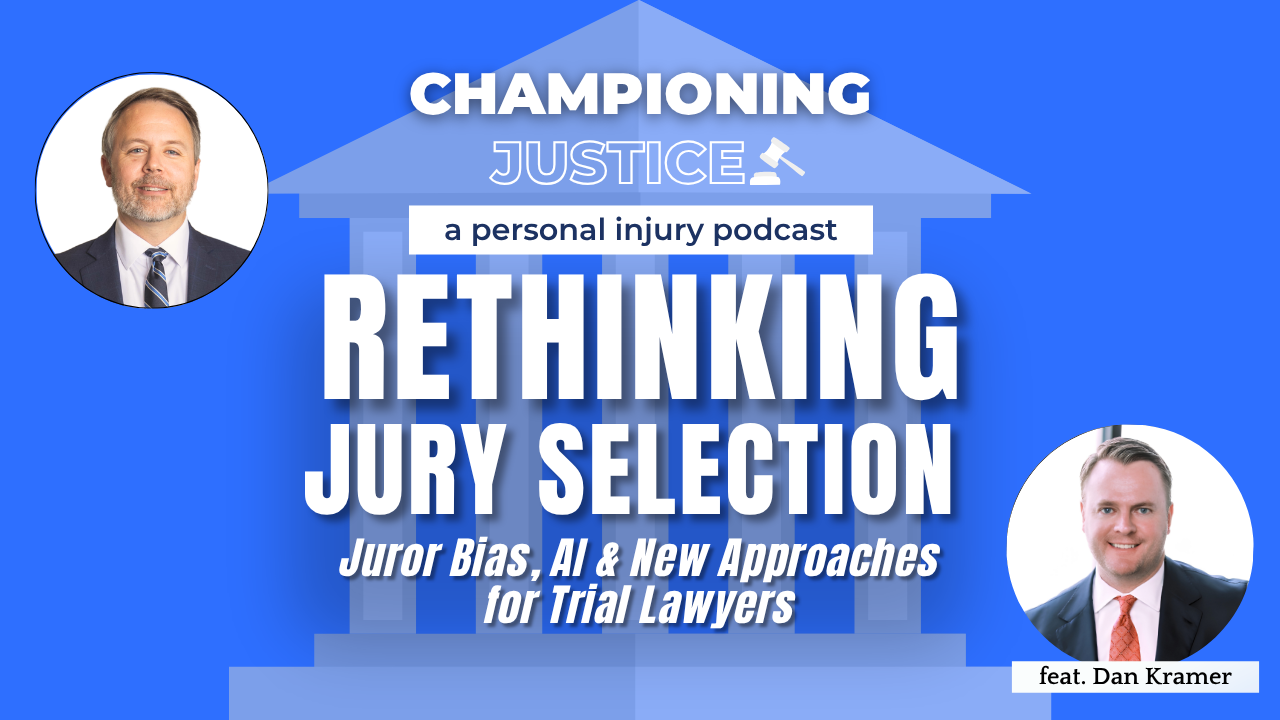
The following is a transcript of Episode 34 of Championing Justice. You can listen to the full episode here, or watch it on YouTube.
Darl:
Welcome to the Championing Justice podcast. My name is Darl Champion.
Today's guest is Dan Kramer, a founding partner of Kramer Trial Lawyers in Los Angeles and an accomplished trial lawyer who represents individuals and families in catastrophic injury and wrongful death cases and employment cases. He has a very impressive track record. I was looking at his website and saw some of his massive verdicts and settlements. Recently got a very large municipal liability verdict as well out in California, I believe, that we might mention today as well.
Several of his verdicts have ranked among the largest in California. He's a graduate of Gerry Spence's Trial Lawyers College, a member of the prestigious American Board of Trial Advocates and a past president of the Los Angeles Trial Lawyers Charities. He's also served in leadership roles with several trial lawyer organizations.
Despite living in Los Angeles, one of my favorite things about Dan is he's a diehard Braves and Falcons fan, which is something for us to talk about.
Dan:
You better believe it. Oh man.
Darl:
Especially after the Braves beating the Phillies last night.
Dan:
Yeah, Dale Murphy's right there behind me.
Darl:
He's awesome, man. I have a signed Acuña jersey right outside my office here.
Dan:
Oh, there you go.
Darl:
Dan and Harry Plotkin host a podcast on jury selection called Picking Justice, which focuses on the complex art of jury selection. And jury selection is what we're going to be talking about today. Thanks for coming on the podcast, Dan.
Dan:
Yeah, man. Thanks for having me. I'm pretty pumped after last night's game.
I'm going to be in Dodger Stadium tomorrow. I don't know when this is going to air. Hopefully we're still in it, but I'm going to be decked out in Braves gear, cheering on our Braves tomorrow amongst a bunch of Dodger blue.
Darl:
Awesome, man. Well, I'm sure your schedule's packed next week and it's kind of hard to plan these playoff series and knowing...
Dan:
I can change my schedule for the Braves.
Darl:
But as you can tell, Dan and I could probably spend the whole podcast talking about Atlanta sports. But I want to talk about jury selection.
Dan:
Yeah, let's get into it.
Darl:
Yeah, man. So jury selection is incredibly important and it's one of those overlooked things I think for a couple reasons. One of which is the opening statement, the closing argument, the impeaching the witness gets so much attention.
The other thing is I just think jury selection is such an unnatural thing to be standing up in front of a group of people and asking them questions. I feel more comfortable with it as I've gone on in my career, but when I first started trying cases, I felt so uncomfortable standing up there and just awkward and I'm trying to remember people's names and I've got my jury chart.
And what do you tell the lawyers when they come to you and you're trying to emphasize to them the importance of picking a jury and how important that is to your case?
Dan:
Yeah, man. I mean, it is by far the hardest thing. I don't think anyone listening to this should beat themselves up for struggling with it. I think it's extremely hard. This is why we started the podcast because when I was first trying cases and I would devour everything like I'm sure most of your listeners do, every podcast, the great one like you have or audiobooks, David Ball stuff, trial guides, whatever. And there's hardly anything on jury selection when it is the hardest thing to do.
And I used to be terrible at it too. And it's constantly something that we have to try to get better at, try to work on. But I think the biggest thing I've learned lately, honestly within the last 18 months is that I've started to tell myself that almost like a mantra, you're a moderator, you're just a moderator. You moderate, you moderate, you moderate, you are the moderator.
So I say that to myself a lot when I'm starting to ask questions or when I get started in jury selection or even the middle, just to remind yourself that you're just there to be the Phil Donahue. You just want to get, "Okay, this person said this. Oh, how do you feel about that? What do you think? What do you think? What do you think?"
And if you have that mentality when you approach it and while you're in it, it really will change the way you talk to people and listen to people and it really will achieve the goals you want. Because I think too many lawyers, I think the mistake most of them make nowadays is that they'll have an agenda and we all should have a plan, but that agenda, you'll be too tied to it and then you'll get a really bad answer right out of the gate and then you immediately go for cause.
And so you just attack, attack, attack because they said something and then you'll go through whatever your state's case law is about a strike against, uphill battle, whatever that is, and you'll go too quick there. But I don't think that you want to do that early on because it'll stifle the conversation and you want to achieve your goal of being the moderator. So that's the biggest takeaway I've had lately is just the mindset going in.
Darl:
Yeah. Well, in California, I imagine that's where you try the vast majority of your cases.
Dan:
Yeah.
Darl:
Are there any specific rules about the length of jury selection? Are judges asking the questions versus lawyers? Does it just vary by county or district or however your courts are set up?
Dan:
Yeah. I mean, a new law came out, I think it was two years ago that says that judges can't set arbitrary time limits. They do still. They say it's 60 minutes, but it's not arbitrary. So they'll do that. It used to be like you would have 20 minutes, but judges, we've pushed back a lot on that from the plaintiff's bar.
So I typically see you'll do a six pack, which means that there'll be 12 in the box and then six in front. So you'll do 18 people. Most judges give about an hour, I would say, for those 18, and then you'll refill the seats and you'll maybe have another 20 minutes. So that's kind of what I've been seeing.
Obviously I push for more. I follow trial briefs and all that, but if I can get an hour to an hour and a half for the first 18, I can accomplish what I need to there.
I don't like time limits, but that's kind of what we deal with. What about you guys? What do you guys deal with out there?
Darl:
Varies by judge. And obviously federal court's a totally different animal and it's like that is so judge specific. There's some that's like the judges want to pre-approve the voir dire questions. Even in state court, some judges want to pre-approve them, some don't want to see them. Some put strict time limits, some don't. It really is just kind of like a crapshoot.
You really don't know what you're getting. And it's important to talk to the court beforehand and ask them at the pretrial conference like, "Hey, what's your preference for this?" And the other thing is the way each judge does it is very different. So I had a trial recently, earlier this year, it's a case I want to forget because it had some bad facts.
Dan:
I've had many of those.
Darl:
Yeah. So it's one of those things you look at retrospect and you're like, "How the hell did I think I was going to win this case?"
Dan:
Why did I take it?
Darl:
Yeah, but that's part of it. But the judge had all of the jurors. So all the jurors have to get vetted for their financial bias, financial relationship. Are any of them insured by State Farm? Because State Farm's a mutual company. So in Georgia...
Dan:
Wait, were you suing State Farm directly?
Darl:
No. And so...
Dan:
Wow, what a great question. The judge...
Darl:
Oh, get this. This was even better. So I had a trial one time where the judge, after they ask them and they qualify the jury in the jury assembly room, they bring them up. So there's not supposed to be any more State Farm policy holders in the room or employees.
Dan:
Wait, I don't get it. Why State Farm specifically?
Darl:
Well, so you're qualified as two insurance companies, but because State Farm is a mutual company, even if you're just insured by them, you're disqualified because you're essentially equivalent to a stockholder in the company. If it's not a mutual company like State Farm, then it's really just the officers, director, shareholders, employees type.
Dan:
But that's so great insurance is being talked about.
Darl:
Well, so it gets talked about. So I had a case one time where the judge said again, he's like, "I know this question was asked in the jury assembly room, but is anybody here insured with State Farm?" And a few people raised their hand and he said, "Well, you need to go down the hall. This is a State Farm case. That one's an Allstate case."
Dan:
Oh my God.
Darl:
And I'm like, "Is the defense coming back?"
Dan:
Wait, wait, sorry. I just want to make sure I get this. So the jury's allowed to know that there's insurance?
Darl:
No, but because of the nature of the question, they know.
Dan:
Oh my God, this is unbelievable.
Darl:
Yeah. There's actually a court of appeals decision where it says they have to be qualified in open court if counsel requests. If they were qualified in the jury assembly room or whatever in private, you're entitled to have them qualified as to the insurance company relationship.
And so yeah, that's a question that we have. But we had a case though where the judge did not qualify the people in the jury assembly room as to their relationship with the insurance company. And so these people coming in, he was putting 12 in a box and having us do voir dire with just 12 at a time. Well, out of those 12, five of them were insured by State Farm.
So then five are out and then I'm just doing voir dire of seven people. Then you get a couple strikes for cause. We had to go through three panels to get our jury.
It literally took until 5:00 PM. And so that was rare. That's not something I'd ever seen before. We have some judges that will put all 30 to 36 out in the gallery and you stand up and you ask your questions that way.
Dan:
Yeah, I've had that too.
Darl:
I saw them that do the 12 in the box and then the rest out in the gallery and you're rotating between the two, which is also very weird and uncomfortable.
Dan:
Yeah, so there has been kind of a movement in LA a little bit about with some judges wanting you to voir dire the whole room. I don't like it, but then sometimes I actually think it can be to our benefit if you have enough time because the worst is when you have... I personally, I like to pass a lot.
In California, each side gets six strikes and I like to roll the dice and Harry and Claire Plotkin are always like, they get real, not mad at me, but they're like, "This is really risky. You sure you want to do this? What if they accept?"
But it's almost always where a defense attorney will use the strike at least in the first round so then I can get ahead of them on strikes. So I'll have six, they only have five left. I like to pass twice so that they have four left and I have six left so you can stack the deck.
I think one of the benefits of when you can voir dire the whole room is that you can really know who's coming up. So you know who's next in line.
Whereas if you can only do the first 18, if you have more strikes, I think knowing what the whole room's going to do, you can really stack the deck with the jurors, if that makes sense. So I don't love it, but in a way I get a lot more information about I know who's next in line.
Darl:
Yeah, no, I mean, I think one of the things that would be good if we had this in Georgia is just some sort of uniform method of doing jury selection.
Because again, it's like you could have four trials in a year and you're going to get four different completely different ways between where they're sitting, if you're doing 12 versus the whole panel, whether there's time limits. And so talk a little bit about that, about the importance of being flexible in jury selection and having to deal with these. What's the shortest time you've ever had to pick a jury?
Dan:
I mean, I think at one time I had in San Diego 45 minutes for 50 people, so it's tough. The thing is I ask a lot of questions at the final status conference or right before because judges don't really like to tell you everything, but I ask a ton of questions for cause, how do they like to do it? Where do they like to do it? What kind of language do they like to know about bias?
I kind of remind them on the case law because I just think judges, a lot of times, well, I don't know about a lot of times, but they don't necessarily know the case law on jury selection because I think it's rarely an issue that comes up on a motion, so they don't see it in the papers. They're rarely appealed, to be honest, because you got to use all your strikes in California if you want to try to appeal that, and it's just not something that's really done.
So the judges think they just do things the way they've always done it. But I think if you remind them before trial on the case law, on what the magic words are... So I do a lot of that is to educate judges, frankly. So I'll do that before, so I know going in that they know I know what I'm doing in jury selection.
So I like to have that command of the law in the room so that when I do start to move for cause or I try to do all that, that they know what I'm saying is correct on the case law. And so I'll do that initially and then always beg for more time. I brief that issue, make a big deal about it. I say, "Your Honor, look, you can limit me on opening. You can limit me on my case in chief.
I promise you I'll be very efficient, but give me as much time as I need in jury selection." So I'm doing a lot of prep work there. And then look, if they're still going to shut me down and say you have 45 minutes, then you got to really be selective on the topics you talk about.
So you got to talk about money. You got to put that out there. That has to be something that you cover. And then the other topics, depending on your case, is going to be you want to find out who the tort reformers are. So something about filing frivolous lawsuits, filing who doesn't like these or who doesn't like slip and falls, whatever. It's got to be liability and then quickly go into money.
So I think if you're limited, you got to be very selective about what you get to, and it's got to be about money, I think.
Darl:
How do you structure your voir dire in terms of the categories you go through and the order of questions? Do you start out immediately with certain bias questions or do you ask more of the broad biographical like, "Does anybody here had to work in the medical field? Does anybody..."
Dan:
So I try to avoid those. Yeah, I really try to avoid those kind of questions, but it's changed. I've kind of morphed a little bit lately is that I used to hit bias stuff pretty hard in the beginning and almost go too negative. And that became a mistake, I think, is that I would, maybe a slip and fall or whatever, I would just talk about how much people hate slip and falls and all that.
And things can snowball real quick. You can get a lot of people who say, "Well, you got to watch where you're going," and you can get good jurors. If you do too negative, like in California, we can do a mini opening statement. If you go too negative, then you're going to get a lot of cause challenges. And I noticed a lot of attorneys brag about how many cause challenges they get.
But if you're getting a lot of cause challenges, you're getting a lot of negativity out there, a lot of bias out there early, then either there's something really wrong with your case and it's a bad case or you're not framing it the right way.
So my old way of thinking was go negative, get as much cause as you can, but I think you potentially lose a lot of good jurors that way because they may say some bad stuff about their feelings on slip and falls, but if you have a righteous case and you believe in your case and it's not frivolous, they could be wonderful on damages and they could actually get really angry at the defense, but the way you framed it out from the outset, like who's sick of billboard lawyers or who doesn't think people should sue for car crashes? If you do that early, I think that could kind of send a negative message.
So I kind of framed things a little different initially. In this case, I just tried. It was like it's a tough liability sidewalk defect. My client was riding his bike 3:00 AM without a helmet, no light. I mean, he was a longshoreman, so he had gotten off work but decided to get on his bike. But you hear those facts, it's a tough case.
And I was suing the state of California CalTrans because they were responsible for that sidewalk and they knew about the defect for a long time. So I think before I would go, my first question was like, who here thinks that if someone falls on a bicycle, it's on them no matter what? Or I would talk about helmets and that would start kind of a negative thread. But this one, I think I opened it with, I always like to do kind of two extremes and then find out who leans one way or another.
So I think I opened it with this case involves a defective sidewalk. Some people, and I'll walk to one end of the jury box area, some people think that our governments or cities or the state should keep our sidewalks safe for pedestrians. And if they don't, it's okay to sue them if someone gets hurt by tripping or falling on one of their defective sidewalks, then I'll walk to the other end.
But other folks feel or think that the cities or states are too busy, budgets are too tough. They have a lot of other things to worry about and people need to watch where they're going and they shouldn't sue for these kind of cases. Then I'll go back to the middle and I'll say, okay, does anyone lean a little bit? I'm not saying all the way, but does anyone lean a little bit to the side that thinks that the cities are too busy, people shouldn't sue?
So I'll start the conversation like that because it's not going super negative on my client's actions yet. I do get there. I have to cover bias against bicycles, bias against helmet. I have to put that out there, put the skunk on the table as my buddy Ricardo Echeverria says. But I want to start with the framing of who feels about the cities, because inevitably you're going to get some people who are going to say the opposite.
In this jury selection we had, I had a woman who ended up staying on the panel who was wonderful for us. She's like, "Well, I think they need to keep it safe. And what about someone in a motorized scooter? They're not wearing a helmet. They need to keep it safe for people who are 88." That was a great answer for me. And the jurors start thinking that, but I had some really bad jurors who said, "Yeah, I don't think people should sue for bad sidewalks. I think this is ridiculous." And then I honor that answer.
It's a really good answer I get early on, and I really appreciate that. I used to be scared of those jurors, but now I'm just so thankful that this person said that because then I could say, "Does anyone else sort of agree with that and think that way?" And I'd be honest, I would say, "My dad thinks that way or my uncle thinks that way, and that's okay. It doesn't make you an unfair person. It just means that in this case, maybe we're starting a little bit behind." So I just want to take that question, get the answer, then be the moderator from there.
Darl:
So I'll give you what I've always felt like I'm bad at. I'm bad at reading people. I've had cases where I'm like, "Man, this person is going to be the worst juror ever."
And then you find out after the trial, you're like, "Man, they were totally in your corner." I had a case one time where I was like, "This person's going to be my best." And you find out after, they're like, "They wanted to give you nothing." How do you...
Dan:
Vibes? Talk about vibes.
Darl:
Yeah. How do you deal with the vibes and what sort of data-driven or...
Dan:
I don't like vibes. I mean, I don't like vibes in jury selection. I don't like that being a deciding factor because I've had jurors, men or women who want to grab... I could tell they want to grab a beer with me or they'd be cool to hang out with. I don't know, man. I think vibes is something.
It's a data point, but I don't think that someone is really going to... If they're set against the evidence or against your case or your client, just because they like you, I don't think that's going to make them change their mind. I do think that if you're credible and you're trustworthy and honest, that will make a difference to the jurors.
But just based on how much they like you, I don't know. It's a risky thing to do that just be like, oh... Because Harry and Claire and I, Plotkin, who I always use, we talk about this and it's like just because they like you doesn't mean they're going to give you a lot of money or fine for your client.
So it's tough. It's something, but it's not...
Darl:
I think it's more of the stereotypes, not necessarily the vibes.
Dan:
Oh, the stereotypes. Yeah.
Darl:
Yeah. And it's not always ethnic or socioeconomic, but I had a trial in a suburb a few years ago and we ended up getting a good result in the trial, but because it was a conservative venue, the kind of thought was, well, hey, maybe somebody who's not from this county is a typical Atlanta suburb transplant might be better.
They might be better on damages versus the more conservative juror that grew up here. And so there was a lady from New York City who had had a car accident, who had sued for her car accident, and I'm like, "Dude, she's going to be great for us."
And then you have this other person who grew up in that county, kind of fit the bill of like, "Man, they're going to be a conservative juror on damages." But then find out after the fact, the one I thought was going to be great, wanted to give us a lot less, and the other one wanted to give us a lot more.
Dan:
Yeah, so this is really important, and I don't believe in stereotypes at all in jury selection. I think it's such a bad way to pick juries. I mean, out here in California, you pick a jury in Santa Monica, you could have these flaming liberals who you think...
I think a lot of PI attorneys think they'd be great on our cases and they're terrible. They don't want to get... But again, I wouldn't stereotype that way either. You could have hardcore MAGA people who get really pissed at taking away someone's freedom to live independently in a defense.
Darl:
Well, that used to be the old school way of jury selection, right?
Dan:
It's not like, oh, Asians are bad, or whatever. Look, if it did work, I would use it. If stereotypes, I would 100% use it. To me, it just doesn't work. I'm not trying to say it like, oh, I'm blind to all of it, but it just doesn't work. It doesn't create good results.
Darl:
I totally agree with you, and I've learned my lesson, but I'll give you an example. First of all, I spent two years clerking for a federal judge right after law school, and we had to approve all the voir dire questions. I would see this very similar questions on a civil case. "Do you have any bumper stickers on your car? Who do you listen to?"
Dan:
"Where do you get your news?" Yeah.
Darl:
And then when I started practicing, the more senior lawyers I worked for would ask those kind of similar questions. That's just bad advice. That's terrible advice. Should we just not even ask those questions anymore?
Dan:
Well, I guess with every question you ask, you always got to go down, this is what I teach in my class. It's like, where is it ultimately going to get you? Okay, so let's play that out. So where do you watch your news? Where do you get your news from? I get it from Fox News or the New York Times or MSNBC. Okay. So what data did you just get? You found out what, that they... What's the data tell you?
Okay. So say you have a car crash case against a mom who's the defendant. Your client is injured, had back surgery. So what data helped you to determine if this juror is going to either get angry at the defense or want to award a lot of money or believe that quality of life is worth a lot of money, lost quality of life? So they say Fox News. Okay. I still don't know what does that help you determine, right? I'm asking you...
Darl:
Yeah. And I mean, I'll tell you historically what it was, was it would tell you theoretically who the conservatives were, who the liberals were, the thought? The conservative jurors. Well, so this is where I think it started. This is my theory.
In the 90s, especially in the early 2000s, tort reform was a big thing. And so the thought, I think, where all these questions developed was the thought was, well, if you're politically conservative, you're probably going to be a tort reformer. And if you're politically liberal, you're not, and you're going to be empathetic people money. But that's clearly not true.
Dan:
Well, no, no, but let's follow what you're saying. So you think that asking that question will determine for you that someone who watches Fox News believes in tort reform. And so that's what you think. Why ask that first question? Why not just go right to the exact issue?
This is the thing. I think people dance around it. Why not just ask them, does anyone here feel that there should be caps on damages? That it should be the legislature who determines that any amount in excess of a million dollars is not right and that there's too many runaway juries.
Darl:
And really liberal people might believe that.
Dan:
Right. I mean, they do. But the thing is why not go directly to the heart of things? In jury selection, I think we try to be too cute. I think attorneys try to be too fancy or too... They think they're going to find out this deep, dark feeling or deep feeling someone has because they find out they listen to Sean Hannity as opposed to MSNBC, where why not just go right to the issue?
Because you can get both sides can say, "I don't think that a million dollars for pain and suffering, I think anything over that is excessive. I just don't believe that their loss of quality of life is worth any more than that. Does anyone feel that way? And it's okay if you do." Then why not just go right to it, is my point.
Darl:
Yeah. No, I agree. And I think that, again, there's historically jury selection has kind of been these mental shortcuts that people would try to make based on stereotypes, and they don't really work. Instead, like you said, you cut to the heart of the matter, right? Ask those questions.
Dan:
It's not that complicated. The thing is, jury selection is extremely hard, but we also make it way harder than it needs to be, and we overthink it. And I think this is why there's nothing better than... The only way you get good at jury selection is just by doing a ton of jury selection. But the reality is that I love being in trial and I wish I could do more.
I mean, we try about five to six cases a year, which is a lot, but I get the itch when I'm 48 hours out. I keep telling my wife, I need a break, but I guarantee you, and she looked at me, she's like, "Next week, you're going to want to be in trial again." That's just how I'm wired.
But for those of you out here who can't try cases, and you should all try to try cases, but focus groups, we do four to five focus groups and we do them on the cheat because we run them ourselves.
We recruit and we pay $100, $120 per person for three hours, do them in our conference room. It's self-run and it's not that hard. Anyone can here can do it, but that's how I get my reps. It's like we talk about the Braves batting practice. So if I'm only picking a jury five times a year, that's not that often, and I have to stay sharp.
And so every focus group, I do at least half hour to 45 minutes of jury selection just so I can practice how does this sound coming out of my mouth? How do I react to people giving me bad answers? Is the conversation flowing? So it's just getting as much reps as you can. I don't even know if that was your question, but...
Darl:
No. Yeah, absolutely. So let's say you're talking to a lawyer who's trying their first civil case and they're just first trial overall, but it's a civil case, and they're like, "Dan, I'm going to pick a jury." What are the main pieces of advice you would give them just to boil it down to the essentials?
Dan:
Yeah, I think number one, it's just listening. I think the hardest thing, and I still struggle with it, and I really... I mean, truly, it's thinking about your next question while someone is talking to you. The hardest thing to do is just blank your mind and truly zero in on this person and focus.
And as lawyers, it's so hard because you're up there, you're on stage, everyone's looking at you, you're worried the defense is going to object to some question, you've rehearsed the cherry pie, all that stuff, which I mean I don't even use, but I used to and it just wasn't natural for me.
And I think it's just being a total 100% present listener to every juror and give them that respect. And then once you do and you listen, don't worry about what your next topic's going to be, what your next question is.
I think just always default to say more or does anyone else feel that way?
Yeah, just be present. But your question should not, or your follow-up should just be like, thank you for sharing. Does anyone else feel that way at all or feel different? Just always just bounce it or say more or why do you feel that way or tell me more.
Does anyone else feel that way? I think that's like if you just keep it to that and then you go to your next topic once you've kind of gotten a good feel on the room, then introduce it and be like, and the next topic I want to talk about is feelings about people not wearing helmets on a bike. Anyone have feelings about that? And then someone will speak up and then they'll either be really harsh against it or they'll say, well, it's not the law, so I don't... Say more about that. Anyone else feel that way?
I think just being the... The jury selection is going, it's like a canoe down a river and you just got to just tap each side, tap each side, tap each side and then let it just go down. So that would be my biggest recommendation is take the questions out of your head, have your list of topics, be present and then just bounce that juror off the next one.
Don't try to go for cause early. I think I usually don't go for my cause until my third round of questioning because on that note, I mean I think that if a juror gives a bad answer on the helmet issue or the sidewalk issue and I immediately go for cause, but then I come back to my damages and loss of quality of life and imagine that juror who you just went hard on cause, you locked them in, you did a great job, but what if they're like, "I believe there's nothing more valuable than loss of quality of life. I think it's worth tens of millions dollars. Who knows what they say?"
And then you're like, "Shit, well, you think they're a bad juror, but this is why..." How can you know if someone's really that terrible right away? I mean, sometimes you can, but I just still don't think you want to go for cause too early. So that'd be my long-winded advice.
Darl:
And then they say, "All right, well, how do I come up with my questions?" I mean, obviously you've got certain questions you're just always going to ask that are your essentials, but how do you teach them to formulate the questions that are going to be really pertinent to the issues in their case?
Dan:
Yeah, I think you obviously, the stuff I learned from Jerry Spence, your danger points, you want to put down, okay, what worries you? Obviously, like in this case I just tried, it's obviously cities being responsible for sidewalks, people suing for that, cyclists, people who are just biased against that, riding on the sidewalk without a helmet, these things that scare me about my case, like preexisting conditions.
My client had diabetes, heart attack, he's 64, so it's the feeling of he's already kind of broken, so why should the defendant have to pay him a lot of money for someone who's... So it's like whatever low property, not much visible property damage. So you want to formulate, okay, what are the five things that I'm most scared of? And then I always like to scale, so I always do some folks feel this, others feel this, where do you lean?
So some people believe that you can't judge if someone's injured just by looking at the vehicles. Others think that if there's not much property damage, the person can't be hurt that bad. You do that with all of your topics. Some people believe that the golden years are the most valuable because you work hard and they're the most valuable.
And so if you lose those, it's very valuable. Others feel that if someone's hurt kind of older in life, they were probably going to decline anyway, so it can't be worth that much money. So you figure out what your topic is and then you can both sides of it, figure out the extremes on both sides, whatever your fact pattern may be, and then people will feel comfortable hopefully opening up to I lean this way, I lean that way, and then you get the conversation going.
Darl:
So your recent trial, tell me about the helmet issue and how you attacked that.
Dan:
By the way, the defense helmet expert was a guy named Bruce Miller out of Atlanta. I don't know if you know him with expo.
Darl:
That name rings a bell.
Dan:
Yeah, he was the helmet guy. We torched him. But yeah, so in California, adults or anyone over the age of 18 is not legally required to wear a helmet, but it's a big issue. I went back and forth with Claire about this because the helmet thing is I couldn't come out and say it's totally fine not to wear a helmet because I believe people should wear a helmet.
If I got up there and said helmet's not a big deal, most of the jurors would disagree with me. I think almost every juror is going to say, "Yeah, the guy should wear a helmet.” You should wear a helmet. He had a brain injury or skull fracture. If he had a helmet, it wouldn't happen. So it was a struggle to deal with, and I think the way I had to frame it was that does anyone feel that if someone's not wearing a helmet and they hurt their head, no matter what, it's going to be on them?
You got to just assume the risk there. So that's how I put that out there because I wanted to find out who are my hardcore helmet people. But what's funny is inevitably a lot of jurors actually were like, "Well, if the law says he doesn't have to wear one, yeah, he probably should have been, but I'm not going to just say he's automatically at fault for it."
And I actually got a lot of jurors who took the opposite position, which I thought was interesting. And so the issue wasn't really necessarily meant to be a strike or cause question because I think it's a little tough to get cause on that. It was just meant to put it out there and just find out who are the hardcore, real safety, safety, safety.
But on the flip side of that too is if I got a juror who's really big on safety, I also know that this juror is going to get really pissed at the defense because they were very neglectful and negligent and had noticed this for a long time.
So it's tough because some of those jurors who are safety, safety, safety can be actually really, really good for us.
Darl:
How do you balance that?
Dan:
Well, so yeah, I mean it's just how do I balance it?
Darl:
That's why it's called the art of jury selection on your podcast description.
Dan:
So in that case, if I have someone who is hardcore pro helmet... Well, I'll tell you this, I made a conscious decision. I did not want avid cyclist on the panel because just like in a motorcycle case, I wouldn't really want hardcore motorcycle riders because I think they judge each other way more harshly than a layperson would.
And so I wanted to avoid the cyclist because most cyclists who are avid cyclists would wear helmets and they would judge every action of my guy. So that was something I thought about ahead of time. If someone's going to be hardcore helmet, hardcore safety, but also a cyclist, they're going to judge my guy way harsher than they would judge the defense.
So I kind of balance it that way. It's just like I see how they're going to respond to other questions, so that's why you ask them.
Darl:
You mentioned this, the hardcore cyclist and that sort of thing, they might be more judgmental of your client and scrutinize their actions more.
Dan:
Yeah, sorry, go ahead.
Darl:
Well, I was just going to say, is that something that you got from running focus groups or you just kind of intuitively knew it because you were carrying it over from other lessons with other types of scenarios?
Dan:
It was both, but the focus groups affirmed it. They confirmed that I noticed that... Because I always have my focus groups, I'll do a jury selection just to practice and then I'll do plaintiff's opening and then someone from my office will do the defense opening, closing kind of thing.
And then if I don't put on a witness, then they'll be given forms and they'll fill out a questionnaire I can happy to send to your listeners. It's like three pages. It's like how do you assess liability and the percentages and then did anything make you angry? It's a variety of questions depending on the case.
And I noticed that the people who did bike a lot were giving a much higher comparative percentage than the ones who didn't. So it was kind of both.
Darl:
There was something that I have in my notes here. There was an episode from your podcast.
Dan:
Wait, you guys prepare for these podcasts? You actually do preparation? Wow.
Darl:
Yeah.
Dan:
You're much better here. Wow, look at that. Wow.
Darl:
I mean, Kayla's been digging in and everything.
Dan:
Wow. Very impressed.
Darl:
Harry said, and by the way, my note here says Episode 2 with Harry Plotkin. I don't know if that was my episode with Harry or this is your podcast, but apparently Harry said at one point he would rather have one more minute of voir dire with a juror than all the time in the world to look them up online.
Dan:
Yeah, that's a good question.
Darl:
That seems counterintuitive to me, right?
Dan:
No. So this is a big topic. People have been hitting me up a lot lately about technology and jury selection. I mean, I think there's all sorts of AI coming out about it, and I actually just talked to Harry about this yesterday. I don't know, man.
I think jury selection's one of the last places I think technology will take over in what we do. I mean, I hope trial lawyers are never replaced. We got to stand up there, but I feel like...
Look, I use Claude and all those a lot to help me, and it's been amazing for helping me elevate my trial skills. And I use it a lot for cross and all that. I mean, I don't have it write my stuff necessarily, but it's helped. But I think in jury selection, I just don't know, man.
I think a lot of people are trying to use AI for jury selection, but I don't know how that helps you assess whether someone's going to be a good juror or not, because all of the information of a juror is going to be online.
So we 100%, we have a whole Google sheet that as soon as we get the names of the jurors, we plug it in. It's totally legal, and we plug them in, and then I have my staff in my office, they break them up and they look up each person's assigned to five people and they look them up, find all the data, and we get that information, which is helpful. It's all data, so data's helpful, but I've never actually let it guide where I strike a juror or not, because their presence online is not... I don't know. I don't know how you assess.
It goes back to the same question. It's like they watch Fox News, maybe online, they run a pet adoption agency and you can tell they're just the sweetest people, but you ask them some questions and what they're saying is not... They hate lawsuits.
So I don't know, man. I just don't think that... The information I get online is not guiding my decision. It can help data, but I don't know.
Darl:
Can it hurt? Can it cloud your judgment to Where you're like...
Dan:
Yeah, I think so. Yeah. I mean, in this case, yesterday, I was looking at the Google sheet that we had where one of the comments was like, "This woman is totally MAGA, and she ended up being our best juror." And I mean, who knows, maybe that's because we're suing the state of California, but I think...
Darl:
Hey, that's a good point.
Dan:
Yeah, no, no. I mean, I definitely though that. When I saw that they had written the MAGA notes and I was thinking, I was like, "Well, that doesn't bother me in general for my jurors, but also we're suing the state of California. Maybe that could be a positive for us."
Darl:
That's a good point.
Dan:
But anyway, so I don't know. Yes, to answer your question, I do think if you over-rely on it, I think it can 100%, you can lose a good juror or keep a bad juror if you over rely on it. I'm not saying ignore it. I think it's helpful, but obviously I agree with Harry that he never uses it.
I mean, I've told him, I'm like, "Lude, my office is doing..." He's like, "That's right. I don't really..." He just doesn't need it for what he's trying to do. He cares way more about how they answer it and the way they answer it.
Darl:
Well, I could go on about AI. I mean, people think that I hate AI just because my social media posts, I mean, there are some problems with it overall.
So I've got a teenage daughter, she's 14, and kids hate AI from an environmental perspective, from a human rights perspective with job loss and that sort of thing. And my criticisms of AI have always been, I think there is a tendency to abdicate your role as an attorney to AI and turn it over and let it run your cases.
There's a big difference in that versus using Claude as a tool because I'm a big Claude user. I've used it in trials to help me map out cross-examinations, help me with my openings, help me identify issues. I'll upload all my deposition transcripts to it before the trial. And it's great because in a medical malpractice case, you've got three different experts on the defense side.
Hey, prepare a table for what they said about this specific issue and boom, it'll do it. But it's also great for helping refine and jury selection questions. It may come up with some creative idea based on the information in the case and you're like, you could decide whether to veto it or not.
Dan:
Well, so here's my fear, and we've probably been practicing about the same amount of time. Truly, it's like we're almost at the perfect time. So we had what? I don't know. How long have you been practicing for?
Darl:
2007.
Dan:
Yeah, 2008. So we had all this time to learn how to think like lawyers and trial lawyers and without the Claudes. And so now it's almost like it's like the star in Mario, right? It's like the super boost that we have now.
And what I fear, this is what I want to... I constantly impress on my younger associates, is that you have to go through the suck. You have to learn how to think like a trial lawyer, not just a lawyer because you learn how to do that in law school, but a trial lawyer, and then you can rely on it.
But if you just let it... And sometimes I catch myself doing that. If you just let it do the work for you, it can catch you sleeping, man, in trial.
Darl:
There's actually a name for that. I forget the name for this, but I read something about it. It's a certain type of bias where you tend to over rely on it because it seems so convincing. It's why these lawyers are getting in trouble with AI hallucinations.
Dan:
No, I know.
Darl:
No, I tell my lawyers all the time about using templates even. Don't just change the caption on the discovery. Ask yourself, why are we asking each question in these discovery requests?
Because sometimes it may not make sense in another case. We've got a Kroger case, but it's a pharmaceutical case involving a pharmacist. The discovery we get has slip and fall questions, right? That is somebody...
Dan:
Oh yeah, no, 100%. It's bad.
Darl:
Threw the case. And that's the kind of stuff that happens when you don't think about your case.
Dan:
Yeah, it's that too. I noticed when I was like, okay, help me build this cross of the neurosurgeon in this. And it has amazing questions, but it'd be an hour and a half cross.
And I think the thing that you learn as a trial, I really just had to... I had it. I had it all there, but I also realized with this expert that he is very polished, very good, but also just a straight up fucking fraud, just a liar. And my gut was like, okay, I got to keep this to a tight 15 minutes and just not let him just keep him very controlled and very tight because if I ask all these questions here, he's going to have time to talk and sound smooth and I can go...
It happens to all of us in cross. You ask one question and it allows them for a narrative and then you're like, "Fuck, why did I do that?" So I think the biggest lesson for trial lawyers, and this is something Claude will not teach you, is just when to get out, when to just hit a single.
And I think so many times, and I'm very guilty of this, you try to hit a home run with all these witnesses and your Claude can give you a home run questions, but then if you don't handle it the right way and you realize that you just need to single with this witness and then you just keep it tight, then I think that's where the trial lawyering and learning how to be a trial lawyer and not over relying on Claude, I think that's where that has to come in.
And I do worry for these newer, younger attorneys that they're just going to over rely on it and not know that instinct that Claude can't teach you.
Darl:
We talked a little bit about this earlier about stereotypes and why that's a bad idea. What are some of the traditional prevailing thoughts about signals or certain answers that people give that historically people have thought was really important that you found really aren't particularly useful?
One, obviously being like, "Do you get your news from Fox News or not? Are you conservative or liberal?" What are some other things that you found just aren't very helpful that people tend to over-rely on?
Dan:
Yeah, I mean, that's a good question. I mean, I think, and I know I brought this up earlier, but I think the question of asking about what do you feel about frivolous lawyers? I know I said I kind of recommended that, but sometimes I think you can over-rely on that and then a juror can say, "Yeah, I don't like frivolous lawsuits," or, "I think there's too many of them."
So someone gives you that answer and you ask that question about who hates frivolous lawsuits. But deep down, if you really think about it...
Darl:
Everybody hates them.
Dan:
Yeah, exactly. Don't we all hate frivolous lawsuits? And I tell them in jury selection, if that comes up from a juror, I'll be like, "I agree. If you think this case is frivolous, give zero dollars. I think that's terrible for the system."
But I think if people just ask about who doesn't like frivolous lawsuits, you could have a juror say, "I don't like it," and then you'll think that juror's bad. But to be honest, if your case is righteous, which it should be if it's in court, then that juror could be great for you because they don't like frivolous lawsuits, but they actually are going to see your case as righteous, right?
Darl:
And then they hate frivolous defenses.
Dan:
They probably do. I mean, anything frivolous is not good for anyone. So I think there's a lot of that. I also think in terms of people who have been injured before or who are dealing with chronic pain, those can be very dangerous jurors.
Darl:
Oh, 100%.
Dan:
I think this is common knowledge, but I don't know.
Darl:
Well, I'll tell you, I used to think that you would think, well, they know what my client's gone through. Of course, they're going to want to give them a lot of money and it's the opposite.
Dan:
This is where it becomes 3D chess, right? So you get that juror talking about chronic pain and how terrible it is and all that. There's a couple ways to go about it.
You want the defense to strike that juror. You don't want to strike that juror because you don't want to waste a strike, even though you know deep down that that person's going to be very bad for you, but you want the defense to think they're going to be very bad for them.
But you also don't want the defense to be able to use a cause on that person even though you don't want that juror. So this is where you really got to thread that needle because you want the person, even to talk about how bad chronic pain is, I think it's good to get that information out there and be like, well...
So you almost want to prehab that person in a way so that the defense hates them, but they can still be fair. So you want to talk about it sounds like what you've gone through is really bad, but are you still able to give the defense a fair shot because they deserve a fair shot? You seem like a very fair person. Can you set that aside? And hopefully they say yes.
So then you've prehabbed them for the defense, so the defense has to use a strike on that person, even though deep down you know that person's bad for you. So it's complicated, but I think that's how you really need to think about jury selection. It's like you want them to use one of their strikes, don't get a cause, even though you don't want that person.
Darl:
That's a good point. That's a good point. I got a few more questions here before we wrap up. What are some good resources out there if a lawyer's wanting to learn more and better themselves on jury selection? Obviously one is your podcast with Harry. Go ahead and tell people where they can find that.
Dan:
Picking Justice, it's on Spotify. We're on all the same ones you're probably on. And the website's pickingjustice.com, I think. I should know that. But yeah, I mean, it's on all the...
Darl:
I'll Google it right now and double check you.
Dan:
Thanks, dude. I should have come prepared.
Darl:
You're right pickingjustice.com.
Dan:
Alright, there we go.
Darl:
100%.
Dan:
All right. Yeah. So yeah, look, to be honest, we really did start that because like we said in the beginning, it's the hardest thing. And I think I'd love to have you on. Joe Fried was one of our early guests. He did a great one. I mean, we've had so many wonderful... We just had John Marco, we just did his yesterday. So Sean Claggett, Rahul Ravipudi, a bunch of the great trial lawyers who talk about jury selection and how to ask questions. So I use that.
I mean, I've read almost everything from trial guides, like Keith Mitnik stuff. I've read his book a ton. I've listened to a lot of his talks on jury selection. I mean, trial guides and podcasts really, to be honest, is kind of where I get most of my stuff from. Sometimes when CVN is able to cover jury selection, I watch a lot of that.
Darl:
So you got jury selection and the judge says, "Mr. Kramer, you only have one question." One question. What's the question you're asking? I don't want to put you on the spot, but do you have one that's kind of like, "Man, if you can only ask one..."
Dan:
Yeah, I'd probably say that... Well, I'd probably say something like," What are your feelings about the value of loss of quality of life being in the many millions of dollars? What are your feelings about that? "So I think I'd have to do that.
I mean, depending on the facts, but I think you're going to get a lot of information from jurors on that. And I think that in any case we're trying, our goal for the client is to compensate them for what happened, and it's got to be about money.
If you have a really tough liability case, you may want to ask the liability question, but I think you could have really good jurors who just don't believe in awarding money, and then you could be great on liability for you or we get really pissed at the defense, but if they're not comfortable with those kind of damages, then what's the point? This is why we're doing it for our client.
So I think it would have to be about money.
Darl:
Great response. I love that.
So last question here. Love asking all my fellow trial lawyers this question, and this can go any direction you want. It can go to a marketing perspective, business perspective, you can talk about the law practice, but what major differences or major, you could just pick one if you want, changes do you see happening in the personal injury industry in the next 10 years?
Dan:
Yeah, I think about this a lot. It's funny because I think there's never been a better time for an attorney to start their own firm. I mean, it's a scary thing. You and I have both done it. It's very scary. It's very hard. You need a lot of resources and all that. But with technology and obviously AI and all that, attorneys can start their own firm right now and do a great job.
What I fear, and I think that's super important for us trial lawyers to protect because by nature we are disruptors. We don't like big Walmartization of society, and that's happening everywhere with private equity and all that.
And so I think we have to not be Amazon. Our industry just shouldn't be that way. And what I fear is that you're seeing through private equity and Wall Street get involved and all that is that you're getting the walmartization of our practice.
And I worry that with consolidation and money controlling decisions that ultimately the people who lose is the little guy. And we have to protect the little guy at all costs because if we don't anymore, the corporations aren't going to do it. Politicians are obviously not going to do it. And we are kind of that last line of defense for holding up our rights in our society and our country. And if we don't do it and we become slaves to private equity or the bottom line, then it's all lost.
And I truly believe that as a society, we have to have trial lawyers protecting the smallest of the small, the weak, the vulnerable from bullies. And if we become the Walmarts or the Amazons because a few big firms control us and then no one's looking out for the little guy. And so I really want us to promote and do everything we can to protect the small law firms and small business practices from being gobbled up.
So it's a long-winded answer.
Darl:
We're basically the same person, but on different sides of the country.
Dan:
I know, man.
Darl:
Have you read some of my LinkedIn stuff?
Dan:
I haven't dude.
Darl:
That's all my stuff.
Dan:
Are you serious?
Darl:
Oh, everything. It's bad for our profession and people need to know, man. 100%. Their commercials are such bullshit.
They have a commercial here in Georgia, they probably have in California too where it's like when you hire Morgan & Morgan, you get an army and it shows a client walking with all these people behind them. I interviewed a lawyer from there a few years ago for an attorney position at my firm. He had 400 to 500 cases.
Dan:
I've heard all the stories. People think it's going to be a lot of money, but it's like they're miserable.
Darl:
It's insane. It's absolutely insane. So I could go on and on about this. Maybe that's the subject of another...
Dan:
Well, dude, no, look, I mean, at the end of the day, I'm glad to have, from coast to coast where a lot... And we should join forces on this, man. We should not just let this... And anyone else who's listening, please reach out to us because we're all feeling this and we have to stand up together.
I mean, that's the only way we're going to do this, not only against the people from the outside, but also the ones in our house. So I love it, dude.
Darl:
Thanks, man.
Dan:
It's been great.
Darl:
Thank you to our listeners for tuning into this episode of the Championing Justice podcast.
Please follow us on Spotify, Apple Podcasts, and YouTube so you can see our latest episodes when they go live.