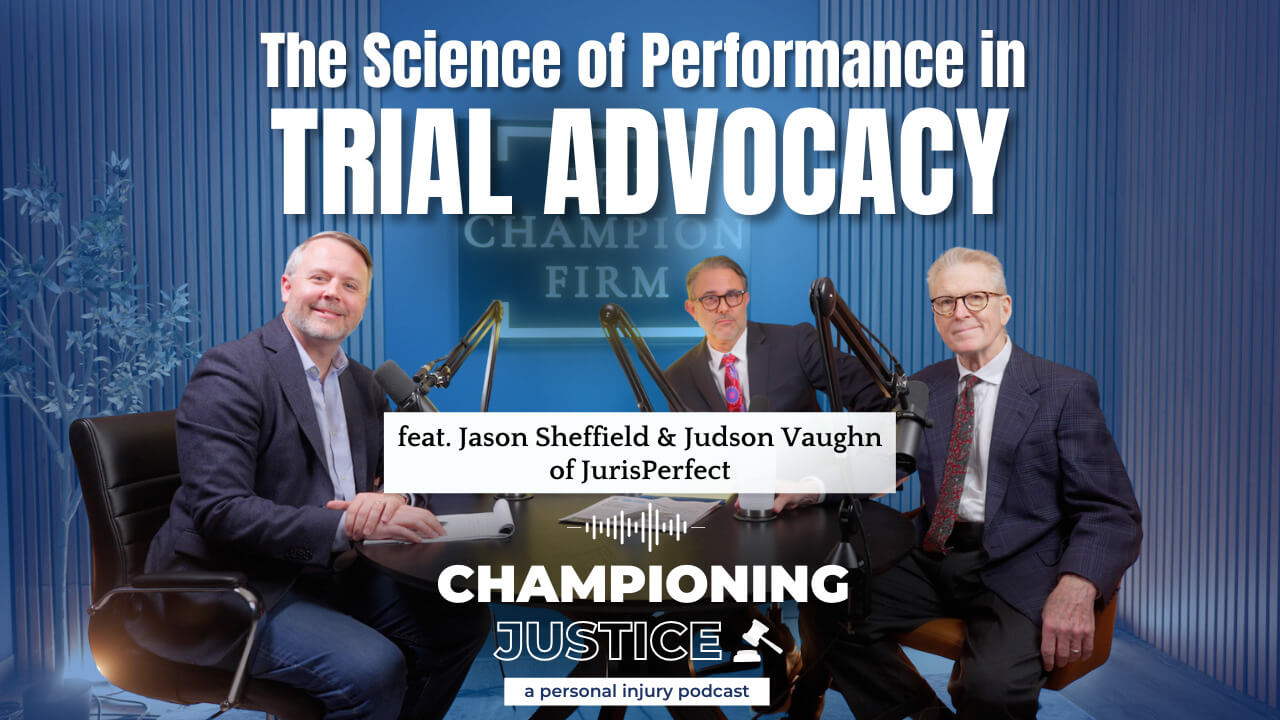
The following is a transcript of Episode 26 of Championing Justice. You can listen to the full episode here, or watch it on YouTube.
Darl:
Thank you for listening to the Championing Justice Podcast. My name is Darl Champion. I'm the founder and owner of The Champion Firm. We are a personal injury law firm based in Marietta, Georgia, just outside of Atlanta. Very excited about this month's episode. I say that every month because we have great guests.
I'm joined by Jason Sheffield and Judson Vaughn, and they're here to talk about JurisPerfect Performance Lab, which is their, would you call it a trial academy? A trial course? How would y'all describe it?
Jason:
It is a course for trial lawyers who are trying to take control of judges' and jurors' brains.
Darl:
I love it.
Jason:
To try to get the jury to correct the wrong that has happened to their client and to restore justice through their verdict. And it's teaching them to do the one thing that no lawyer is really taught to do, which is to perform.
Darl:
Interesting. Yes, they do not teach that in law school. A lot of the trial advocacy stuff in law school is very formulaic, very dry, and it's often taught by lawyers who are very dry. One of my heroes is Mark Lanier, who's a famous trial lawyer in Texas, and he does Lanier Trial Academy every summer in Houston. And it's all about presentation and visual presentations and how to make your story come to life.
And just so our listeners know, I found out about this because I was having lunch with Jason recently, and Jason's a local Atlanta lawyer, and we'll have him and Judson introduce themselves in a minute.
But Jason was telling me about this program and I thought, this is awesome. This is something that I think is missing in our area that a lot of lawyers don't have access to or haven't had access to, those types of skills. So before we dive into it, why don't y'all introduce yourselves? Tell us a little bit about your background, Judson. Let's start with you.
Jason:
Let's start with a really interesting fellow.
Judson:
Well, I was a character actor for a couple of decades in LA and then during my time there, I decided I really wanted to make films, not just be in films. So I thought Atlanta was potentially a good market for creating films, and this is back in the early 90s when no one was making movies here.
And so I opened a company called What Films, and we trained actors and writers and directors and producers there. And the acting skills we train were radically different than what actors have learned for the last hundred years. In other words, the classical acting training is the actor gets all these emotions inside of him.
And if you and I are doing a scene together, you get all those real emotions. You use these techniques and I use these techniques, and then we're supposed to do this scene together. And the theory is, if your emotions are real and my emotions are real, the audience out there will feel reciprocal emotions.
Well, it's complete BS. It doesn't work at all. It has never worked at all. There is no science behind it. And prior to becoming an actor, I was a social scientist, I was a gerontological researcher. So then I start learning these acting things and I said, wait a minute. This stuff, there's no science behind it. It doesn't work at all.
And if you and I were on the set and we're doing a scene together and I'm screaming at you at the big closeup, I see if I ever, I ever see you near my wife again, I'll kill you. Well, by the time we get to my closeup because of this angle and this angle and this angle and this angle and all the things that can go wrong, I've said that line 47 times. Are my emotions real?
Darl:
No.
Judson:
No, they're not real at all. In the late 70s, early 80s, I started developing a different technique, completely different techniques where I didn't have to feel any emotion whatsoever to get other people to feel emotion. So at What Films, over 10 years, over 3,000 people studied there. One fellow, I can't remember, oh, who could it be? Who was it? That's where Jason and I met.
Jason:
1996.
Judson:
'96. So people started telling me about this system of, it's really a communication system. And people started saying, I use this stuff every day, every single day in my job and so forth. And I said, well, I wonder if other professions would find it valuable. So I said, okay, what is the most cynical, egotistical? You can't tell 'em anything. They know everything about everything.
Jason:
This is where we act really confused about the answer. By the way, Darl.
Darl:
Who was it?
Judson:
You're baffled.
Jason:
Is it healthcare workers?
Judson:
Well, it wasn't salespeople at Walmart. It was lawyers. And I thought, because I have the heart of a scientist, the heart of a researcher, I said, okay, if lawyers can learn this in very high stakes trials with millions of dollars or lives on the line, then I've created something amazing. And my first call call client was King and Spalding, and they were all in. And since then it's been, I go all over the country now more than doing CLEs or presentations. I do trial strategy. I look at a case like it's a movie, not like it's a case. And so anyway.
Darl:
Yeah. Well, I have a couple follow-up questions. You skipped what I think a lot of people will find the most interesting part: the acting part. You worked as an actor, you got to tell us some of the stuff. Where can we find you? Where can we go back and…?
Jason:
We call this the secret sauce, by the way.
Judson:
Well, it's very funny. My wife is very good at reciting my resume. I'm not very good at it. Some memorable experiences working with Brad Pitt on a movie called California, long before he became a big star. And that was a fun one because he's a serial killer and I'm his parole officer, and I've got a prosthetic hook for a hand. And so that one, one was fun.
Another one that was fun was a movie called The War with Kevin Costner and Kevin Costner during the movie is having this nightmare about being in Vietnam and this guy not letting him get on the helicopter and so forth. And that's me.
And another fun one was Robocop 3, where I was, that was a fun death. I've been killed so many times. I was in a tank and Robocop flies through the air and shoots a rocket and kills me and kills me in the tank. But it was great. It was great, great fun. And I loved, I really loved doing it.
Jason:
Jim Carey, Truman.
Judson:
The Truman Show.
Darl:
Great movie.
Judson:
Really, really wonderful movie. And it's very funny, as an actor, you get residual checks, and so you never know when they're going to come and you never know how much they're going to be. And this sounds like a weird thing. I don't think I'm in that movie 10 seconds and I have a little cubicle next to Jim.
But because of weather and so forth, I was actually working for six weeks, but never went to the set. I mean, and I was being paid for six weeks. And so at the, I'll clean this up, a wonderful Australian director, Peter Weir, directed, and Peter said, Judson, everyone says, all you do every day is go surfing and work on pre-production for your movie. I said, yeah. He said, is it true? I said, yeah. He said, is this the best blank job you've ever had? And I've said, yes, it is. Peter, thank you so much for having me.
Darl:
So how did you link up with Jason to put this together? Because Jason's from the legal field, he's a trial lawyer. How did y'all make that connection and start working together in JurisPerfect?
Judson:
Actually, I called Jason, I think I wrote you, and I'd been keeping up with his career. I was so proud of him. I'd been keeping up with his career over the…
Jason:
We were together for about five years doing acting and writing. So I was at What Films leading all the way up to when I went to law school in 2002. And so I've started using the stuff that I learned from him in law school, but he also started his move to start working with lawyers.
Judson:
Right. In 2003, I launched this company, JurisPerfect. And so that has been my consulting and trial strategy company. But Jason actually was working on a very high-profile trial. And I actually called, this is, I don't know, maybe embarrassing for someone, but I'll say it. Anyway, I called Jason and said, I've never been so happy to see a friend lose a case.
Jason:
This was in 2020, 2021.
Judson:
Yeah.
Jason:
The McMichael Arbery case.
Judson:
Yes, it was. And so we got together after that and Jason said, Judson, I really want to teach. I really want to teach. And he's taught all of the world from Georgia to the Republic of Georgia trial strategy. And I said, well, actually, I've been working on a program with Judson Graves from Austin Bird, this legendary medmal lawyer. I said, we've been working on an online program for five years at that point, and Jason says, I want to do a live program. I said, Judson Graves is going to be all over this. And so, what did we spend? About two years?
Jason:
Yeah, we linked up at our old haunt Fellini's Pizza where we used to go after the acting performance class and said, let's do it. And so it was about a year and a half of work and prep of trying to incorporate what you typically might experience and how to turn that on its head and give people something that they never experience in trial advocacy. We are tell people. That's what we're taught. Let's figure out what this narrative is. Lets figure out how to tell this story. Let's figure out how to dive into our client's life and find the nuggets of their story.
Judson:
But we're not tell people.
Jason:
We don't want to be tell people, we want to be show people. We want to show. And that's where we really focused on is I've been teaching trial techniques for 15 years to criminal defense attorneys and other attorneys across the country, and nobody talks about how to secure trust, how to maintain that trust throughout the course of a trial.
Judson:
Okay, let's put Darl on the spot here.
Darl:
Oh, are you going to make me act?
Jason:
No, no, no, no.
Judson:
Worse than that. Worse than that.
Jason:
Okay. Do it it. How long do you think it takes for a client to trust you?
Darl:
It depends. Typical lawyer answer. I would say for clients that come as a referral, the trust is built quicker. If it is somebody who does not know us, they find us online. It takes longer.
Judson:
So when a client enters your office and she sits down across from your desk, how long do you think it takes her to trust or distrust you?
Darl:
Well, I could probably screw it up quickly and cause her to distrust me by doing something bad.
Judson:
Yeah, she could.
Darl:
But yeah, I mean, I think it could be seconds, it could be minutes. I would think.
Judson:
The seconds is closer. Five one-hundredths of a second.
Darl:
Interesting.
Judson:
Five one-hundredths of a second. Now we're not making this up. The leading neuroscientist in the world is a guy named Alexander Todorovo at the University of Chicago. And this is his research that has been backed up again and again and again. We trust or distrust in five one-hundredths of a second.
Darl:
Is this kind of like Blink? Malcolm Gladwell's book?
Judson:
Bingo, bingo, very, very much.
Darl:
You make snap judgments based on things that you see, which is, and I appreciate y'all talking about that because one of the things like Linear Trial Academy that I've learned is they talk about things like the halo effect and other things with how you present your evidence to structure it in a way so that you have these things. That's interesting though…
Jason:
Well that speaks more to maintaining, which is also important. How do you maintain that trust? You're going to earn it in that fraction of a second. But how do you maintain it? And so you have to build in a strategy and a structure of maintaining it. And it begins literally before you leave your home. It begins when you get in your car and you put yourself into the world on the day when you're going to meet the person whose trust you so desperately want to secure.
Darl:
So what is this talking about? Getting yourself in that frame of mind or not engaging in road rage. They always say that assume everybody's a juror is a juror all the way to the courthouse.
Judson:
We teach specific things. We teach specific things that you can do that get people to trust you in a fraction of a second. Now, in, I guess it was two or three months ago, I was at the University of Chicago with Alex Todorov and I was teaching the same. We have a system called the Six Elements of Instinctual Trust. And these are precise, objective, repeatable skills that are the foundation of everything we teach.
And so a few months ago I was in Chicago and I'm in a room full of for 15 or 20 neuroscientists, and I am showing them my six elements of instinctual trust and the foundational element, the thing that makes people trust or distrust you in fractures of a second, is identical to the things that Alexander Todorov discovered identical to the things that John Freeman at Columbia discovered. And it has to do with what you're doing with your face. And that has to be there. We call it a good dominant face.
Darl:
Are you guys sizing me up?
Judson:
Oh yeah.
Jason:
Oh, for sure.
Judson:
Oh yeah. We've been sizing up since.
Jason:
You have a good one.
Darl:
Good what?
Jason:
Dominant face.
Darl:
Thank you.
Judson:
We don't really know that. We haven't seen his dominant face. Your dominant face…
Jason:
I saw it. I saw it. He was coming when he walked into the restaurant, when I first met him, I saw it and I thought, I like this guy already. This guy, I like Darl already. He's also got a good performance face.
Judson:
Yeah, this is your performance face. The dominant face is the face you wear when you don't think you're communicating with anyone. So walk through an airport, you don't think you're communicating with anyone. But we're always communicating.
Darl:
Like resting bitch face.
Judson:
That would be an example of a bad dominant face. I've been teaching dominant face since 1993 and seven or eight years ago when resting bitch face came out, I had all these lawyers and actors from all over the country saying, someone has renamed dominant face. You either have a bad dominant face that's not trustworthy or a good dominant face, which is trustworthy, and it happens in a fraction of a second before you ever speak.
Darl:
Interesting.
Jason:
The other thing that jumped out at me when we were talking about kind of coming together and trying to figure out what we were going to do, and it settled into an old concept that I knew that he had taught me when I was an actor, but that he had kind of reframed with the idea of what is your most powerful tool to direct the emotions of others, to direct the thoughts and emotions of others.
Judson:
Let's put him on the spot again.
Jason:
But do we want to give it away? I don't know that we want to give it away. They got to take the course. No. Alright, let's put him on the spot. What do you think?
Darl:
I'm ready to sign up, by the way.
Jason:
What do you think is your most powerful tool to direct the emotions of others?
Darl:
That is a good question. And I don't know the answer.
Judson:
And I'm so glad you said that. Because between 1993, April of 1993 and October of 2002, at What Films we trained thousands of actors and actors had no idea what their most powerful tool to direct emotions was. And since 2003 till today, I've trained thousands of lawyers, and lawyers have no idea whatsoever what their most powerful tool to direct the emotions of the judge and jury is. Have no idea.
Darl:
Do we have to take the course to find out? So a guess: the most powerful tool is it something physical? Can I do a process of elimination? Is it something about physical?
Jason:
Throw it out there.
Darl:
Authenticity?
Jason:
That's interesting.
Judson:
Wow. That is authenticity. Another guess. Another guess.
Darl:
Okay. Authenticity is that somewhat related, but your passion for your cause? Your belief in your cause?
Judson:
That's good. What else? Deeper. Give another.
Darl:
Your own emotion for the cause?
Judson:
Ah, okay.
Jason:
Authenticity, passion, emotion.
Judson:
I want you to take this and put it somewhere because it's really worthless.
Darl:
It's a great acronym. Authenticity, passion, emotion.
Jason:
Yes. You nailed it. Yes, I like it.
Judson:
Okay. Depending on if I can get our camera operator, Corbin, to help here. And you might need to follow me a little bit. Corbin, I'm going to go over there. What I found Darl was that actors didn't know what their most powerful tool to direct emotions. And lawyers don't know what their most powerful tool to direct emotions in a courtroom is. But wouldn't you say that is the fundamental foundational thing that they need to know?
Darl:
Sure. That's important.
Judson:
So your most powerful tool to direct emotions is the position of your body in relation to the primary person you're communicating with. So your most powerful tool to direct emotions is the position of your body in relation to the primary person you're communicating with. So Darl, your most powerful tool to direct emotions is the position of your body in relation to the primary person you're communicating with. Do you think you can remember that?
Darl:
Yes.
Judson:
I think you can. I think you can. Okay. What just happened is I literally took control of your brain. I made you think and feel what I wanted you to think and feel. And I forced you to produce two neurotransmitters. The first one was adrenaline. When I got closer and closer and closer, your amygdala said, wait a minute, wait a minute. Back up, back up, back up.
But then when you got amused, a different area of your brain, the pleasure center, the nucleus accumbens, produced dopamine, and the dopamine made the adrenaline go away. And I didn't change what I said. I didn't change my prosody, my tone, my volume, all I changed was the position of my body in relation to the primary person I was communicating with. And here's the cool thing, I didn't only change your emotions, I changed the crew's emotions too. Didn't I gang? Yeah. They were…
Jason:
They looked uncomfortable, Leticia looked uncomfortable and then laughed and almost shrunk down with, oh my God.
Judson:
And so that becomes essential when that, you know that, and obviously you're not getting in your client's face, but in a courtroom, our partner, Judson Graves, who has taken over a hundred cases to all the way to verdict, won almost 90% of them. Like a cartographer over the 37 years he practiced, he mapped the courtroom.
So, okay, this is where you do cross-examinations. This is where you do direct examinations. This is where… and when Judd and I started working together and he started showing me his, what he calls his battle stations. I said, wait a minute, that's proxemics. That's the science of proxemics. And he said, what's proxemics? And so…
Darl:
He was doing it intuitively. He just didn't know what the name was.
Judson:
Yes. Well, and he learned over a hundred cases, this works better than this. This works better than this. Well, there's science behind all of it. And the foundational thing is what we call choreography, the position of your body in relation to the primary person you're communicating with. And that's how you direct judges' emotions, jurors' emotions and clients' emotions.
Jason:
And here's what's interesting about what you said is, okay, so he was doing it intuitively. He just didn't know the name of it. One of the things that we find is that a lot of people say, yeah, I've done that, or I've thought about that, or that's kind of happened while I'm in court. So it's not that you want to do it intuitively, you want to do it intentionally and strategically.
Darl:
So Jason, you being the trial lawyer, have you ever had times where judges have put some restraints on you and affected your ability to do these things where they say, stand over there at the podium, don't move away.
Jason:
We hear that a lot. So the answer is no, no, that courtroom is my space. Now there are rules that, you know, judge, may I approach? Judge, may I do this? But with that permission and the judges always grant permission, witness come down off the stand, something that we teach in witness work, witness come off the stand. We're going to do a scene, we're going to create a picture in the courtroom opening, which we call first closing, your opening argument.
Of course the courtroom is your theater, it's your stage. And I've never been told not to go somewhere in the courtroom. Once I've established that I have permission to move about federal court can be different.
And so we craft it. We craft it to do it. If you are restricted improperly to the lectern, then there are things that you can still do the lectern. And there are things and scenes that you can still create at the witness box. That witness box can become a balcony. That witness box can become a place where somebody had to hide. That witness box can become a place where somebody fell over or whatnot. And you can use that as a set piece and for a scene.
Darl:
Yeah, go ahead.
Judson:
I was just going to say it is such a good question because in federal court, I remember I was working with a legal team and a very high profile case in Washington. And when the lawyer standing at the lectern and he was doing his opening and he leaned not six inches from the lectern, the judge and Brinkema is her name, and boy, she was a great judge, but boy was she tough and she counsel back behind the lectern. Okay.
Darl:
Well that's why I asked. I worked for a federal judge for two years after law school, and I remember hearing that a lot.
Judson:
If you can't do it, if they don't let you do it, they don't let you do it.
Darl:
There's other techniques that y'all teach.
Judson:
Yes.
Darl:
Yeah. So let's talk about the structure of the program. So how many days is it?
Jason:
So it is a two and a half day program. And the first day is really built on learning the language of communicada. Communicada is what Judson has called the language of the concepts and the high level principles, the theories, and then literally the how to skills that are about performance.
And so that first day is really spent learning the language and beginning to apply that language. We also incorporate what we call the theory of right. The theory of right is not the theory of defense or the theory of the case. The theory of right is much more than that. The theory of right is a strategy. It's a system of thinking about how to help the jurors realize the wrong that has been committed against your client and how they can restore it with their verdict. And so it incorporates a lot of psychology. It incorporates a lot of performance, it incorporates a lot of trust, and it becomes the blueprint.
The blueprint of everything that you will do and say during jury selection, opening argument, witness work and closing argument. And it incorporates what we call the emotional core. The emotional core is a psychological principle that helps us identify what are the fundamental needs that we all have, that we all share together. That no matter how your age, your race, your gender, your ethnic background, that a jury will say, I can see myself in that client. I want to restore and do the right thing. We know jurors want to do the right thing.
So our other day breaks down into what we call storyboarding. Again, we're not tell lawyers, we're show lawyers. We want to think about not what's the narrative of this case? Certainly that story is important, but how do we show it? What objects, what props, what items that may serve as a signal, a call to attention, an actual item, whether it's an item of evidence or something from your client's life that can become a metaphor for the case. Something that can rest in the juror's mind, not only as a relevant object of evidence, but then becomes an ultimate metaphor for how they do the right thing for your client.
And so we storyboard and then we break down the scenes. Who are our characters? Who are our witnesses? Let's talk about what scenes we see them in. And those scenes have to tie to the theory of right and the emotional core. If they don't, they're useless.
Judson:
One of the foundational things that I began to discover because I'm a researcher, before I launched JurisPerfect, I spent about a year, I lived in downtown Atlanta in the Healey Building, which is right downtown and probably a half dozen courtrooms within a mile area. So I went in and I started studying lawyers and I would take notes. And unfortunately I discovered that most lawyers are really boring. They're incredibly boring. As you were saying, you don't learn to entertain in law school and you're learning skills from…
Darl:
We're also very logical, right? I mean everything is about logic and that's not the way people make decisions.
Judson:
Well, yes, one of the things we always say when logic and emotion get in a fist fight, whether you are in a courtroom or a bar room or in a bedroom, which one wins?
Darl:
Yeah, emotion.
Judson:
But for hundreds, if not thousands of years, lawyers have been appealing to the wrong decision-maker. We've got two decision-making systems within our brains. Our fast brain, that's our gut brain, and our slow brain, our calculating brain. Well, your fast brain, that's your decision maker. You didn't get married because of logic. You didn't buy your most recent car or house because of logic. We make the most important decisions of our lives based on emotion. And then our slow brain comes along and justifies it for us.
So we think, so when you stand up in front of a jury in court, they're making their decision based on logic, based on emotions, not logic. And if you can grab their emotions and hold onto their emotions during the same trial and make them think and feel what you want them to think and feel, most of the time you're going to win.
Darl:
This is the thinking fast and slow. Daniel…
Judson:
Daniel Kahneman. Yes.
Jason:
It's not a foreign concept. Not a foreign concept. But the question is how do you do it? How do you do it strategically and repeat it?
Darl:
So we got, one day we're going to learn communicada.
Jason:
We're going to learn a language.
Darl:
Day two is storyboarding. Is that the entire day two?
Jason:
No. So most of day two is on your feet witness work. So we are in a courtroom and we are learning how to now prove the case that we talked about with our opening theory of right. And we are now showing how to do it through witness work.
Darl:
And are the witnesses people that are part of your company or are these the actual participants?
Jason:
They're the actual participants in the course.
Darl:
Okay.
Jason:
So there's a case problem. Everybody studies the case problem. We orient that case problem. We learn the language, we storyboard, we figure out the characters, the scenes, the set pieces, the props literally as if we're storyboarding a film. We want these two characters. Here's the scene. What are we going to use? We can use council table, we can use a chair, we can use the lectern, we can use the judge's bench. We can use the bar in front of the jury. What are our props? What's the evidence? What are we going to bring in? What are we going to surprise the witness with? That's ultimately going to become a metaphor for the case.
How are we going to pull out that theory of right and the emotional core through witness work and solidify those powerful images? Not how do we tell the story, but how do we get the visuals out now that become part of the promises that we made in our opening argument? That we're then going to come back with metaphor and more demonstration and closing argument.
And then the last day really is a half day. We shoot the closing argument of each participant. So we limit the class to eight people. For those eight people, each of them are going to do a three minute closing argument, soup to nuts about what this case is about with multiple scenes, multiple props.
Darl:
That's short.
Jason:
Multiple set pieces.
Judson:
It is interesting.
Darl:
That sounds short.
Jason:
3 minutes.
It is a short period of time. But what you can accomplish…
Judson:
Yes, what you can accomplish. And our point is, if you can't grab that jury by the throat in three minutes, you can't do it in 45 minutes. And again, and again and again, as I began studying lawyers, I would see these lawyers stand up and do a 45-, 60-, 90-minute opening. And I thought, no, it is like watching a movie. No lawyer is fascinating enough, no lawyer in the country is…
Jason:
It's Charlie Brown: wa wawa wawawa wa…
Judson:
That's what they begin to hear.
Darl:
And you can see when you've lost the jurors.
Jason:
Oh, glazed over.
Darl:
Glazed look over.
Judson:
Exactly. Because lawyers love to hear the sound of their voices. And so one of the reasons we focus on three minutes and we say you've got three minutes on day one. They learn the language of communicada, which is they learn specific objective communication skills. I'll give you one for example. We teach about specific movement, SPM specific physical movements.
So if you're presenting a piece of evidence, let's say you're the witness, I as the lawyer can present it one of two ways. I can say, have you ever seen this cup that says almost nothing, but I can do this. I can stand up at council table and go, it's a little more dramatic. Now I have the jury's attention. The jury just said, okay, what is it about that cup? Why is that? Why is that important? Why is that important? Now they are paying attention to you.
That's a specific physical movement. So they learn 25, 30 specific communication skills like that on day one. And then we expect them to put as many of those into their closing three minutes. And in one of our last labs, one actor, excuse me, lawyer, lawyer I should say lawyr/actor put 28 concepts, 28 specific skills within three minutes. And it was mind-blowing. Now anyone watching that would just think, oh, he's a remarkable lawyer. That's just a remarkable captivating lawyer. It was specific skills he learned.
Jason:
And he's now been elevated from second to first chair.
Darl:
And y'all work with criminal defense lawyers, civil lawyers, everything in the civil context from business, personal injury. Tell us about who you work with.
Jason:
Yeah, I think most of what we are teaching has benefited criminal defense lawyers. It's benefited civil defense lawyers and plaintiffs. So we are appealing to really everybody. And that's who's taking our course right now.
Judson:
Because it really is, this stuff is a universal language. It doesn't, communication is communication. So whether you are taking this, and one of the interesting things, Darl, to me is our two brilliant lawyer guys eyes are using powerful dramatic skills. And you would think that someone who is defending someone accused of murder or Judson Graves defending a doctor in a brain-damaged baby case, you would think in both cases the defense lawyer would want to take the drama out, just take the drama out of it. But both Judson Graves and this guy said, they say if you don't have drama, if you're not controlling the drama, someone else is.
Darl:
Now the course is taught at the Georgia Bar, is that right?
Judson:
We've taught several and the last couple of times we've taught at Krevlin and Horst.
Darl:
But y'all need a court room, right?
Judson:
Right. Yeah. For the last half day, the first labs we've done have been three and a half days. But doing it three times, we've said, okay, we can restructure this in a way so that it's a two-and-a-half-day course and the first day and a half is ideally in someone's law firm so that they have, and the classes are very limited in terms of it's six or eight lawyers period. And we're not expanding it to 20 or 30 because if it's six or eight lawyers, everybody gets to work. If it's 20, no.
Jason:
You don't get the attention.
Judson:
We said eight lawyers maximum.
Jason:
So we can do a lot of the instruction in a conference room, but then when it comes time to witness work, we got to be in the courtroom. We've got to be using battle stations, we have to be coming off those marks and using the courtroom as part of the stage for the scene that you're creating. And then of course the final day is in the courtroom.
Darl:
Question everybody probably wants answered: How much does this cost?
Judson:
Five grand.
Darl:
Reasonable. Very reasonable.
Judson:
Well, we look at that and if you add the 37 years of experience that Judson Graves has and the 25 years…?
Jason:
20.
Judson:
20 years that he has, and then the 40 years that I have in performing and so forth, that's a lot of experience.
Jason:
Well, and what you also get is we're not trying to do the typical course. Okay, let's talk about theory of the case. Let's talk about your story. Let's talk about how to do a cross-examination. Let's talk about how to do a direct examination.
We certainly want to remind our attorneys of those things because we do have lawyers that have come into this a year and a half, two, three years in practice all the way up to 48 years in the practice who are wanting to expand. But we are teaching the show aspects of it. But we will bring in that experience.
We will say, that's not the cross-examination question you want to ask. Here's a better way to do it. That's not the direct examination. Or you need more cowbell, you need more cowbell. What we call, you got an answer, but we don't know what the answer means. And so we need more cowbell on that term that they just used. Or you just use an incredibly argumentative term on your cross-examine. There's no witness who's ever going to agree to that. So we're bringing that kind of instruction in those moments. But really it's about get to the picture, get to the scene.
Judson:
Well, and I've had people say, boy, that's a pretty pricey course. And I always say, what is the value of learning how to get clients and jurors to trust you instinctually?
Darl:
Right.
Judson:
What dollar figure do you put that?
Darl:
I think it's reasonable.
Jason:
Thank you, Darl. Thank you.
Judson:
We're the only people in the world teaching that.
Jason:
And we haven't had pushback on the price.
Darl:
So a couple questions: Psychodrama is a big term that I hear a lot of trial lawyers use where you sort of immerse your… maybe that's the kind of acting…
Jason:
It's not a term we talk about. We understand it. We've heard it.
Darl:
What do y'all think? Is that something that y'all are like, eh…?
Judson:
BS, worthless, completely worthless. Completely worthless. We say feeling is not persuading just because you feel emotions when you, and there's so many lawyers who go out there and they want to get themselves fired up for their opening or fired up for their closing or they want to feel these emotions and experience it makes no difference whatsoever.
Just because you feel emotions doesn't mean the jury's going to feel emotions, doesn't mean a judge is going to feel emotions during a hearing. So we teach a system that is absolutely emotionless for the lawyer. You can do it whether you're thinking about anything.
Jason:
What you're doing as soon as you sit down.
Darl:
So let me…
Jason:
I have an additional thought on psychodrama.
Darl:
So would the thought be psychodrama isn't inherently bad, it's just that if you have it but don't have the communication piece, it's not effective?
Jason:
How are you defining it in this question?
Darl:
So I think of psychodrama as when people sort of put themselves in the positions of the various people in their case and try to relive what happened to them and what they went through to kind of, and maybe that's what you talked about with that old school acting formula.
Jason:
There isn't a therapist in the world that tries to live in the emotion of their client. Not one, one will sit there and go, oh, I feel it. They won't do that. They'll say, tell me more how that felt. So getting the information, digging for truffles as we call it, rocking with your client and understanding your client's story. Of course you have to understand your client's story.
You don't have to live the emotions of that. Why would you carry that burden? You have 15 cases? You have court appearances? For some criminal defense lawyers, they have 200 cases. You are going to exhaust yourself. You don't need to exhaust yourself.
You need to care enough to dig for the truth and ask probing questions and tell me more and explain how that felt and ask questions. Where was this? Show me your home. Show me some of the objects in your head like ask good questions.
Judson:
Jason, remember in our last lab there was a young lawyer, Megan Harrison was her name, is her name, still is. And she started her closing by going over to a chair, wrapping herself in a blanket, pouring herself a glass of wine and lighting a candle.
Darl:
I thought you were going to say lighting a cigarette.
Jason:
It'd have been a totally different scene.
Judson:
Yeah.
Jason:
Totally different scene.
Judson:
And lighting a candle. And all of a sudden before she said a word, the jury was with her. The jury was absolutely with her. Now did she need to feel any emotions to do that? No, not whatsoever. Not whatsoever.
Jason:
Or to feel emotions to get that story or to understand that story?
Judson:
No, none. No emotions were required. Just like when I got in your face, I made you feel emotions. But I've done that a thousand times.
Darl:
A little uncomfortable.
Judson:
A little.
Jason:
It's okay. You can be honest. It's very uncomfortable when he does that.
Judson:
I've done that so many times, I don't have to feel emotion because I know what my most powerful tool is. It's the position of my body in relation to the primary person I'm communicating with.
Darl:
So, as with all podcasts, the time flies by and we are coming up on about hour.
Judson:
Oh sure does. Great. Wow. We only have two more hours.
Darl:
Yeah, only two more. We actually did a podcast recently with a good friend of mine, Steve Litner, and we had to make it into two parts. We talked for about two hours, but we won't do that to y'all.
Where can people find y'all if they want to sign up for this program, if they want to learn more about it, what's the best place for them to go?
Jason:
Yeah, jurisperfect.com. And that's where they can learn about the program. But really we want them to have direct access to us. So where they try to contact, that's going to go to me directly. You'll have my cell phone number and just, you call me.
Darl:
We have a lot of people that listen to our podcast in other states. Do y'all have any resources or any programs available for them? I know Judson, you had mentioned that you had started with an online-based program. If somebody is out-of-state and they can't travel here to be onsite for this type of training, do y'all have resources for them?
Judson:
Yes, indeed. The course that Judson Graves and I have spent all these years creating is Innovative Skills for Fearless Trial Lawyers. And it's six and a half hours. It is 54 separate scenes, about seven minutes each in Georgia and New York.
It's six and a half CLE hours and we're applying in other states. And so that really gives you the foundational things. And we like for before people come to our performance lab that if they've seen the Judson Squared course.
Darl:
It's a good primer.
Judson:
Yes, it puts you there because you're watching it and then you're learning those and then you're being able to apply them. So judsonsquared.com.
Jason:
And that's what's cut our three and a half to two and a half days: applying those teachings of those things. Yeah.
Darl:
Well thank you so much guys for coming on the show. We are looking forward to learning more about this when we go through it. I want to talk to y'all about signing up for this program. I think I've already talked to Jason a little bit about it. I've got to see what everybody's schedule is like for the rest of the year, but this is right up my alley.
I love this kind of stuff, the terms you're using, the fast and slow, thinking fast and slow. Those are the things that really kind spark my interest. My dad's a college professor in criminal justice, so social sciences, and he's always sending me stuff like that, read this book, check out this book. And so I think this would definitely be something I would really be interested in and get a lot out of.
Jason:
And now you can find great joy in watching one of your partners or associates learn what their most powerful tool to direct the emotions of others.
Darl:
Exactly. We've got a great team and I think this will be a great program for us. So thank you very much for coming on.
Jason:
Thank you.
Darl:
And thank you to our listeners for tuning in.