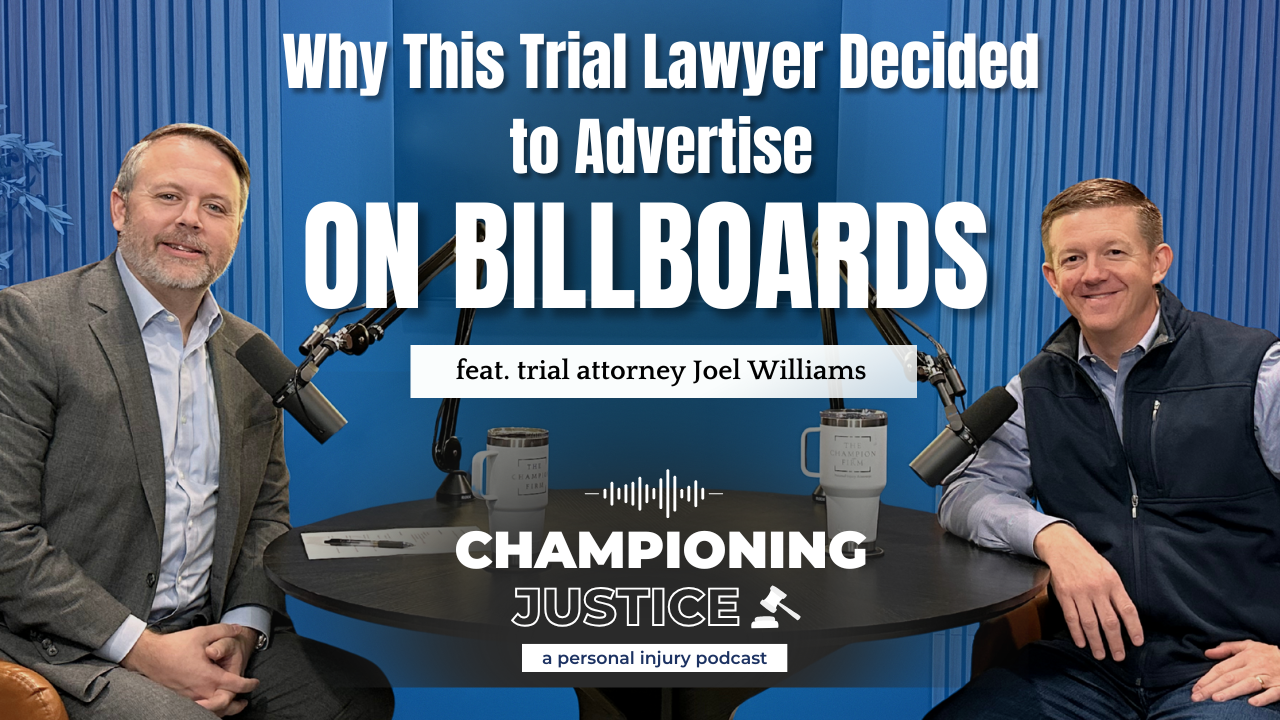
The following is a transcript of Episode 28 of Championing Justice. You can listen to the full episode here or watch it on YouTube.
Darl:
Thank you for listening to the Championing Justice podcast. My name is Darl Champion. I'm joined today by my good friend, Joel Williams.
Joel is a founding partner of the law firm Williams Elleby Howard & Easter. As I like to call it: WEHE.
Joel is going to be talking about some of the changes that they've done in marketing over the years and mainly their focus on or their shift to using billboards as a marketing strategy. Thanks for joining us, Joel.
Joel:
Absolutely, man. Thanks for having me.
Darl:
So let's talk a little bit about you and your firm. When did you start your firm?
Joel:
2013.
Darl:
It was just you, right?
Joel:
Yeah, it was just me. We actually had to lick stamps back then, and that was the worst part of the job, I think. But no, I've been around for quite a while now and it's just slowly grown over the years and added people as needed.
Darl:
Well, one of the interesting things about your firm and why I wanted you to come on the podcast is you're a trial lawyer. And we talk about the term trial lawyer and it's used loosely, but I mean, you actually try cases and you prepare cases for trial and you're on billboards now. So what kind of led to that decision to do that?
Joel:
Yeah, it's kind of odd, right? Because most of the people that you see on the billboards are not the people you're going to see in the courtroom.
I think that was a precipitating factor for it is because, and I know this happens to you because we've talked about it before, but when you get the phone call from a client who is looking to terminate the attorney they have. It is almost never The Champion Firm that needs to be terminated. It's almost never some of our peers that are good lawyers and respect their clients. It's almost always the people that you see on the boards.
And it's because they're oftentimes are selling something that they're not really giving, right? The everyday person out there will see a Morgan & Morgan billboard and they think they're getting John Morgan that's going to walk in the courtroom with them. They think they're getting Keenan Nicks that's going to walk into a court rhythm.
Darl:
Probably better for them, by the way, that it's not John Morgan in the courtroom with them.
Joel:
Well, possibly. But it's they get something that they don't expect. Instead, they get intake to legal assistant, to case manager, to paralegal, to maybe never seeing their attorney. And that's frustrating for them, especially when they have questions or there's challenges in their case.
So the more calls we got where the question was, "Hey, I hired this person a year ago. I've never talked to my attorney. I'd like to make a change." It started getting frustrating for me because it told me two things.
It told me, one, we were getting passed over to begin with. They were hiring the person that just came to mind. And then two, the person that they were hiring was not giving them the service that they deserved and expected.
And so one, it was born out of a desire to see people at least have another option where they could get the kind of legal representation that they should be getting.
And then two, it was a frustration with digital ads and the increased cost of trying to, whether you call it pay-per-click or if you're doing social media ads and all that, number one, it's complicated. Number two, if you don't do it exactly right, you're going to waste a ton of money doing it. I think we both have probably done that before. And number three, you don't really know what's going to happen. It pops up one time and then it's gone.
Darl:
It's hard to depend on.
Joel:
It is, but the billboard's there. It's going to stay there and it's going to hit most of the time the same people over and over and over and over every time they ride down that road.
Darl:
Every time I bring my kids to school, I see it on 75.
Joel:
That's it. And so to that extent, it was more of an increased consistency of views so that the brand awareness increases because the more somebody sees something, the more they're going to trust it. First, they're going to get annoyed with it. "Oh gosh, here's another lawyer billboard." But over time, they will begin to trust it. And then there was the illegal solicitation and runner situation that we have in Georgia.
I know that people in other states have the same issue. After about the 20th time of having a client sitting in my office in their cell phone ring where it was a runner illegally soliciting their case while they were in my office, I started to really look at the ROI and see how much our marketing spend was increasing.
And the only things that I could attribute it to would be, number one, I don't really call them my competitors because we approached business completely differently, but the appeal to the billboards that were everywhere, which fine. That's an ethical way to market. If that's your thing, do it. Two, the illegal methods of obtaining cases where the runners were working behind the scenes and in the emergency rooms and all that and taking the cases.
And so both things directly affected revenue at the firm. And when it affects revenue at a firm, it affects your ability to represent people like you want to because then you start thinking about, do I really need to hire this expert or do I really need to take that deposition because it's going to cost another 800,000, $5,000?
And that's not a position you want to be in. You don't want money to be something that holds you back from pushing a case like you know you should, right? So those are the three things that really pushed us in that direction.
Darl:
So a little background on your firm, because I think it'll help our listeners kind of understand. So Atlanta is a city, but it's also a region.
I was talking to somebody in South Georgia and they said, "To people down here, everything north of Macon is Atlanta." But your office is not in the Atlanta city limits. And my office is in Marietta. Is your office technically in Cobb?
Joel:
Yeah, it's in Kennesaw. So we're on the northeast border.
Darl:
Gotcha, gotcha. And are you close to Cherokee, though? Close to Cherokee County? Or what would be the closest county? Bartow...?
Joel:
Yeah. So we're probably closer to Cherokee, but then we're five minutes longer to get to Bartow.
Darl:
Gotcha. So in that area, for people not familiar with Atlanta, most people, like if you were on vacation somewhere and they'd say, "Where are you from?" You'd say, "I'm from Atlanta," but you're actually up in Kennesaw.
Joel:
Yeah. It depends on how long of a conversation I want to have with them because if I tell them Kennesaw, it's going to be five minutes that I have to explain where it's at. And if it's Atlanta, everybody knows where it's at.
Darl:
Yeah, exactly. And so you're in an area though that is slightly less competitive. I mean, the whole Atlanta region is extremely competitive. The Atlanta metro area is competitive, but we've found some success in Marietta and Cobb County.
You're still in Cobb, but kind of a little bit farther away than us. And you mentioned the digital ads and the SEO. Did you see a change in your digital marketing efforts over the last several years where even that area and that sort of territory that you're in, that it became harder to kind of control it?
Joel:
Yeah, 100% because when we first moved up to Kennesaw in 2017, I really didn't have to do many digital ads. Organic worked because there were maybe two other firms that did what we did in that city or town or whatever you want to call it. And then there was a influx of people that tended to say that they were from Kennesaw and they're not, or they started spending a lot more ad dollars in Kennesaw.
And so of course, at that point you notice it, you start having to spend more and more, but then I got to thinking, I'm like, "Yeah, I'm not going to try to compete with somebody that's spending a million dollars a year on PPC ads in my town. I'm just not. So I got to figure out other ways to do this." Because it was too hit or miss. There was no consistency to it.
Darl:
What year did you start kind of thinking about doing billboards?
Joel:
Well, we started ... What is this? This just turned into 2026. So I guess the first one went up in November of 2024. So it's probably a six month process trying to ... The hardest part's trying to figure out what are they going to look like and what's the ... We used to have a slogan. I don't know that slogans matter too much unless it's the ones that we can all remember from our childhood, like milk does the body good or whatever.
But the hardest part was coming up with a design for it and then coming up with something that would stick in people's mind when they saw it. And I bet we had 100, 200 different things that we had kicked around the office and literally we were sitting at lunch one day and my law partner, Jared Easter, wrote down on a napkin like, "Call us. It can't hurt." And I looked at the trademark for that and we couldn't get a "can't," but we could get "won't." So anyway, we landed on that because it's simple.
And then we had to make the decision, do we put the phone number up there and we said no, because we wanted the boards to drive traffic to the site after people saw it enough, they would go, "Okay, well, how am I supposed to call these people if I don't have the phone number?" Well, you got to go online to find it. I know that's another step. It's another area of friction between the potential client and the lawyer, but it does...
Darl:
Well people aren't driving down the road writing down phone numbers too, I assume. So unless it's maybe a vanity phone number that kind of sticks in and people remember it.
What year did you graduate law school? Was it 2008?
Joel:
Six.
Darl:
Six. Okay. So I was 2007 and I interned at a plaintiff's personal injury law firm in law school. So that kind of 2006, 2005 timeframe, I was kind of exposed to the personal injury world for the first time. And the firm I worked at was an old school trial lawyer, Manley Brown in Macon, worked there, Chris Clark was there, Jerome Gotro.
Joel:
All great lawyers.
Darl:
Yeah. And I remember there was this differentiation between the trial lawyers and the billboard lawyers. And even when I finished up, I think 2009, I finished up my clerkship, came to Atlanta and then started with a plaintiff's firm in 2010, there was still that differentiation.
I've often said that I think that's just gone, like that differentiation doesn't exist. And I think lawyers that are continuing to differentiate that based on that are sort of behind the times and living in a different time period. But still, you came up within that kind of time period where there was that stigma associated with it. Did you wrestle with that at all?
Joel:
Yeah, absolutely. I still get annoyed when I see my face on a billboard. I don't know why. Maybe it's because I grew up in Early County, Georgia where there's 6,000 people that was super conservative at the time when I grew up there. It's changing a little bit now, but the mindset was advertising for a professional service is bad, means you're desperate or whatever.
I think that's a limiting mindset because I've seen there's a reason that bigger firms that don't practice the way that we do continue to put their boards out there. And it's because they know that repetition and visibility and brand awareness is going to work over time. And then I got to thinking like, "What are these guys doing that I don't like? " And we talked about that a little bit earlier and it's basically throwing it into a settlement mill mentality, trying to get it settled.
I know like literally some of these firms around here, I know at least two of them had a rule at one time that their associates were not allowed to file lawsuits.
Darl:
Interesting.
Joel:
I'm like, "What?" And I wish I never had to file a lawsuit, man. I wish I could get fair offers from insurance companies and settle cases real quickly for people for fair amounts, but that's not always an option.
So either their clients are getting the small amount or they're getting kicked to a different law firm that's got a relationship with the billboard firm and they're getting a firm they didn't expect to get, right? But I just saw that the efforts of some of these law firms was not delivering what people would expect or what I would expect as a lawyer.
So I had to really struggle with that mindset shift in, am I okay putting myself into this world that these people that have a very different view of how to handle a personal injury case than I do, am I okay being there?
And it took me a few years to say, "Yeah, well, I guess I am," because at least it's a different option for people that don't want to get thrown into that endless ocean of not knowing who their attorney is and paralegals and legal assistants and case managers just getting shuffled through like a deck of cards.
Darl:
So that's one reservation I can imagine that you had. Did you also think, "Well, what if I become like them?" Is there a way that I can advertise on billboards without handling that kind of volume and building that structure? Did you have to kind of grapple with that too?
Joel:
Not really. It's just not who I am.
Darl:
I would totally grapple with it.
Joel:
It's just not who I am. I can't, and I know you're this way, I can't do something without going all in on it.
Darl:
Right. Well, I'm thinking more along the lines of not ... I'm thinking more in terms of could this be successful without me shifting to that model?
Joel:
Yeah.
Darl:
Does that make more sense? Can I still maintain this kind of boutique approach while having billboards or is it like, "Hey, if you're going to kind of advertise and kind of reach out to the general public that way, you're going to need to have a different structure." Did that come up at all?
Joel:
Maybe, but that is not always necessarily true, right? A lot of people see the boards go up and assume, "Oh, they must have a thousand cases." I don't have a thousand cases.
Darl:
I know. We have more cases than you, I assume.
Joel:
Absolutely.
Darl:
We talked about it.
Joel:
100% you do. And what I have found is that if you set your firm up correctly when it's small, as you grow, it's not that difficult to continue that model.
Maybe you have to change some intake stuff because you're getting more calls, but as far as saying, "Okay, I've got attorney A, I know that he or she can comfortably handle a hundred car wreck cases. I've got attorney B, I know that he or she can comfortably handle 15 med mal cases or some combination of the both, you get to know your attorneys personally.
Everybody I've just ever worked at at my firm I've known way before they ever came to work at my firm, so it may be different if I was hiring somebody I didn't know, but you understand what the sweet spot is for those attorneys. You understand what kind of assistants or paralegals they need to operate efficiently.
And I think if you make the right hires, then you just know, okay, when I'm at a hundred cases, this is what structure I need. When I'm at 200 cases, this is the structure I need, 300, and you can keep that same structure and still provide the same quality of service that you want to provide.
Now, the one thing that is becoming more difficult is me personally being as involved in the cases. So what I've found myself doing is our caseload is still small enough to where I'm familiar with all the cases and I can keep up with them, but it's more of a 10,000 foot view as opposed to like getting down in the weeds on everything. I have to be able to trust my law partners to be in the weeds handling a lot of that stuff.
Darl:
Right, right. How many billboards do y'all have now?
Joel:
Last time I checked, it was like 65 or so.
Darl:
Now that includes the rotating, the digital?
Joel:
Well, yes, actually. Yeah.
Darl:
How many do you have that are like, it's only you on that billboard?
Joel:
18.
Darl:
Okay. And so when you're deciding where to place your billboards, what kind of things were you thinking about?
Joel:
The same mindset that I had when we moved our firm to Kennesaw, because we were in Buckhead before that. That's Atlanta for people that don't know. We were in Buckhead and then the move to Kennesaw was really a family issue because the drive back and forth, I was living in Kennesaw, drive back and forth. I was missing my kids' ball practice and I'm like, "That's not happening."
So moved up there and I said, "You know what? There's, like I said, two other law firms up here that do what I do. I know I can put a good effort at doing it much better than they do it. Hopefully I've done that. I don't know."
But my focus was there is enough people in Kennesaw, Georgia and Acworth, Georgia, to sustain a firm of my size. And so all of the marketing efforts were more community based and trying to make sure that the people that were my neighbors knew who I was and knew who my law partner was, and that they would call us when they needed to.
And so I said, "Well, obviously I'm not catching everybody because I'm getting Kennesaw citizens and Acworth citizens and Woodstock citizens that are calling me after they hired a different law firm saying they stink. I want to hire somebody else." So I was like, "Well, let's have outdoor advertising for this town to hit the people that don't already know who we are." So that's been the biggest strategy.
This year, it's sort of expanding outside of just that core area because we hit it super hard last year. We're leaving the majority of the boards there, but we are expanding out. There'll be a few in Marietta, you've probably seen a few on 75.
Darl:
Coming into my territory, Joel.
Joel:
I know, I know. Just get ready, brother.
No, but just expanding it out a little bit, and that's more a coordinated effort to be more effective with digitals and geofencing, right? So we can put the board up, then we can geofence the board.
Darl:
Tell people what that means.
Joel:
So geofence is basically, you pick a location and I don't understand the technology behind it, but essentially you pick a location, if somebody comes into that location with a device that's got an IP address on it, then it can capture that IP address and then follow that device around and you can serve ads to that device, right?
So the thought process is they go by the board, they see it outside, then they go home and they pull up the Weather Channel app or they pull up their favorite game or whatever and it serves them the ad.
So they're getting it when they see it, they're getting it on the ad. And then we also have a streaming TV commercial that will hit them if they're watching TV instead of being on their phone and sometimes they're doing both.
Darl:
Is that a streaming TV commercial? Is it on Hulu?
Joel:
So Hulu and Disney, sorry, Disney, are way more expensive than other platforms. We use Vibe and Vibe will feed that commercial out to ... You set the parameters just like you would a PPC ad, right? You say, I'm interested in adults, not children. Children aren't hiring me. It's going to be their parents if it's an injured kid, 18 and older. And then you kind of set what parameters you want around it, but it's the same idea and then it streams it out to different traditional television stations, but...
Darl:
Are y'all doing that? Is that ad only getting served to people that have driven by your board or could like just some random person?
Joel:
No, the TV ... So the geofence ad is, but we intentionally didn't do it for the boards on 75 because half of the people that drive past there are going from Ohio to Florida, right? So it's the ones that are on surface streets in our area.
Darl:
Technology's a little bit scary, by the way.
Joel:
I know.
Darl:
I feel like I'm being shot by laser beams driving down the road.
Joel:
I know. You just watch. You'll probably get a WEHE ad as soon as I leave here because my phone has been in your vicinity, right?
Darl:
I have an idea for some commercials after we go off the video.
Joel:
Okay. Yeah. I'm always ears for that, but with the vibe ads, you do it by zip code basically.
So if you know that your board's there, you know that the geofencing is there, then you go, "Okay, I'm going to also supplement that with the television commercials."
Darl:
Gotcha. What else are you doing besides the billboards? You mentioned the TV...
Joel:
I think we pretty much talked about it. Community. Spend a lot of money in Kennesaw that nobody ever sees unless you go to a kid's soccer game and you see our poster up there.
Darl:
What about online? Are you still investing in SEO and any kind of paid ads there?
Joel:
I've scaled that back significantly. We have our YouTube channel and it's got tons of videos on there and we selectively promote them, which honestly it's not really that expensive to do that. So we tend to get a lot of traction there.
And we actually do get a decent number of cases from our YouTube channel. Get a lot of out of state people calling that somebody in Wisconsin has a potential med mal case.
And so I spend more time now trying to help those people find a Wisconsin lawyer or something like that. As you know, because I text you probably once a week and go, "Hey, do you know anybody in San Bernardino?"
Darl:
I think that was the reason.
Joel:
Anybody what, right? A lawyer, Darl.
Darl:
That's why it is.
Joel:
Yeah.
Darl:
So what have you seen with the billboards and kind of their effectiveness?
Joel:
So it's a slow bleed with those. I think any brand awareness campaign is, it just takes time to build up. So I would say that if anybody's listening to this podcast or—I'm assuming this is going to be on YouTube at some point—or watching this, just make sure you're ready for it because it's not like the PPC ad.
You're not going to put the dollar into it and get it back in 30 days. And in our world, you're certainly not getting the dollar back in 30 days. Maybe you get the client, but so you got to be able to invest in it.
And it can't just be like, I'm going to throw one or two up. You have to saturate whatever area you're going to be in. And then you got to pour tens of thousands, sometimes hundreds of thousands of dollars into these boards until...
Darl:
A month...
Joel:
More than that. Before people drive past them enough times that it just sticks in their mind when they're not staring at the board, right? Then you get the client.
Darl sees my board. He calls me six months into, after I've already spent $300,000 on these boards, then I got to work Darl's case. Maybe it resolves in three months, maybe it takes three years. I don't know.
Darl:
And you got to pay people in the meantime to work on those cases.
Joel:
Exactly.
Darl:
The bigger the case, the more people you have to pay to work on them.
Joel:
That's exactly right.
Darl:
And you got to fund the expenses.
Joel:
All that stuff, right? Any personal injury lawyer that's listening to this knows those struggles. But when you decide to go into a outdoor advertising campaign like that, my best advice would be make sure you build up the war chest so that you can ride it out because it's not going to do you any good if you do it for six months and then you can't afford it anymore.
Darl:
Right, right. Obviously, billboard cost is going to vary. We've got people all over the country that listen. Some in small towns, some in bigger cities, bigger cities is going to cost more because it ... But generally speaking, the cost is tied to the amount of views per day. And that's basically the traffic that drives by.
Joel:
Yeah. All these companies have estimated traffic for whether it's going north or south. I mean, you could put a ... What is this? Franklin Gateway? If there was a billboard out here, it may cost more to put it on the east side than the west side or the north side than the south side.
Darl:
Just because of the traffic's coming.
Joel:
Yep.
Darl:
So what does a billboard cost roughly? I mean, are we talking as cheap as $1,000 a month, up to $5,000 a month?
Joel:
I don't know that I've seen one in this market that costs more than $5,000. I know there are, but the reps that I have with the companies know not even to try that with me because I'm not spending $10 grand on one billboard. I've heard as high as $20,000 down by Atlantic Station in Atlanta. I haven't confirmed that, but I heard it from a pretty reliable source.
But you can get ... We've got one digital package running right now where it's basically, they just say, these are 10 boards in Cobb County that we have this eight second slot that'll rotate in with other people and it's like $1,500 for all 10 of them a month. Some of the posters ... So the way that the outdoor advertisers look at it, the big ones, they call bulletins.
Then they have, I don't know, like enhanced bulletins that are lit and it's the only one there, but it's not as big as the huge ones that you see on the interstate and they have posters. Those posters are the ones that you see on side streets and they're pretty cheap.
Usually in the realm of three to $500, sometimes more, depending on where it's at, but you're getting less eyeballs. So you could lots of times get three, four, five or more posters for what one big one would cost you.
Darl:
What advice do you have for anybody out there who's thinking about jumping into advertising on billboards?
Joel:
Just make sure you're prepared to do it long term, because it's not a quick hitter, right?
Darl:
Right.
Joel:
Make sure that you have the resources planned ahead and saved up, or you've got the financing ready, however you're going to do it. I really would not suggest financing billboards, but if you feel like you need to...
Darl:
Is that a thing?
Joel:
Well, I mean...
Darl:
Through the company itself, or you would just taking out a loan?
Joel:
Yeah, basically that. You would get financing from somewhere. The billboard company isn't coming to you saying, "Hey." No, no, no, no, no, no. They're expecting to get paid every month, but-
Darl:
Yeah, they want to get paid right away.
Joel:
Exactly. Which is fine. I would too if I were in their shoes, but...
Darl:
Well, there's so many vendors in the personal injury space. They come up with so many crazy schemes on how to fund things. Everything can be funded now. Just wait, the funding, the billboard thing will come.
Joel:
Oh yeah. You know what else? You just reminded me of something though. When you asked me at the beginning of the podcast, what's one thing that made us do that? I have found, I will never claim to be an expert on digital marketing. I hate it. I can't stand it. It takes a lot of being a specialist with it.
So you either got to hire somebody to do it, you got to contract with an outside vendor. Yeah, I know. Or you got to learn it, right? And there's, like you just said, how do I know that I can trust this vendor?
Because most of the vendors that are doing it have dual loyalties, right? Darl may hire this vendor. Joel may hire this vendor. Our friend Chase Swanson may hire this vendor. We're all within a 20 mile radius of each other.
Darl:
Try and get exclusivity if you can.
Joel:
Right.
Darl:
That's what I always recommend to people in a marketing vendor.
Joel:
Right. But even then, how do you really know that they know what they're doing?
Darl:
Yeah. No, it's tough. And that's one of the reasons why we have dedicated people in house that manage that. My foray into SEO, the first few times I did it, two or three years into my firm, total failures. Like most things I try for the first time, just total flops.
And eventually I kind of figure out, okay, well this is why it didn't work. And one of the reasons I realized that our SEO was struggling was we didn't have anybody in-house to manage the team. If you, the lawyer, owner, or the one who's getting the deliverables from the SEO company and having to approve the article, like "top 10 things you should do after a car accident," and you're preparing for an expert deposition in a medical malpractice case, that's not getting reviewed.
And Kayla could tell you, the stuff she sends me, she has to email me four or five times sometimes to get it approved even in-house. So that is something where I think having an in-house marketing person is important. Tell me about the people in-house at your firm that are managing your marketing.
Joel:
Yeah. So we basically have three people. One focuses more on social media, community relations, things of that nature.
The YouTube channel is a huge undertaking. As you know, I know this podcast is a huge undertaking and it takes significant staff and resources to do it. But the YouTube deal is almost its own animal. And then I've recently switched because I kind of had my office manager doing the website and I think she was getting ready to shoot me. So, I was like, all right, fine.
So we've contracted with a company to come in and kind of manage that SEO stuff, but it's almost like they're... I think they're like an employee to an extent because I basically have three people within that company that work just on our site and on the SEO for that site.
And I've got the exclusivity clause in there where they're not going to do that for anybody else in like a 20-mile radius of Atlanta.
Darl:
Did you hire a company that specializes in either personal injury specifically or law firms?
Joel:
I did. Yeah. It's probably not one that ... It's not the FindLaws of the world and all that kind of Scorpion and all that.
Darl:
Well, and I think that's important for anybody who's listening to this and is interested in just the digital marketing side of it.
I think with SEO, what I would tell people is find somebody that focuses on law firms. I think that's just incredibly important because it is just an entirely different animal. We tried PPC, it was about a year and a half ago.
I can't remember exactly when it was, but the company we used, they had some experience with law firms, but just talking to them, it was clear that they didn't really understand some of the terminology, but also their expectation for what a cost per click would be was not accurate.
And so you need to kind of get somebody in that space. How do you track whether your billboards are working? I mean, obviously one way is just to say, "Hey, are we seeing an increase in intake over time?"
Because part of it is brand awareness, right? It's not just, "Hey, I'm driving down the road. I saw the WEHE billboard. Let me call that number." What kind of attribution plan do you have in place to kind of figure out if these things are working?
Joel:
Yeah. So it's definitely a lot more difficult than any of the digital stuff because that's pretty easy to track, as long as you have the right software to do it.
So the approach that I've taken so far is really just keeping up with the number of leads and intakes that we have and then comparing that like every quarter, every year, looking back on what was before the billboards and what is happening now, is it continuing to increase over time as brand awareness gets there? And it seems to be.
I mean, I'd say when I looked at the end of 2025, our intakes, or I should say our leads were as a whole, about 25% more than they were the year before. So it doesn't tell me that it's the billboards that are working, but it's a strong indicator that they are because it's really the only major change that we make.
Darl:
It's top-of-mind awareness. I mean, the thing with personal injury lawyers is like a realtor. You don't need one every day and so you want to kind of be top of mind.
So it could be somebody who already knows you, too.
Joel:
100%.
Darl:
And they may just forget, but they remember like, oh, they see the billboards all the time.
Joel:
Somebody hired me last Friday that I've gone to the gym with, same gym for five years now and got in a wreck with her husband. Her husband settled his case with AllState for $900 bucks and she's like, "He's an idiot."
But the other people at the gym were constantly reminded because there's one right by it, they see me in there, then they see the billboard and they're constantly reminded about it and she wasn't going to hire a lawyer. She was going to try to handle it. She wasn't going to take the $900 that her husband took, but she was going to just try to handle it on her own.
And everybody's like, "No, no, you need to hire somebody. You need to go hire Joel. You need to go hire Joel."
And so then she pulls out after hearing that from the people in the gym and sees the board and she literally called me and goes, "I've ridden past your face for the past hundred days and seen you every single day and this happened. Do you think I need a lawyer?" And so, I mean, maybe she didn't need me, but I went through the questions and I think that we can add value to her case.
So I suggested that she did.
Darl:
Right, right. Well, a lot of the top-of-mind awareness stuff is hard to track and is kind of hard to attribute to one particular source, but like you said, it's important to stay top of mind also with the people who know you.
Joel:
And former clients, they see it. Former clients. Because we've talked about it before. A former client that you get a million dollars for is going to remember you. A former client that had a smaller case and it resolved for $10,000 and they were able to pay for all their kids' Christmas presents that year with the five grand that they got out of the case after everything was paid for, might or might not remember you.
Probably not 10 years from now because chances are you didn't spend as much time with the person that you got the $10,000 recovery for because it was easier to get than the person that you had to fight for three years to get the million dollars for. But I'm finding that some of those people that even that had gotten pushed to the back of my mind see it and it jogs that memory.
And some of the people here in the Cobb Bar that practice in criminal law or divorce law or family law or contracts or whatever have actually collaterally benefited from us having those boards because my clients get reminded of it.
And then I go, they're like, "Oh yeah, I got a DUI the other day. What do I need to do? " And I'm like, "Hey, Carlos Rodriguez, he's right over here. He's a good dude. You should call him."
Darl:
Great example of why it's so hard to attribute things. So because of those billboards, you get non-PI cases referred to you and you're able to build goodwill and solidify your referral relationships with non-personal injury lawyers. And how do you attribute that, right?
Joel:
As long as you take the time to make sure that they get in the hands of somebody that's good, right? And you're going to want your referrals coming from attorneys that are good at the craft and the path that they've chosen, right?
Darl:
Yeah.
So a couple more things before we wrap up. One of the things I've got to ask you is, how are you standing out from all the other billboards?
I mean, I think every time I talk to people, I was at the Peach Bowl Friday night with some folks from Indiana, came down to watch the Hoosiers play and they said, "Hey, there's billboards everywhere. When I came in here, I'm just shocked at how many I see."
How do you try and stand out from that?
Joel:
I think we try to supplement it with ... We're not trying to take over the state of Georgia. We're trying to have a strong physical presence. And all of my law partners and I have different things that we do on a daily basis outside of work. So we have our different circles and just expanding, seeing that face, seeing me.
I sat down at the movie theater to watch the new Avatar movie with my daughter the other day and there's this kid right next to me and she's like staring at me and I'm going, like, I'm not really famous. I have to pay to have my face up there. This feels weird.
But people just start to associate that. And then I think once they realize that you actually are their neighbor and you're not John Morgan living in Hawaii, that they go, "Oh, this is different." And maybe that's another reason it's worked well for a lawyer up in Cartersville is because she's everywhere, but she also puts a lot of effort, I think, into having that strong presence within her community.
Darl:
So I'd love to ask people this question before we end the episode, and that is, do you have any predictions for the future of ... And you can talk about the personal injury industry in general or legal advertising in particular... What do you think is going to happen over the next three, five, 10 years?
Joel:
I think with ... In the state of Georgia or like everywhere?
Darl:
Let's talk about Georgia.
Joel:
All right. We'll talk about Georgia because that's where we're at. I think a lot more cases are going to be getting tried or settled for dirt cheap, one of the two.
People are going to have a choice to make because the offers are about to get terrible, but in large part because of some of the tort reform that was passed here in 2025, but you're either going to have to take these lazy offers or you're going to have to put it in litigation and you're going to have to put your foot on the gas, right? And it's going to be harder to put your foot on the gas to get to trial.
Darl:
Because of the backlog of cases, because so many people are trying to get there.
Joel:
And that's why tort reform is going to work because there's going to be fewer attorneys that are willing to do that and more attorneys that can convince their client to take the crap offer.
Same reason that fewer attorneys take medical malpractice cases because we both do those cases. We know they're hard as hell.
Darl:
We don't have to worry about runners.
Joel:
They're expensive. They're hard. I don't have to sign that case up within five minutes of somebody calling because nobody ... Well, there's not many people willing to put in the money and the effort and the time.
Darl:
You can get great results on cases that other lawyers turn down. We've gotten several multimillion-dollar settlements and medical malpractice cases that other lawyers have either thought wasn't a case or they thought, "Hey, this might be a case, but it doesn't meet my threshold."
Joel:
That's right. And I think I hope, I don't know that this will come true, but I actually hope that I will be in a courtroom trying $20, $30, $40,000 cases more in the next year because I love being in trial. You know this about me, that's my favorite part of the job. Of course, I love getting a $10 million verdict, but those cases don't just...
Darl:
But you also like a million-dollar policy limits cases.
Joel:
Dude, I like- I like $20,000 trials. I don't care.
If I can go down there in a day and do it and it takes me two days to get ready for it, then great. It keeps me sharp and it keeps my skills in the courtroom going because that's a struggle now is to actually be able to get to the courtroom.
Darl:
Yeah. No, it's true. It's true.
Well, what do you think is going to happen with legal advertising in Georgia? I mean, the market's already pretty saturated. We've got a lot of ... We've got Morgan & Morgan here, we've got another firm out of California that opened an East Coast office and...
Joel:
Yeah. I don't know why anybody would think of that billboard and think they should hire that person, but it's just me.
Darl:
Just me. Yeah. We're not naming names here. Yeah. We're not naming names, but most people will know who we're talking about.
So what do you think is going to happen? I mean, do you think you're going to see a just continued explosion of advertising and more money going into it?
Do you think that there's going to be some people that just lose out completely and it kind of scales back?
Joel:
I think there will be some people that get weeded out and there's going to be some really good lawyers that find themselves in a position they never wanted to be in because it's going to get more and more and more and more expensive, or people are going to have to turn to AI to become more efficient.
But the one thing that I'm certain about is that it's going to continue to get more and more expensive. And all I can say is I'm so glad that I'm not starting a firm in 2026 because you don't have the resources that firms that have been around longer have to put into getting that brand awareness out there. And you're competing with giant multi-state law firms, and you're competing with your peers that are just starting out.
And so I'm grateful that I started in 2013 and have been able to just kind of learn as we go, but I think it's going to get a lot more expensive.
Darl:
Yeah. And I've heard that from a lot of people that cost per case is going up a lot kind of nationwide. One of the things that I'm concerned about is private equity going to expand into other markets.
Arizona has the alternative business structures that they can set up. And I was on a podcast, or not a podcast, a webinar where this was being discussed and somebody said, "Yeah, as soon as that happened in Arizona, our costs per acquisition kind of went up and we had to kind of maneuver some things." I think one of the things you're going to see is, and I've always said this, higher cost per acquisition means less money for operating.
Joel:
Yeah.
Darl:
You know, it means that you're going to have to try and cut corners and be more efficient on the operating.
Joel:
Yeah. So you're hiring lawyers out of Cuba to work your cases.
Darl:
Yeah. And so I think what...
Joel:
Not you.
Darl:
Well, not me, of course.
Joel:
But you know who I'm talking about.
Darl:
So I think what you're going to see, though, is an opportunity for smaller firms that may want to kind of focus on service and kind of that human connection and not treating people like a file number because they're not going to have to dig themselves out of that hole from a marketing spend standpoint.
I mean, if you're, as a law firm, let's say you're spending $300 to $400,000 per lawyer per month or per year on marketing. That lawyer has to generate more than $400,000 in fees just to cover their advertising costs.
That doesn't include what it costs for office, support staff, the lawyers' salary, benefits, your profit. So that's why you see these firms where they're having to load these lawyers up with 300, 400, 500 cases.
Joel:
Because it costs the firm a million dollars a year to have that lawyer there.
Darl:
Exactly, exactly. And so I think if, as a smaller firm, if it costs you a fraction of that, maybe that's where you can kind of dial in and focus on those other things.
Well, Joel, this was a great conversation. I really appreciate you joining us.
Where can people find you if they want to reach out to you and talk to you about, whether it's billboards, hunting. I know you're a big outdoorsman.
Joel:
I was hoping this would be a fishing and hunting podcast, but apparently not. We could have talked about something I'm actually good at, Darl.
Darl:
Oh, come on. Joel's very self-deprecating. He's a very, very good lawyer.
But where's the best place for people to find you? Are you on LinkedIn, Facebook? Where's the best place for people to reach out to you?
Joel:
The only time I go on LinkedIn is to read your posts. Very entertaining. By the way, you should definitely look at Darl on LinkedIn if you haven't.
But I would say just our website: gatrialattorney.com
Our YouTube channel is Williams Elleby Howard & Easter, or drive down Cobb Parkway and you'll see our face staring at you.
Darl:
Call the number on there and then it'll show up as a lead, probably because it's a tracking number.
Joel:
Yeah, exactly.
Darl:
Thank you to everybody for listening. Make sure to follow us on Spotify, Apple Podcasts, and YouTube to see our latest episodes as soon as they go live.
Outro theme and voiceover with Leticia...