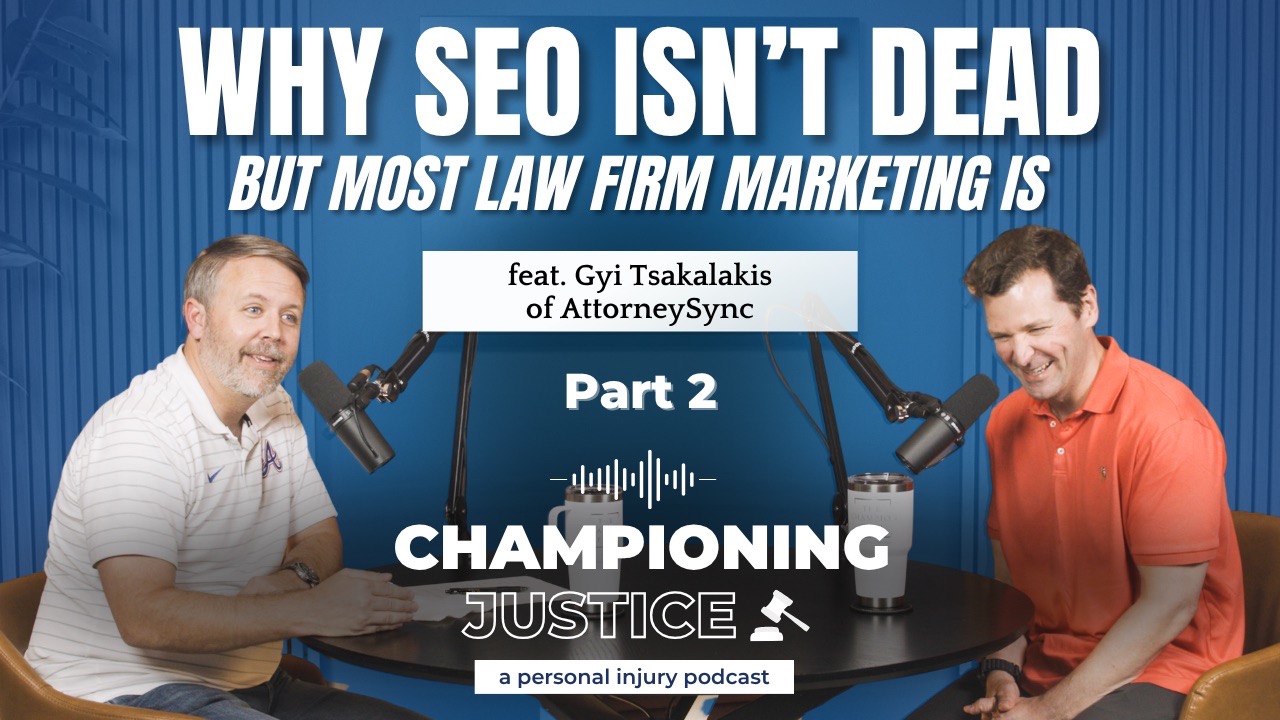
The following is a transcript of Episode 30 (Part 2) of Championing Justice. You can listen to the full episode here, or watch it on YouTube.
Darl:
Thank you for tuning in to part two of my podcast episode with Gyi Tsakalakis, where we're talking about digital marketing for personal injury lawyers.
These AI intake services, what are those calls? I mean, are they like a per lead per call thing?
Gyi:
There's varying models and I'll disclose I'm invested in a couple of them and I think at some point and in certain contexts they can make sense, but here's the thing. If someone wants to talk to a person, they're investigating whether this firm's the right firm for them. They're dealing with the worst situation in your life. Do you want to talk to a robot or do you want to talk to a human being? And I think that in that kind of context, people still want to talk to people. But if someone calls the firm and is like, "When's my deposition? Can an AI handle that? " Probably. Probably pretty well.
And I would say this, I would be very conscientious about listening to, assuming you do call transcripts and intake, listening to the experiences people are having with the tech enabled, whether it could be a phone tree.
Darl:
They need to listen to the human conversations too, right?
Gyi:
100%. I mean, intake manager, the person that's actually running intake is the most important job.
Darl:
Uh-oh. All right. She's going to ask for another raise now. She's going to be like, "I need a raise."
Well, so the reason I ask about the cost of the AI intake and I think that there's a difference between using it for screening to route it. So instead of doing the call tree where you press the buttons, it probably is if your choices were that or robot voice, it's probably robot voice might actually be better. What are you calling about? And then it just sounds more natural.
But you're right, talking to a human being if your husband just died in a rack is very important. You don't want to talk to a robot. But in terms of cost, let's say that you were like, "Hey, I want to scrap all my human intake people and hire AI intake, or I want to hire people in the Philippines to do all my intake or whatever." I mean, look at the cost of that.
And let's say that, hey, having a highly paid intake person here or multiple people, let's say it's $100,000 or whatever, that's not a lot of cases for the personal injury side to make that justify itself. So again, you use the example of you get a million dollar case, that's a one-third fee, that more than justifies it.
So that's why I say the people doing the intake, that might be one of the most underrated jobs in law firms. Not that the intake manager isn't, but it's not underrated. People already recognize the importance of it. It's the person actually on the phone and people treat it sometimes like it's like an entry level job.
Gyi:
Well, and also just to carry your point further, if you're going to measure the cost, you better measure the lost opportunity from someone that gets frustrated dealing with the bot because I mean, I can tell you, I've listened to the calls.
In fact, there are tools now out there to try to reengage when it's botched intake for this very reason because it's not just the cost of paying the person versus the cost of paying the bot. It's the lost cases where someone got frustrated and goes somewhere else. That’s really what you paid for.
Darl:
Well, I think talking about measuring lost costs, there's so many things you can't measure in the personal injury world. Is it Jason Hennessy? He had a post about this about the kind of brand or about attribution about how the person that calls you may not be calling you because they heard your ad on the radio, but it might be they've been hearing your ad on the radio for 10 years. That's hard to measure, but think about the things you don't know that you lost.
So the client who has a bad experience, you may never know that their next door neighbor had a seven figure or eight figure case and they never referred you because they had a bad experience with you. And it was because you wanted to pay your paralegals $20,000 below market, right? And so the way to build, from my point of view, a successful law firm is to kind of identify those things where you could lose out and kind of sell off those gaps.
And that's hard work though, right? No one wants to do that. It's so much easier, Gyi. If I get a big settlement and I just settled a case for $10 million, I just want to write you a big check and just maybe show up number one for "car accident lawyer Atlanta." That's tangible.
I can't measure the, well, did this person have a great client experience and go and tell people about it. I've gotten multiple seven and some at least one eight figure case from a former client.
Gyi:
Absolutely. And I think it's a good point and this is where this buzzword of attribution comes in and I think the digital marketing industry has weaponized attribution, right? Everything is turned into last click, last touch. Instead of trying to fill in as holistic a picture of the client journey as we possibly can, because like the examples you gave, if you're doing multi-source attribution where you're actually asking like, "How did you hear about us? Who do we thank for the referral?" And then you couple that with the quantitative attribution, like where they actually, what their journey looked like.
Do they click an ad, they do a search? You're getting a much richer picture of what's going on and still it's not perfect and people will say, like you already said, people will say the wrong thing. They thought they saw you on TV and they didn't, but you're getting a much clearer picture of what's going on in their mind and that should directionally inform what you're doing because once you see a channel or an activity or a marketing activity show up at an attribution, you're like, "Hey, it's validated now. Let's continue to invest in that."
And we see the opposite all the time where everybody optimizes to last click and they stop doing the local community events. They stop doing a lot of other things that are more difficult to manage because they don't have the analytics data for it. And then they're surprised when the call volume goes down because all of a sudden it's like, oh, it turns out that all that stuff we were doing was actually generating goodwill that was helping people refer cases to us.
Darl:
Here's something that I want people to kind of shift their focus on. I hear this all the time with friends of mine will say, "Well, we have a need for this, but it's not a 40 hour a week job."
I don't think that lawyers, especially contingency fee lawyers should be measuring stuff based on the time investment because we don't measure our own product or our own service based on the amount of time it takes. We do it based on ROI.
So I thought about this a few years ago. I was like, why are we basing this off of ... We're not billing by the hour. We're not measuring our own productivity by the hour, but why are we measuring individual productivity based on is this a 40 hour a week job?
If I need to hire an employee and pay them X amount of dollars, but it's only going to be needed for 30 hours a week, but I'm going to get a 10X return on investment, wouldn't I hire that person? Why would I not hire them and be like, "Yeah, but they're not going to be working 10 hours." To me, that seems like an antiquated way of thinking.
And so I don't know what your thoughts are on that. I think the economy as a whole is going to shift to that mindset just because of AI. You can't really think of output and how much time you're putting into stuff. It's going to be more of the product and the judgment and the result that you're obtaining.
Gyi:
100%. I mean, my mantra here is invest in doing what the bots cannot. I mean, if you think about it, technology is going to be ubiquitous. Everybody's going to have access to AI. I was just laughing about this because right now the whole pitch on AI that's coming out of Silicon Valley is the reason these companies are so highly valued is really wage replacement.
They're like, the only way you get to these valuations is to go to an enterprise company and say, "Hey, look, we're going to take this much off of your payroll P&L." That's the only way that they can justify the investment. But the truth is that it's actually going to be the opposite because once they have you captive, they're just going to raise the prices anyway, but that's a conversation for another day.
But the do what the bots cannot thing is, is that whatever the time that they're investing in it, you're literally investing in something that cannot be done by technology.
And so you think about the context of where there's human interaction. And so whether it's handing a check to somebody or listening to somebody tell the story of losing a loved one, that's all that's left for us to do really is the human connection and intake is a big part of that.
And so I would forget about the amount of time. I mean, to your point, you can't put a value on that specific hour, but there's going to be a complete decoupling from the amount of time and the value in the time. And you'd think that plaintiff's lawyer would be the first people to pick up on that because they don't think about it in terms of time.
Darl:
It's crazy. And some of it's generational too, especially I don't think of myself as an older lawyer yet. I still think of myself as a younger lawyer, though I don't qualify for any of the younger lawyer awards anymore.
Gyi:
It's all a mindset.
Darl:
Yeah. I'm not a rising star anymore. I've already risen, but I hear it all the time.
They're like, "Well, I don't know if I need to do this. " And it is such just a shortsighted mentality. I think that people need to look at that. I will say this too, I think that there's going to be a revolt against technology. I think there's going to be a revolt against AI. I think it is already disrupting some people's jobs and lives and they're pissed off about it. Are they going to want to call and talk to a robot when they're sitting at home unemployed?
I mean, to me that just seems like, I don't know, and it pisses me off too. And it's funny because my 13-year-old daughter, who I'm incredibly proud of because she thinks just like me, she doesn't like AI. She thinks it's like taking people's jobs and it's not good.
And look, I use Claude and ChatGPT for some stuff. I think it does have a place, but even when she sees me using it, she's like, "Why are you doing that? " Or if I'll use it to create an image, she's like, "Why don't you just pay an artist to do that? " And it's so funny because that is her mindset.
I think you're going to see a revolt. I think people are going to be pissed off. They're not going to want to deal with companies that are doing that. I think the businesses that are focused locally and having that kind of human connection are going to benefit.
Gyi:
That's my bet too. Whether you want to call it debt internet theory or agentic or all this kind of stuff at the end of the day, when someone's dealing with one of these issues, if there's still a human being involved, people are going to want to talk to people. They're going to want to connect with people. And again, I use AI too and there's all sorts of stuff that AI does that if it's me doing X, Y, and Z thing that I found very menial anyway and the AI can do that repetitive and maybe do it more consistently than I can, great context.
If it's like investing in a relationship with somebody, if it's establishing trust, I mean, I think about trust and it's like we can't count the number of horror stories there are on hallucinations and court cases, can't count the number of times if there's, I mean, this whole cybersecurity thing is a whole new world, you're going to see many more incidents of that.
And so there's going to be a big trust gap with this stuff.
Darl:
I think AI creating the ads is a problem. Again, my daughter's only 13 and she saw something and I sent it to her. I'm like, "Hey, what do you think about this? " She said, "I don't trust it because AI created the ads. And if they're using AI to create the ads, I don't trust the product." She's only 13.
Gyi:
And I'll say this too, and I'm going to say this and then people that are watching this are going to be all bashing me online. What are they flaming me?
Darl:
People bash you online probably anyway.
Gyi:
They do anyway.
Darl:
Because you criticize everybody just like me.
Gyi:
But think about this. Google in particular has a technology called Synth ID, which is trying to distinguish between AI generated images and actual images that you take at your business. And it's particularly relevant to them in the maps context because if you think about it, they're not just thinking about personal injury lawyers, they're thinking about restaurants and all these kind of stuff.
And so they want real pictures. Now, even if they're not using Synth ID right now to minimize visibility in maps, they have the ability to do that. And so if you're right now churning out AI after AI content and all this kind of stuff and that signals to Google that, hey, this is primarily fake, you're going to be less likely to show up in the maps in my opinion over time. And it's a weird thing because you're like, there's this amazing technology.
We see a lot of the stuff that it does and we're like, that is really remarkable that it can do that. And so a lot of people are jumping in full steam ahead, but every time that you do that with a new technology, and again, I'm not saying bury your head in the sand, but be careful. There's trade offs. It might be more efficient and you might not recognize what the trade off is today.
Darl:
Right. That's kind of like Black Hat SEO, people that had the short term benefit and then all of a sudden their site is what they call it blacklisted or whatever they call it.
Gyi:
We're seeing it right now because the new hotness is in GEO, is that you create these listicles where you go out and you say like 10 best Atlanta personal injury lawyers and you name yourself because you're like, "Oh, I'm training the machine to think that I'm the best." And then a bunch of other sites do the same thing.
And of course there's countermeasures now where they're trying to mitigate the impact of that. And so these machines, they start off as pretty dumb and then they get better really fast and all of a sudden this, I always say spam works until it doesn't. And so you took advantage of this loophole and that might work for a little while, but if you're trying to build a sustainable law firm that's going to stand the test of time, there's trade-offs.
Darl:
There was a firm, well, it wasn't just one firm, but there was a time, I forget when it was, it might've been 10 years ago, where all of a sudden all these out- of-state firms were showing up with multiple locations in Atlanta. Some of them were houses and I don't know if they were paying somebody and sending them whatever to register and it was insane and all of a sudden they'd have all these reviews and all this other stuff, but that didn't last very long.
I mean, I think it was like a year or so that it was going on and I don't know that that was ever a way to get business, but I think it's just incredibly shortsighted. But again, that's the human default, right? Insane. Let me try and press the easy button. All right. So let's talk about Google reviews. This is an area where it gets abused a lot.
It's horrible. And I don't remember if you posted this or somebody else did, but there was some sort of announcement from Google that they were not going to allow employees to request that their name be mentioned in a review.
Gyi:
Trash rule.
Darl:
So well, it's a trash rule, but how does Google know if the employee asked for the name to be mentioned in the review versus somebody just doing it organically?
Gyi:
I'll tell you what they do. They have a little popup that says, "Did someone at this business ask you to review this person by name?"
Darl:
Interesting. Do they have that already?
Gyi:
Yes.
Darl:
Interesting.
Gyi:
And here's the thing is I think it's --
Darl:
That seems easy to defeat. Sorry, Google, if you're listening. Don't penalize us.
Gyi:
Well, maybe, but if you think about it, so you've had a great experience with The Champion Firm and you're going to go online and sing their praises and you go to Google and you start typing in person's name and it pops up and it says, "Did someone at the firm ask you to do this? " And they say yes, you can try to educate consumers like, "Hey, there's going to be this popup window. Click no, we didn't tell you to do it. "
But especially at scale and that's really what they're trying to combat is these firms that are doing it at scale and they can tell because it's like the same review over and over and over again. So that's
Darl:
What I was going to say. My fear was that they were going to create some sort of weird algorithm that was like, if X percent of your reviews mention a person...
Gyi:
I'm sure they will. I'm sure that's in the sauce.
Darl:
But they're going to be penalizing people that do things right. And that's kind of my criticism about all these rules is I think of myself as a rule follower.
I'm not like ... I mean, there are some things that ... Yeah, not from an internet marketing perspective, but I'm also not like...
Gyi:
That's Champion Justice After Dark.
Darl:
Yeah. That should be a new one. But I'm also not like ... I mean, some people get paralyzed by stuff. They're like, "Well, I don't know. I need to call the state bar and ask them for permission to do this."
I'm like, "Look, I can read the rule myself. I went to law school. I can tell you it's fine." And to some extent, you do have to have a little bit of like it's easier to ask for forgiveness than permission.
Gyi:
Absolutely.
Darl:
And be able to discern that. But there are some firms that are going way overboard on the Google reviews, right? I mean, they're not that old and they've all of a sudden got 2,000 reviews and a firm that's been around a lot longer handling similar volume, they've got a fraction of that. Nothing ever happens to them.
Gyi:
Drives me absolutely crazy.
Darl:
So what's a firm like mine to do that is following the rules?
Gyi:
Yeah. So a couple options. I'm going to go through all of them.
The first thing that you can do is you can report them, right? And a lot of firms will say, "Well, I don't want to report this other firm." It's not professionally collegial. This firm refers cases to me. And that's been like as a former plaintiff's attorney, I'm like, I understand it, but it's a self-regulating profession. If we want to continue to be a self-regulating profession, we have to hold ourselves accountable.
And so in my view, we have a duty to report that when we have evidence of that happening. So you can report it. You can report it to the platform. It's probably not going to go anywhere. I think get state AGs involved because it's clearly a violation of consumer protection laws in most states. It's clearly a violations of rule of professional conduct, but I don't think that this is going to be a platform fix. I don't think Google's going to fix it. And there've been a couple cases where there's been a client who said, look, I made a decision to hire this lawyer based on fake reviews. I was misled in the hiring process and that's fraud and straight up fraud.
And so I think that some of it will work itself through that. The second thing you can obviously send cease and desist letters, no one likes to do that, but there's not a lot of great answers. What I've been really telling people, and this is also in the context of firms that even competing, because forgetting about fake reviews for a second, large volume-based firms have a competitive advantage on review numbers. They're just doing more volume.
And so I'm like, back to the original point, diversify. Don't compete solely in surfaces that are so heavily influenced by reviews like local SEO and LSAs. And again, I would say that should be part of your portfolio, but don't rely on that for your sole source of business, especially if you don't have a competitive number of reviews. But in terms of just the fake reviews, it's a much bigger problem than anyone has any idea about, except people that live in this space.
Darl:
I mean it happens on Amazon too, right?
Gyi:
Oh, it's all over the place. Yeah, it's everywhere. And people will push back and say things like, "Well, when consumers realize that there's this ... " And you hear it. In our research, you hear people say, "Well, you can't really rely on these reviews. I know that a lot of these reviews are fake."
And so consumers know it, but we're so trained and to your point, short attention spans, it's knee-jerk reaction. So you see you got a thousand five-star reviews and a lot of people will just make the choice on that even when they've--
Darl:
If you have a thousand five-star reviews, it's bullshit.
Gyi:
Right, right.
Darl:
Well, if that's all that there is.
Gyi:
Right. And there are studies that show that having a mix of some negative reviews actually makes the reviews more trustworthy. Amazon sends some studies on that. But my thing is this, I'm just like, look, don't compete in that space solely, provide great experience, get creative about other ways to get reviews.
We think it can only be clients, but Google's guidelines are pretty ... I interpret them very broadly talking about rule following any experience that someone has with your firm. So if you're doing focus groups, if you're doing speaking engagements, if you do educational webinars...
Darl:
What about community events?
Gyi:
Community events. Those are all great places to have a QR code.
Darl:
They do great work in the community.
Gyi:
They do great work in community.
Darl:
They're giving away bicycle helmets.
Gyi:
Yeah. Giving away bicycle helmets. They gave us distracted driving awareness checklists, all that kind of stuff. Cookies. Cookies, delicious, homemade cookies.
Darl:
Delicious cookies from Detroit. Fresh from Gyi's kitchen.
Gyi:
But I think you have to get creative to get outside of the, I'm only going to ask happy clients for reviews. If you're going to compete, this is the lay of the land.
Darl:
Yeah. So a few questions, Gyi. I'm going to kind of bounce around here. Some of these are pretty broad.
One specific question I have, because I get this, lawyers will say, "I just Googled my own name and this other lawyer's PPC ad showed up." Is that somebody else bidding on that other lawyer's name or is it Google just knows, "Hey, if you're searching for Darl Champion, maybe you need a personal injury lawyer, so I'm serving you up a personal injury firm's ad."
Gyi:
Could be either. So there are lawyers that have taken a very aggressive stance on what marketing people would call Conquest. So they actually would put Darl Champion would be in their keywords that they're bidding on, but as you mentioned, Google will also match.
So if Google thinks that Darl Champion is relevant to car accident lawyer, unless Darl Champion is a negative on the list, they might show a competitor ad for search on your name.
Darl:
And Morgan & Morgan is famous for sending lawyer cease and desist letters. To say, "You're either bidding on my name, or if you're not, you need to just go ahead and put us in a negative keyword," which I think is total BS.
Gyi:
Yeah. And my other issue is that, and there's a split of authority on this. Some firms believe differently, but I would do an assessment of are those conquest campaigns actually generating cases?
Because you think about it, someone that's searching for you by name and they get a different law firm, what's their experience? Is that a positive experience or a negative experience?
Darl:
Well, I can tell you, Gyi, they may not know who they're talking to.
Gyi:
I think that's true too.
Darl:
I mean, we have some pages on our website, like how do you file a claim with USAA or whatever? People reach out to us and think that we're USAA or State Farm.
Gyi:
You don't record that because that's a great strategy and you shouldn't tell people that.
Darl:
Okay. Don't... delete that part... but we don't get many cases from it because it's all unqualified leads. To your point, I didn't include that page because I was like, "Hey, I want people to think that we're this. " I got it because I thought people just wanted to understand the process and maybe we've gotten some cases from it, but the bulk of them are like Allstate.
I had a page one time and this might have been, I think this is before we came to you I ranked number one in the country for what to do if my lawyer won't return my calls because I had a really good article on it and I got so--
You talk about how data can be misleading. If you looked at my leads from that man, you'd be like, "Oh, Darl's getting so many leads from this. " None of them were qualified leads, none of them. I had a guy call me from South Africa one time. I'm like, "Sir, I am not licensed in South Africa." I had multiple people. I had somebody from Ireland reach out to me. I'm like, "I cannot help you with your situation."
Gyi:
And this is the problem with a lot of internet marketing agencies, is that they're reporting on traffic, just raw traffic and analytics pixel fires. Nothing qualified about it. And that's just a tip for folks that are listening, work your way back from cases and qualified consultations, not the other way around.
And this goes back to the attribution thing, when you can see we know this person hired the firm, let's try to understand what their journey looked like. That's a different way to think about your marketing than to say, "What's our rankings and how much traffic do we get? And how many raw phone calls?"
Because none of those things in and of themselves are actually value metrics. They're like maybe leading indicators of success, but they don't mean that it's qualified at all.
Darl:
Another question I hear a lot of is, should I do my marketing and my SEO in- house or should I hire an agency?
Gyi:
It's a great question. And again, annoyingly, the answer is it depends on where you are in your journey. But I'll tell you this, the clients that we have the most success with as an agency owner are people that have internal resources because there are things that flat out agencies can't do.
Agencies are not on the ground with the firm picking up all of the positioning, the local events, the local community, the sentiment with clients, taking pictures of the firm. Unless they're sending people out to do that, you need the in- house resources.
And the in-house resources are a great liaison between the other functions at the firm, because again, this stuff's all connected. You can't just have marketing siloed off it. What happens around the firm impacts marketing and vice versa.
Darl:
And I think too, SEO changes so quickly and there's so many different changes and things you need to be up to date on.
Unless you are a massive firm to where you could have your own internal agent, essentially your own internal agency like Morgan & Morgan does, and I'm sure some other volume firms do, you need to outsource part of it at least, like the technical expertise.
Gyi:
And I'm obviously extremely biased so you can take my opinion with a grain of salt, but there are lots of firms who have invested heavily in full in- house marketing teams and we wouldn't recruit those people.
Darl:
Interesting. Wow.
Gyi:
Not always true.
Darl:
Yeah, no. And I think too, I mean, I hear this where people talk about, "Well, I'm going to bring my SEO in- house because I want to save money on it. " And again, it's like you're looking at it as a cost and not an investment. Let's talk about budgets.
So I hear this a lot. People say, "What do I need to spend?" And you're going to say, "It depends." How'd you know? It depends. But in terms of a major metro, you can't get by on $5,000
Gyi:
A month. Well, I mean, realistically, I mean, again-
Darl:
You're $15,000 to $25,000.
Gyi:
I'm trying to give you the more nuanced answer.
Darl:
I know.
Gyi:
So look--
Darl:
I if had to have a specific number. Very specific.
Gyi:
Well, a $5,000 a month investment. If you have a lot of execution resources at your firm and you're hiring an SEO consultant to guide them strategically, then maybe that kind of arrangement can work. You're like, you're paying this expert to tell our team what to go execute on. Maybe that works.
Darl:
Or maybe have a super niche practice, right? Like, "Hey, I just need this one specific page on colonoscopy injuries." That's all I'm doing.
Gyi:
Exactly. And really what I always say is this, forget about--
Darl:
Can you imagine going to law school to do that?
Gyi:
Someone's dream. Someone's dream. My bigger thing is this, because I even forget about SEO for a second. I'm like, what are your growth objectives for your firm? And then let's talk about where you should deploy marketing resources across these channels. And so there are lots of firms that will come to us. They think, "Oh, Gi's an SEO guru, so we're going to call and ask them for SEO."
And I'm like, SEO, it's on your menu, but you need to focus on X, Y, and Z to hit these growth objectives. And so I think if you're listening to this, before you go all in on SEO or PPC or social media or some kind of AI platform, you got to really start to learn what are the metrics that drive your business?
What are your growth objectives? And then how are you going to capitalize those growth objectives? I mean, the number one issue that we see is firms that are like, "I want to dominate my market." We'll be like, "What's your budget?"
And they're not even willing to spend 5% of their fee basis to reinvest in their marketing. And I'm like, "Well, sure, I want a money tree too." But if you don't capitalize your marketing, your expectations on growth just need to be different.
Darl:
Well, being in Atlanta, which I think is somebody had told me one time, I don't know where these studies come from or if they're even a real thing, but they said that Atlanta was the second most competitive metro behind Las Vegas. Again, I don't know if that's true or not. I don't know what data they were lying on.
Gyi:
What's the measurement? What's the metric they're using?
Darl:
But Atlanta is very competitive.
Gyi:
Very competitive.
Darl:
It is super competitive and it's going to continue to get even more competitive. There are more and more firms that are trying to come to Atlanta as they kind of expand and look for other geographic territories. But you've got to spend millions of dollars a year, millions of dollars. And I don't think people really conceptualize that.
They think of, oh, I'm spending a lot of money to me like, oh, I'm going to spend $20,000 a month. It's like, that's nothing. And look at a PPC budget. Some of these firms are spending a million dollars a month. You're not going to compete with that, but there might be a way to still compete with that. And so it comes back to your point, what do you want?
Gyi:
What do you want? And then let's talk about like, hey, I'm just going to make a numbers up. Let's just say you want to grow 20% top line in fees. And really for me, I don't even know that thinking about top line fee growth for a personal injury firm is really the right metric anyway.
I always look at it this way. If you're at a plaintiff's personal injury firm, you're usually not, if you have a good sense of case selection, you're usually not opening files up unless you think there's a case there. Now, you might get it wrong some of the time, a lot of the time, but at least you're like, "This is qualified enough that I'm opening." And so I might say, let's try to increase our number of open cases by X percent. Okay, this is the budget that we're going to invest to try to do that.
And so then you can work your way backwards and say, "Okay, so we need to hit this cost per client and then work all the way back to, so that means that based on our modeling, we need to pay for this many clicks in PC." And so does the math even math, right? Because a lot of times you'll see it's like we can't generate cases for that cost per case to work for your business.
This is not a great advertising vehicle for you, but guess here's the good news. There's lots of other ways to generate cases. You should be deploying more resources in these things that actually work for the economics of your firm.
Darl:
And $10,000 per lead might be okay for $100,000 fee, but not if you're getting a bunch of $25,000 car wreck cases.
Gyi:
Right. And the economics and individual firms are different because as we've talked about higher volume, think about this, high volume firm that's mostly running on a They're using one of these platforms. There's very few humans. Their cost for case threshold is way higher and the economics still work.
Darl:
You're upsetting me.
Gyi:
Well, and then when there's outside money coming in, they can even drive their cost per case threshold's even higher. And so again, I'm like, do you even want to play that game? My answer is no, I would double down on.
There are going to be people that are like, I'm going to choose a lawyer for all of these other reasons. Get the word out, educate your communities, explain what's happening because the more people that know that, the more competitive that you're going to be in that environment.
Darl:
The easiest way to do that is social media. People have all these tools available to them and they don't use it. I mean, I've tried to post more. I mean, I've been pretty active on LinkedIn for a while and it's led to a lot of connections. You talk about problems with attributing cases. It's hard. There's definitely some where I know we got it from LinkedIn.
But there's a lot of connections I've developed from that. There's a lot of brand recognition and awareness that people have because they're seeing me post stuff a lot. There's former clients who've told me like, "Darl, I really appreciate your perspective." They're not even in the legal industry, but they're on LinkedIn. And they're like, "I just really appreciate the way you do business."
And so you're going to attract those types of clients that want that. But Instagram, Facebook, post it. Sometimes I post these and Brian Glass does a great job of this as well, posting these misleading ads on social media of saying and calling them out.
People need to know that. I saw one the other day with the chimpanzee and the neck brace. It's like, who the hell is hiring a lawyer because they saw an ad with an AI chimpanzee. And then two nights ago, I saw one with a meerkat. I thought it was a ferret. I thought it was a ferret, but it was a meerkat.
Gyi:
Yeah. And again, a lot of different ways to generate business. It's got to be aligned with what's important to you and the kind of business that you want to build. And I would just remind people, invest in winning hearts and minds, not just rankings and clicks.
Darl:
But again, that's hard, Gyi.
Gyi:
It is hard.
Darl:
People don't want to do the hard stuff.
Gyi:
Who wants to do hard stuff?
Darl:
But that's why it's so good for firms that do one. I mean, people talk about AI and I want to use all these demands. I'm going to go on a rant now. But if you're using the same AI intake and the same AI demand writing service and the same AI deposition software and the same AI everything, you're a marketing agency.
That's all that you are. You have commoditized every aspect and you are no different than everybody else. And I think that's a major mistake. It's the same thing with SEO, these firms that talk about, I'm going to create all your content with AI or we're going to use AI to do this. It's like great if you're measuring your production, just if that's your kind of metric is how much can we produce, but you got to look at results.
Gyi:
Well, I'm going to say another thing that's going to get me in all sorts of trouble, but being a trial lawyer is a lot more like poker than it is chess. And all these AI companies think that it's just chess. It's like we know the moves. We got big data, we know all the moves, but negotiating and settlements and trying cases, it's a lot more like poker. It's a lot more like--
Darl:
It's a lot of human judgment.
Gyi:
A lot of human judgment.
Darl:
I mean, you have to talk to the client and get to know them. Are they going to be credible?You can have some things in medical records that might make or break your case, sometimes it might break your case, but they'll only break your case if the client isn't believable.
I've had that. I've had great success with clients who are extremely credible and can explain this problem or this discrepancy, but the client who isn't, that's just that discrepancy is validation that, hey, they shouldn't be believed. AI can't pick up on that.
Gyi:
And again, even as the information and the big data and it gets better and better, at the end of the day, humans aren't perfect.
Darl:
Here's the problem. AI, the personal injury firms that are using it, I'm going to piss off a lot of AI programs because I've had something comment on some of my stuff. They're like, "Will you try this? Just try it."
Gyi:
I saw when I saw one, just commented.
Darl:
I was like, "No, I'm not doing that. That's ridiculous." And I apologize to the guy who made the offer. He seemed very genuine and I'm sure he's a nice fellow. But yeah, you're becoming the insurance company.
If the insurance company is ticking off the boxes of, "Well, you have a gap in treatment, you have this. " Then it becomes a game where all that you're trying to do is game an algorithm and that's not personal injury law. If that does become your personal injury firm, you are essentially the insurance company and that'll be the end of my rant about that. Should you hire an SEO agency that won't give you exclusivity? This one might get you in trouble.
Gyi:
Well, this is a hot one. And again, look, because we had the Scorpion guys on our podcast and they have many--
Darl:
Can I boo them?
Gyi:
You can do whatever you want. It's your podcast. I'm not booing anybody. But he made a really good point is that, look, for some firms that they want just the phone to ring, they're not really thinking about competition and all this kind of stuff. They don't want to pay a premium for what it might cost to have an exclusive relationship with an agency.
They want the GoDaddy version of it and it's working for them. Great. That's their choice. Here's my thing. Think about the thing with the fake reviews that we just talked about. Let's just say that Gyi's SEO agency has two clients. Client A has got a bunch of fake reviews and client B who's competing with Gyi's client A doesn't have fake reviews.
What is Gyi supposed to do? Am I supposed to go and try to take down these reviews or am I supposed to just ignore them and hurt Client B? It's inherent conflict of interest. And again, lawyers should get this. You don't have the same lawyer sitting on both sides of the V.
Darl:
Right.
Gyi:
Why are you going to have your agency folks working with your competitors? And people will say things like, "Oh, abundance mindset and we're sharing all these ideas and stuff." And I'm like, "I'm all for that. " But at the end of the day, if your judgment is compromised because you have a direct competing interest with two clients, I don't understand how you can reconcile those things. And so the conflict is owned, can be waived by the client.
If you know that your agency, if you sign up for an agency that works with 30 of your competitors and you know that, my thing is they're not even disclosing it. So you go in thinking one thing and they're actually working with all the firms down the street and you don't even know.
Darl:
And that leads to a lot of pissed off people when they find out.
Gyi:
Pissed off people. How about this? And well, now the new thing is, is data sharing. So they're using your account data, your analytics data, your cost per client data to inform your competitors to help them manage their media better.
Darl:
Hey, this webpage is doing really great. Let me create one for this other client.
Gyi:
I mean, again, maybe I'm naive. It seems obvious to me.
Darl:
Yeah. No, you're right. I don't like it either.
So I'm starting a new law firm.
Gyi:
Yes.
Darl:
Let's say I'm a couple years out of law school. Should I even spend money on SEO? Does it make sense to even devote some money to that so I can maybe ramp up later or should I just focus entirely on other stuff?
Gyi:
Well, I'm going to ... So a lot of assumptions here, but the first focus has to be back on client experience. Don't go spend time attracting attention or capturing demand if you don't have your intake and your client experience stuff locked down because you can go out and spend, whether you're spending time or money, you can publish, you can go build links, you can do all the stuff that goes into SEO, you can go create the listicles and all this stuff.
If you don't deliver great experiences, it's not going to work. And so look, should you have a Google business profile? Yes. Is that SEO? Yeah. And it's free. It takes the time to go set it up, but the real value is then where you should be spending your time and money is back to what we talked about at the outset, which is delivering great experiences to motivate people to say good things about your business online.
Darl:
One thing that I would recommend, and I posted about this on LinkedIn recently, is just meeting other lawyers and just asking them, "What can I do to help you? " I don't get that a lot. It's actually, there's some cases and LeCicia will vouch for me on this. Some cases we get and we're like, "Well, who do we refer this to? "
We don't have a deep bench on some of these cases. And it's shocking to me because when I started my firm, I was so afraid of failing. I was everywhere. I was going to lunch with people all the time and taking people to stuff and showing up and some of the stuff didn't work and I adjusted and know like, "Hey, I don't need to go there anymore. I've been there a bunch and I didn't lead to anything." But you got to kind of show up and be willing to do the grunt work.
Again, people look for the easy button and it's like, "Hey, I just want this ad or pay for lead gen." Which is to me, I cannot stand lead gen. I'm going to go on a rant about this. I think state bars need to require that lawyers only use lead gens that are cleared by the state bar. And I think there are some states that do this, but these are the ones that are approved.
If you hire somebody else, it violates the rules of professional conduct. Because right now what'll happen is you'll get a misleading ad and you'll send it to the state bar and they'll say, "Well, that's not a lawyer. We don't have any jurisdiction over there."
Gyi:
I know.
Darl:
And then, okay, well, what about the lawyer using them? Well, they didn't know they were using it.
Gyi:
I know.
Darl:
And so you can't do anything.
Gyi:
It's crazy.
Darl:
But the other thing I would do, big fan of sports, as you know, sporting events, go buy some tickets. If you're in Detroit where you are, buy some tigers tickets or if I joke with Brian Glass about this because the nationals aren't very good, get some cheap nationals tickets. Braves tickets might be a little more expensive, but that's 81 home games.
So think of, let's say you spend several thousand dollars on tickets for that. You just sent 81 groups of two to games and one of those is probably going to want to return the favor at some point and it's not a quid pro quo so it doesn't violate ethics rules.
You're not giving it in return for it. It's a, "Hey, this is what we do and client appreciation or whatever, give it to somebody for their birthday." We post sometimes when we've got tickets available and offer them up to teachers. So that's what I would say about that.
All right. One of my last questions, I got two questions I'm going to ask you before we go. One, if I'm looking for an SEO agency, what are the things I should be looking for in the questions I ask?
Gyi:
Great question. The first thing is you have to define success in advance. You have to be talking about like, these are the metrics that this is how we're going to measure the effectiveness of what you're going to do.
These are going to be the leading indicators. When you're just getting started, it might not be qualified consultations on day one, but full transparency into what they're doing. I'm big on asking who are you working with.
I would ask for recommendations and here's the thing about the recommendations things. I say that and then you have to be careful. Make sure the person that you're asking for the recommendation, one isn't getting a kickback themselves.
I can't tell you how many big name PI lawyers that work with agencies are getting free services to go recommend these people without disclosing it.
Darl:
I am not. Just for the record, right? If anybody wants to call me about AttorneySync, please feel free to do so.
Although honestly, I don't want the secret to get out. It's not a secret, but you guys also aren't blasting. Y'all aren't trying to be the biggest agency out there. We're not. But I don't want y'all to get a bunch of clients and then I want y'all to stay small and just work with me and a few others. I know you'll have a lot more clients.
Gyi:
Well, we're committed to ... Look, we don't want to create conflicts for ourselves, but defining success, full transparency, the other big one is ownership of all of your assets. Lawyers should know this.
And again, I say that and I want to be empathetic to lawyers who are like, "We don't have a lot of money and so we're going to rent our content management system or we're going to rent our ad accounts." But people don't understand that there's a huge trade off. If you don't own your data, if you don't own your ad accounts, your Google business profile, your Google ad, there's so much equity built up in those things over time.
You have to own that stuff in my opinion. And so I'd be having a lot of conversations about are the ad accounts mine? What's it say in the contract? Is it all work product done on behalf of the firm owned by the firm?
Those are some of the big ones that we see off the top of my head, but really it's a matter of trust. It's like, do you trust the person and then are you ... The other one that's really important is to make sure that the back of the house is talking to the front of the house like, "Hey, are you using CRM data to inform media buying?" So many firms will just do conversion pixel fires, which that's not a client. We need to talk about qualified consultations in open case files.
Darl:
I have no idea what pixel fires are.
Gyi:
Good, you don't need to.
Darl:
I think of that Napoleon Dynamite where he's putting the crystals in the thing.
Gyi:
Yes, it's exactly that.
Darl:
Turn it off, Kip. Turn it off.
Gyi:
No time machine crystals in your marketing.
Darl:
Last question. I love asking this to people and you can go whatever direction you want to.
Gyi:
Can't wait.
Darl:
What are your predictions for the future in the personal injury space? And that could be whether it's operations and how firms are structured, how they deliver legal services, or it could be marketing related.
Gyi:
Yeah. So this is what I see. I see a lot of consolidation. I see a lot of firms, national firms driving up costs per cases, private equity monies coming in. It's going to make it all that more competitive. But I think there's going to be, I think you'd mentioned this earlier, I think there's going to be kind of a backlash. I think that, and this is going to vary from community community, but at the end of the day, people in this particular context, they want to hire people that they trust.
They don't want to feel like they're getting cheated. They don't want to feel like they're just another number. And so I think the firms that invest in those relationships in the local community, when everybody has technology and it's ubiquitous, when everybody's pumping out AI images and AI slop content and AI LinkedIn posts, we can tell.
And the ones that are going to survive, in my opinion, the ones we're going to gravitate to, the ones we're going to think of at the key moment to make the choice are going to be the ones that are like, "Yeah, that person, maybe they did something in my local community that meant something to me. " Or maybe we're in the same cycling club or maybe we're in the same whatever organization or we care about the same things or our kids go to the same school.
That stuff's going to be even more valuable. And I think it's going to be true in the referral context too, because again, a lot of professionals, they're catching onto this stuff. So that's what I see. And then I think there's a big question mark of from a, and this is more about the law, are we going to continue to give people access to the court?
I mean, I'm in Michigan. Tort reform has, I've practiced medical malpractice and I won't even tell you all the nonsensical hoops we had to jump through, but I hope that people wake up to the fact that this is the way that you get justice for better and worse. And there's definitely an attack on it.
Darl:
Arbitration clauses, right? I mean, so many adhesion contracts and you're signing stuff, the terms of service. I mean, we have to sign it for everything and we're not sitting there reading through all that. Nobody does that. And this idea like, "Oh, well, you signed it."
It's like somebody has to make a policy decision that you can't really do this. This wasn't the intent of arbitration. So it's also why personal injury firms shouldn't have arbitration clauses in their agreements and some do.
So Morgan & Morgan has them and I've been very critical of that. I think that's very, very bad, especially at the same time as you have content on your website talking about how bad arbitration clauses are, and then you have your client sign it.
You sort of become the thing that you're fighting against, right?
Gyi:
Yes.
Darl:
And I think that's ultimately what a lot of personal injury is becoming in my view. They are becoming just like the insurance industry. They're commoditizing people. They're coming up with a systematized way to review claims and just turn it out and turn it into a quick check for them. And I think, can you make some money that way?
Gyi:
Yes.
Darl:
But ultimately, I think the firms that are going to get the best cases are going to be the ones that do it the opposite way.
Gyi:
I mean, again, not to get all high and mighty here, but we give lawyers a license to be able to navigate the civil justice system and the criminal justice system on behalf of the client. It's always about the client. If anything that we do is harmful to the client, we're doing it wrong.
Darl:
Right. Totally agree. Totally agree.
Well, Gyi thanks for coming on. Tell us where people can find you if they want to reach out and learn about more of the services that AttorneySync offers.
Gyi:
Well, fortunately, I have a very unique name, so you can just search for G-Y-I Tsakalakis. You can figure that out. You can go to attorneysync.com...
Darl:
You'll need to do the auto correct on the last name. It'll autocorrect itself.
Gyi:
It'll autocorrect itself.
Darl:
Spell it phonetically, and it'll just come up.
Gyi:
And if you're on LinkedIn, I waste a lot of time there, so I'd love to connect with you on LinkedIn.
Darl:
Perfect. Well, thanks for coming on, Gyi.
Thank you for tuning into this episode of the Championing Justice podcast. Please follow us on Apple Podcasts, Spotify, and YouTube to get future episodes when they go live.