
Key Takeaways
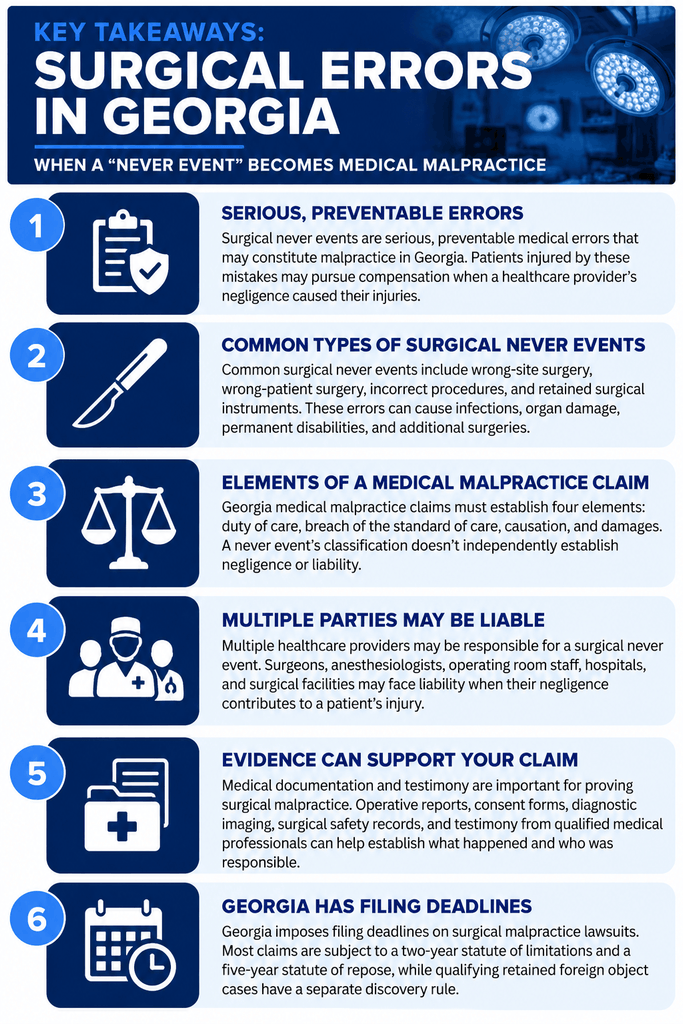
- Surgical never events are serious, preventable medical errors that may constitute malpractice in Georgia. Patients injured by these mistakes may pursue compensation when a healthcare provider's negligence caused their injuries.
- Common surgical never events include wrong-site surgery, wrong-patient surgery, incorrect procedures, and retained surgical instruments. These errors can cause infections, organ damage, permanent disabilities, and additional surgeries.
- Georgia medical malpractice claims must establish four elements: duty of care, breach of the standard of care, causation, and damages. A never event's classification doesn't independently establish negligence or liability.
- Multiple healthcare providers may be responsible for a surgical never event. Surgeons, anesthesiologists, operating room staff, hospitals, and surgical facilities may face liability when their negligence contributes to a patient's injury.
- Medical documentation and testimony are important for proving surgical malpractice. Operative reports, consent forms, diagnostic imaging, surgical safety records, and testimony from qualified medical professionals can help establish what happened and who was responsible.
- Georgia imposes filing deadlines on surgical malpractice lawsuits. Most claims are subject to a two-year statute of limitations and a five-year statute of repose, while qualifying retained foreign object cases have a separate discovery rule.
A never event, which is also known as a ‘serious reportable event,’ is a clear-cut, serious, and mainly preventable medical error that should theoretically never happen in a safe healthcare environment. Common examples include:
- Operating on the wrong body part or patient
- Leaving a surgical tool or sponge inside a patient
- Severe medication mistakes
The National Quality Forum (NQF) maintains the list of these events, and agencies like the Centers for Medicare & Medicaid Services (CMS) often refuse to pay for the extra treatment required to correct them.
At The Champion Firm, Personal Injury Attorneys, P.C., we fight for those impacted by medical negligence. In this guide, we'll explain what qualifies as a surgical never event, when these errors constitute medical malpractice, who may be held liable, and what evidence can support your claim.
What Is a Surgical "Never Event"?
As we explained above, a surgical never event is a serious, preventable medical error that shouldn't happen when healthcare professionals follow established patient safety standards. The term was introduced by the National Quality Forum (NQF), which developed a list of serious reportable events to help healthcare facilities identify patient safety failures. The 2025 update to that list groups 28 events into four categories, which are:
- Procedural events
- Product or device events
- Patient protection events
- Care provision events
Never events aren’t the same as recognized surgical complications. For example, a patient may develop an infection despite receiving appropriate treatment and postoperative care. Leaving a surgical sponge inside a patient's abdomen is something entirely different.
Why Are Surgical Never Events Considered Preventable?
Hospitals and surgical centers use established procedures to prevent errors before, during, and after an operation. Common preventive measures include:
- Patient Identification: Confirming the patient's identity using at least two identifiers before administering anesthesia or beginning surgery.
- Surgical Site Verification: Checking the planned operation against medical records, consent forms, and surgical site markings.
- Preoperative Timeouts: Pausing immediately before the procedure so the surgical team can confirm the patient's identity, the operation, and the correct surgical site.
- Instrument and Sponge Counts: Accounting for surgical instruments, needles, and sponges before and after surgery to identify missing items.
- Team Communication: Giving operating room personnel an opportunity to raise concerns, report discrepancies, and resolve safety issues before proceeding.
When healthcare professionals disregard these protections, patients may undergo unnecessary procedures or suffer injuries that proper verification could have prevented.
Common Types of Surgical Never Events
Surgical never events can occur at different stages of an operation. Each type has its own risks, and the resulting injuries may need further surgery, hospitalization, or long-term medical treatment.
Wrong-Site Surgery
Wrong-site surgery happens when a surgeon operates on the wrong part of a patient's body. Examples include replacing the left knee instead of the right, removing the wrong kidney, or performing spinal surgery at an incorrect vertebral level. These errors can damage healthy tissue while leaving the original medical condition untreated.
Wrong-site surgery may result from inaccurate medical records, incorrect surgical markings, or failures to verify the planned procedure before making an incision. The patient may subsequently need another operation to treat the original condition and address injuries caused by the mistake.
Wrong-Patient Surgery
Wrong-patient surgery occurs when a medical team performs an operation on someone other than the intended patient. This can happen when staff members fail to verify identification wristbands, confuse medical charts, or rely on incorrect surgical schedules.
A patient who undergoes an unnecessary operation may suffer injuries from anesthesia, surgical incisions, or the removal of healthy tissue. Meanwhile, the patient who needed the procedure may experience delays in receiving necessary treatment.
Performing the Wrong Surgical Procedure
A wrong-procedure event occurs when a surgeon performs an operation different from the one intended for the patient. For example, a patient scheduled for a diagnostic procedure might undergo an unnecessary organ removal because the surgical team relied on incorrect documentation.
These mistakes can cause permanent injuries, particularly when surgeons remove healthy organs or perform irreversible procedures. However, a medically justified change during an unexpected surgical emergency doesn't necessarily constitute a wrong-procedure event.
Leaving Surgical Instruments or Sponges Inside a Patient
Retained surgical items include sponges, needles, instruments, and other surgical supplies unintentionally left inside a patient's body after an operation. These objects can cause internal infections, abscesses, bowel obstructions, organ damage, and persistent pain.
Retained items may result from inaccurate surgical counts, communication failures, or staff members overlooking missing supplies before closing an incision. Some patients require additional surgery to remove the object and treat the resulting injuries. Medical devices intentionally implanted as part of treatment fall outside this category.
Other Serious Operating Room Errors
Some surgical mistakes involve anesthesia administration, medication errors, or failures to monitor a patient's condition during an operation. For example, administering the wrong medication or failing to recognize dangerous changes in oxygen levels can cause brain injuries, cardiac complications, or death.
These incidents may qualify under other categories of serious reportable events, depending on what happened. Even when an operating room mistake doesn't meet the formal definition of a surgical never event, it may support a Georgia medical malpractice claim if negligent treatment caused the patient's injuries.
When Does a Surgical Never Event Become Medical Malpractice in Georgia?
A surgical never event may constitute medical malpractice when a healthcare professional fails to meet the accepted standard of care and causes a patient injury. Under O.C.G.A. § 51-1-27, medical professionals who practice surgery or administer medicine for compensation must exercise a reasonable degree of care and skill. When a surgeon or another healthcare provider fails to meet this standard, an injured patient may have grounds for a malpractice lawsuit.
Establishing the Four Elements of Medical Malpractice
To establish a surgical malpractice claim in Georgia, you must demonstrate four elements:
- Duty of Care: The healthcare provider owed you a professional duty to provide treatment consistent with accepted medical standards. This duty typically arises when a physician agrees to treat you or participates in your surgical care.
- Breach of the Standard of Care: The provider failed to exercise the degree of care and skill ordinarily used by medical professionals under similar conditions. Examples include operating on the incorrect surgical site, failing to verify patient identification, or disregarding discrepancies in surgical instrument counts.
- Causation: The provider's negligence caused your injuries. Medical records and testimony may establish that a surgical mistake led to an infection, organ damage, additional surgery, or another injury that otherwise wouldn't have occurred.
- Damages: You suffered compensable losses because of the injury. These damages may include additional medical expenses, lost wages, permanent disabilities, pain and suffering, and future treatment costs.
A never event is evidence of a serious patient safety failure, but its classification doesn't eliminate the legal requirements for proving malpractice. The investigation must establish which healthcare provider acted negligently, how that conduct departed from accepted medical standards, and how it caused the patient's injuries.
Who Can Be Held Liable for a Surgical Never Event?
When a preventable error occurs, liability may extend to multiple professionals or medical facilities, depending on their involvement. Depending on the circumstances, some or all of the parties below may be held responsible for a surgical never event.
- Surgeons and Other Physicians: Surgeons may be held liable when they operate on the wrong body part, perform an incorrect procedure, or fail to follow accepted surgical practices. Other participating physicians may also be responsible if their negligence contributes to the injury. For example, a physician who provides incorrect surgical instructions or fails to verify critical patient information may share responsibility for a preventable error.
- Anesthesiologists and Surgical Staff: Anesthesiologists are responsible for administering anesthesia, monitoring patients, and responding to dangerous changes in their condition. Surgical nurses, scrub technicians, and other operating room personnel also perform important safety duties. Negligence in performing assigned duties may contribute to a surgical never event.
- Hospitals and Surgical Facilities: Hospitals and surgical centers may be held responsible for negligent actions by employees. A facility may also face direct liability when inadequate staffing, deficient safety procedures, improper employee training, or poorly maintained equipment contributes to a patient's injury. Georgia law also recognizes circumstances in which a hospital may be liable under principles of apparent agency.
What Evidence Can Prove a Surgical Never Event Occurred?
Medical records, operating room documentation, diagnostic imaging, and witness testimony can reveal errors that contributed to a patient's injuries. This evidence also helps establish which healthcare professionals were responsible and how their actions departed from accepted medical standards.
Medical and Surgical Records
Medical records can establish what procedure was planned, what treatment the patient received, and when complications developed. Important documentation includes:
- Operative Reports: Operative reports describe the procedure performed, surgical findings, and any complications documented by the surgeon.
- Consent Forms: Consent forms identify the operation the patient authorized and may reveal discrepancies between the intended and completed procedures.
- Anesthesia Records: Anesthesia records document medications administered, vital signs, and changes in the patient's condition during surgery.
- Nursing Notes: Nursing notes record patient assessments, operating room activities, and postoperative complications.
- Diagnostic Imaging: X-rays, CT scans, and other imaging studies may reveal retained surgical items, internal injuries, or damage to surrounding organs.
Operating Room Safety Records
Hospitals maintain documentation of the safety checks performed during surgery. These records can reveal missed precautions, inaccurate information, or unresolved discrepancies. Relevant evidence may include:
- Surgical safety checklists
- Patient identification records
- Surgical site verification forms
- Instrument count sheets
Internal incident reports and hospital investigations may also contain information about a surgical error, although Georgia law protects certain peer review and medical quality assurance materials from disclosure.
Medical Testimony and Georgia's Affidavit Requirement
Medical testimony can establish the standard of care applicable to the operation, identify negligent conduct, and explain how the error caused the patient's injuries. Qualified physicians may review surgical records, imaging results, and the patient's subsequent treatment to determine what went wrong.
Note: Under O.C.G.A. § 9-11-9.1, Georgia ordinarily requires a professional malpractice complaint to include an affidavit from a qualified medical professional identifying at least one negligent act or omission and the factual basis for that opinion.
FAQs About Surgical Errors and Never Events
How Long Do You Have to File a Surgical Malpractice Lawsuit in Georgia?
Under O.C.G.A. § 9-3-71, you ordinarily have two years from the date an injury or death resulting from medical negligence occurs to file a malpractice lawsuit. The law also establishes a five-year statute of repose, measured from the negligent act or omission, that limits when most medical malpractice claims can be brought.
There is a separate filing rule when a foreign object is left inside a patient's body. Under O.C.G.A. § 9-3-72, a patient may bring a lawsuit within one year after discovering the negligent or wrongful act involving the retained object. This exception can permit claims discovered years after the original surgery, even when the ordinary five-year statute of repose has expired.
What Should I Do If I Suspect a Surgical Never Event?
- Seek Medical Attention and Request Your Records: If you develop persistent pain, fever, swelling, or other unexpected symptoms after surgery, seek medical attention. An independent medical evaluation may identify retained surgical items, internal injuries, or complications that require further treatment. You should also request copies of your operative report, anesthesia records, diagnostic imaging, discharge instructions, and follow-up treatment records.
- Document Your Injuries and Related Expenses: Keep a record of your symptoms, medical appointments, and changes in your ability to perform everyday activities. Save medical bills, prescription receipts, and employment records documenting income lost. If a healthcare provider explains that a surgical error occurred, record what you were told, including the date and the provider's name.
- Contact a Georgia Medical Malpractice Lawyer: A Georgia medical malpractice lawyer can investigate the surgical error, obtain relevant medical documentation, and consult qualified physicians about the treatment you received. Your attorney can also identify potentially responsible healthcare providers and determine which filing deadlines apply to your claim.
Concerned About a Surgical Error? Call The Champion Firm
When a surgeon, hospital, or another healthcare professional fails to meet accepted medical standards, you may have the right to pursue compensation for any injuries. At The Champion Firm, Personal Injury Attorneys, P.C., we can investigate what happened, consult qualified medical professionals, and identify the parties responsible for your injuries. For more information or to schedule a free consultation, call 404-637-1709. Hablamos Español.