Key Takeaways
- Georgia pedestrian laws set duties for both pedestrians and drivers, including rules for crosswalks, traffic signals, roadway use, and yielding. These laws can also affect fault and compensation after a pedestrian accident.
- Drivers must stop and remain stopped for pedestrians in certain crosswalk situations, while pedestrians can’t enter the path of a vehicle when the driver has too little time to yield.
- Crossing outside a crosswalk isn’t always illegal in Georgia, but pedestrians generally must yield to vehicles and must follow additional restrictions at signal-controlled intersections and other designated crossings.
- Drivers have a continuing duty to exercise due care around pedestrians, which may include avoiding speeding, distracted driving, traffic-signal violations, and failures to keep a proper lookout.
- A pedestrian can share fault for a crash, and Georgia’s modified comparative fault rule reduces compensation by the pedestrian’s percentage of fault and bars recovery at 50% fault or higher.
- An injured pedestrian may be able to pursue compensation for medical expenses, future care, lost income, reduced earning capacity, pain and suffering, and permanent impairment, while fatal crashes may also lead to wrongful death and estate claims.
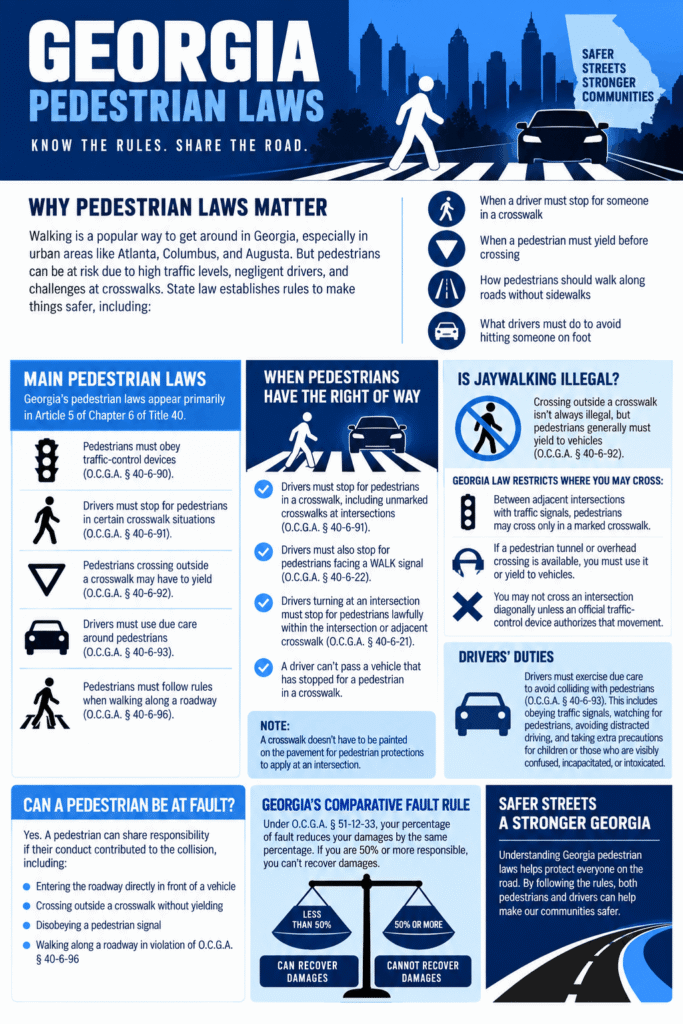
Walking is a popular way to get around in Georgia, especially in urban areas like Atlanta, Columbus, and Augusta. At the same time, pedestrians can be at risk due to high traffic levels, negligent drivers, and challenges at crosswalks. To make things safer for them, state law has established rules that address situations like:
- When a driver must stop for someone in a crosswalk
- When a pedestrian must yield before crossing
- How pedestrians should walk along roads without sidewalks
- What drivers must do to avoid hitting someone on foot
At The Champion Firm, Personal Injury Attorneys, P.C., we represent injured pedestrians throughout the state. In this guide, we explain Georgia pedestrian laws, the respective rights and obligations of those who travel on foot versus in a motor vehicle, and what you should do if a distracted or otherwise careless driver leaves you with serious injuries.
What Are Georgia’s Main Pedestrian Laws?
Georgia’s pedestrian laws appear primarily in Article 5 of Chapter 6 of Title 40 of the Georgia Code. These statutes govern the following behaviors:
- How pedestrians must respond to traffic-control devices
- When drivers must stop for pedestrians in crosswalks
- When pedestrians crossing elsewhere must yield
- How people may walk along roads when sidewalks or shoulders are available
They also impose duties on drivers to use due care to avoid collisions with people on foot. Some of the principal rules include:
- Pedestrians Must Obey Traffic-Control Devices: O.C.G.A. § 40-6-90 requires pedestrians to follow official traffic-control devices that apply to them unless a police officer directs them otherwise. Pedestrians are also subject to Georgia’s traffic and pedestrian-control signal laws.
- Drivers Must Stop for Pedestrians in Certain Crosswalk Situations: O.C.G.A. § 40-6-91 requires a driver to stop and remain stopped when a pedestrian is within a crosswalk on the half of the roadway where the vehicle is traveling, or when the pedestrian is approaching that half of the roadway and is within one lane of it. The same law prohibits a pedestrian from suddenly entering the path of a vehicle when it’s too close for the driver to yield.
- Pedestrians Crossing Outside a Crosswalk May Have to Yield: Under O.C.G.A. § 40-6-92, a pedestrian who crosses somewhere other than a marked crosswalk or an unmarked crosswalk at an intersection generally must yield to vehicles unless they have already entered the roadway safely.
- Drivers Must Use Due Care Around Pedestrians: O.C.G.A. § 40-6-93 requires drivers to use due care to avoid striking pedestrians and to take additional precautions for children or someone visibly confused, incapacitated, or intoxicated.
- Pedestrians Must Follow Rules When Walking Along a Roadway: O.C.G.A. § 40-6-96 limits when pedestrians may stand or walk along a roadway beside an available sidewalk. The statute allows exceptions when no motor vehicle is traveling within 1,000 feet or when the sidewalk presents an imminent threat of bodily injury. It also sets rules for walking on shoulders and along the edge of a roadway when no sidewalk is available.
When Do Pedestrians Have the Right of Way in Georgia?
In the previous section, we mentioned that under O.C.G.A. § 40-6-91, a driver must stop and remain stopped to let a pedestrian cross within a crosswalk when they are on the half of the roadway where the vehicle is traveling. The same duty applies when the pedestrian is approaching that half of the roadway and within one lane of it. If the vehicle is turning, the rule also applies to the half of the roadway onto which the driver is turning. For this statute, “half of the roadway” means all traffic lanes carrying traffic in one direction.
Georgia law also places limits on pedestrian behavior. For example, a pedestrian can't suddenly walk or run into the path of a vehicle that is so close that it would be impractical for the driver to yield. This means a pedestrian's right of way in a crosswalk doesn't permit them to move directly in front of an approaching vehicle without giving the driver enough opportunity to stop.
Here are some other rules and insights:
- Drivers approaching a crosswalk must also pay attention to vehicles that have already stopped. If one vehicle stops to allow a pedestrian to cross, a driver approaching from behind can't overtake and pass the stopped vehicle. This rule protects pedestrians who may be hidden from the approaching driver's view by the stopped vehicle.
- Under O.C.G.A. § 40-6-22, a pedestrian facing a WALK signal may proceed across the roadway in the direction indicated, and drivers must stop and remain stopped for them. A pedestrian facing a flashing or steady DON'T WALK signal can't begin crossing, but someone who started crossing during the WALK signal may continue to the sidewalk or a safety island.
- Under O.C.G.A. § 40-6-21, a driver proceeding on a green signal who turns through an intersection must stop and remain stopped for a pedestrian lawfully within the intersection or adjacent crosswalk when the pedestrian is either on the driver's half of the roadway or approaching within one lane of it.
Note: A crosswalk doesn’t have to be painted on the pavement for pedestrian protections to apply at an intersection. Georgia law expressly refers to both marked crosswalks and unmarked crosswalks at intersections. For that reason, the absence of painted lines doesn’t always mean a driver has no duty toward a pedestrian crossing there.
Is Jaywalking Illegal in Georgia?
Under O.C.G.A. § 40-6-92, if you cross a roadway somewhere other than a marked crosswalk or an unmarked crosswalk at an intersection, you must yield the right of way to vehicles on the roadway unless you already entered the roadway under safe conditions. Georgia courts have recognized that crossing outside a crosswalk isn’t automatically prohibited, but pedestrians who do so generally have a duty to yield.
There are situations in which Georgia law restricts where you may cross:
- Between adjacent intersections where traffic-control signals are operating, pedestrians may cross only in a marked crosswalk.
- If a pedestrian tunnel or overhead crossing is available, a pedestrian who chooses to cross on the roadway instead must yield to vehicles.
- Pedestrians may not cross an intersection diagonally unless an official traffic-control device authorizes that movement.
For that reason, the term “jaywalking” can be misleading. A midblock crossing isn’t always unlawful simply because painted crosswalk lines aren’t present. The applicable rule depends on the location of the crossing, any nearby traffic-control signals in place, the presence of a pedestrian tunnel or overhead crossing, and the pedestrian’s actions before entering the roadway.
What Duties Do Georgia Drivers Owe Pedestrians?
Under O.C.G.A. § 40-6-93, every driver must exercise due care to avoid colliding with a pedestrian on a roadway. The statute also directs drivers to sound the horn when necessary and, as we mentioned earlier, to take proper precautions after seeing a child or a person who is visibly confused, incapacitated, or intoxicated.
A driver may violate these duties through conduct such as speeding, failing to keep a proper lookout, driving while distracted, ignoring traffic signals, or turning through an intersection without watching for pedestrians. A driver may also violate a separate statute by failing to stop for a pedestrian who has the right of way in a crosswalk. The laws can apply together when the same conduct violates more than one duty.
The driver's conduct before impact can become central to a pedestrian injury claim. Evidence such as vehicle speed, braking, sight distance, cellphone use, traffic signals, witness observations, and video footage may help establish what the driver saw or should have seen before the collision. That evidence can also help determine if the driver had enough time and distance to avoid striking the pedestrian.
Can a Pedestrian Be At Fault for an Accident in Georgia?
Yes, a pedestrian can share responsibility for an accident if their conduct contributed to the collision. Examples include:
- Entering the roadway directly in front of an approaching vehicle
- Crossing outside a crosswalk without yielding when required
- Disobeying a pedestrian signal
- Walking along a roadway in violation of O.C.G.A. § 40-6-96
Georgia follows a modified comparative fault rule under O.C.G.A. § 51-12-33. If you are partly responsible for your injuries, the percentage of fault assigned to you reduces the damages you may receive by the same percentage. If you are 50% or more responsible, you can’t recover damages.
For example, suppose you suffer $100,000 in damages after a pedestrian accident but are found to be 30% responsible because you crossed outside a crosswalk without yielding. Your damages would be reduced by 30%, leaving $70,000. If you were found 50% responsible, you wouldn’t be entitled to recover damages at all.
What Compensation Can an Injured Pedestrian Pursue?
If a driver’s negligence causes a pedestrian accident, you may be able to pursue compensation for any damages. Your settlement amount mainly depends on the extent of your losses, the effect the injuries have on your daily life and work, and the evidence supporting your claim. Depending on the circumstances, compensation may include:
- Medical Expenses: You may recover the reasonable cost of emergency treatment, hospital care, surgery, rehabilitation, medication, follow-up visits, and other medical care related to the accident.
- Future Medical Care: If your injuries need ongoing treatment, physical or psychological therapy, assistive devices, or long-term care, those anticipated costs may be included in your claim.
- Lost Income: Time away from work because of the accident may support a claim for wages or other earnings you lost during your recovery.
- Reduced Earning Capacity: A lasting injury that limits the type or amount of work you can perform may support compensation for diminished future earning ability.
- Pain and Suffering: Georgia law permits recovery for physical pain, emotional distress, and the effect an injury has on your quality of life.
- Permanent Disability or Impairment: Serious pedestrian injuries may cause lasting limitations that affect mobility, independence, or daily activities.
If a pedestrian dies from crash-related injuries, certain family members may have a wrongful death claim, while the estate may have separate claims for certain losses.
Call The Champion Firm After a Pedestrian Accident
Pedestrian accident claims can involve disputes over right of way, crosswalk location, and driver behavior. At The Champion Firm, we investigate the crash, review the traffic laws that applied, and handle communications with insurance companies. If an insurer disputes liability or undervalues your losses, we can pursue the compensation available through settlement negotiations or litigation.
If you were hit by a vehicle while walking, contact our pedestrian accident lawyers to discuss your legal options. We can review what happened, explain how Georgia pedestrian laws may apply to your claim, and determine the next steps for pursuing compensation. For more information or to schedule a free consultation, call 404-637-1709. Hablamos Español.