Key Takeaways
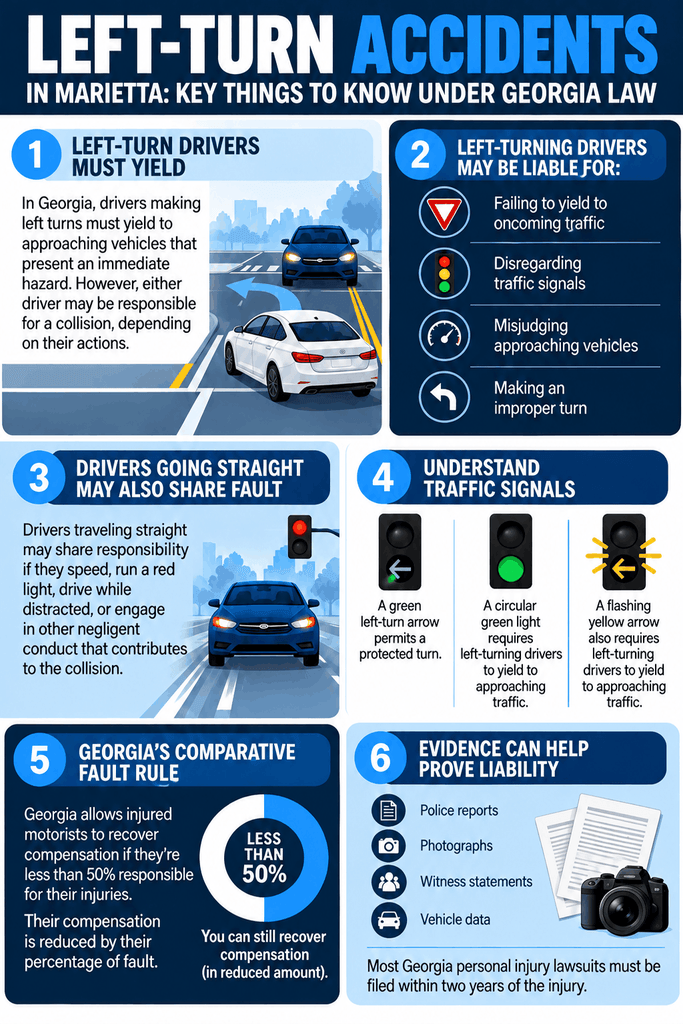
- In Georgia, drivers making left turns must yield to approaching vehicles that present an immediate hazard. However, either driver may be responsible for a collision, depending on their actions.
- A left-turning driver may be liable for failing to yield, disregarding traffic signals, misjudging approaching vehicles, or making an improper turn.
- Drivers traveling straight may share responsibility if they speed, run a red light, drive while distracted, or engage in other negligent conduct that contributes to the collision.
- A green left-turn arrow permits a protected turn, while a circular green light or flashing yellow arrow requires left-turning drivers to yield to approaching traffic.
- Georgia allows injured motorists to recover compensation if they're less than 50% responsible for their injuries. Their compensation is reduced by their percentage of fault.
- Police reports, photographs, witness statements, and vehicle data can help establish liability. Most Georgia personal injury lawsuits must be filed within two years of the injury.
A left-turn accident happens when a vehicle attempting to make a left turn collides with oncoming traffic, a pedestrian, a cyclist, or a vehicle passing from behind. They frequently result in T-bone (side-impact) or near head-on collisions at high speeds, making them among the most dangerous types of road crashes.
At The Champion Firm, Personal Injury Attorneys, P.C., our Marietta car accident lawyers help people injured in left-turn collisions determine who's responsible and pursue compensation. In this guide, we'll explain Georgia's left-turn laws, when either driver may be responsible for a collision, how shared fault affects compensation, and what evidence can help you prove your claim.
Who Is Usually at Fault in a Left-Turn Accident in Georgia?
The driver making a left turn is usually at fault when they don’t yield to an approaching vehicle that has the right of way. In this state, drivers must check for oncoming traffic before turning across an intersection or entering a driveway. However, liability ultimately depends on what each driver was doing during the moments leading up to the collision, including their speed, compliance with traffic signals, and ability to avoid the crash.
Georgia's Left-Turn Right-of-Way Law
Under O.C.G.A. § 40-6-71, a driver intending to turn left at an intersection or into an alley, private road, or driveway must yield to vehicles approaching from the opposite direction if they're already in the intersection or close enough to present an immediate hazard.
Please note that even if they have the right of way, approaching drivers must still refrain from speeding, ignoring traffic signals, or driving unsafely. If both drivers contributed to the collision, Georgia's comparative negligence law may affect how much compensation an injured person can recover.
When Can the Driver Making a Left Turn Be at Fault?
A driver making a left turn may be held liable when their failure to yield, disregard for traffic signals, or improper turning movement causes a collision. Georgia traffic laws establish duties that drivers must follow when crossing opposing lanes of traffic, including assessing approaching vehicles and determining when a turn can be completed safely.
Failing to Yield to Oncoming Traffic
Drivers making left turns must yield to approaching vehicles when they’re already within the intersection or close enough to be a safety risk. Any motorist who continues without taking approaching traffic into account can cause an accident, even when they believe there's enough time to complete the turn.
Failure-to-yield accidents can result from missteps like the following:
- Misjudging the Speed or Distance of Approaching Vehicles: A driver may underestimate how quickly another vehicle is approaching or attempt to complete a turn when there’s insufficient space between vehicles. The resulting collision may occur before the turning vehicle has cleared the opposing traffic lanes.
- Failing to Account for Traffic in Multiple Lanes: At intersections with multiple opposing lanes, a driver may concentrate on vehicles in the nearest lane while overlooking approaching traffic in another. A vehicle in one lane may also obstruct the driver's view of traffic approaching in an adjacent lane.
- Following Another Left-Turning Vehicle Without Checking Traffic: A driver may begin turning immediately after the vehicle ahead without independently assessing approaching traffic. The first vehicle's ability to complete a turn doesn't establish that the following driver has sufficient time or distance to do the same.
Turning Against a Traffic Signal
Traffic signals establish when vehicles may enter intersections and which movements are permitted. A driver who disregards these signals may interfere with traffic that has the legal right of way, resulting in a collision.
Examples of traffic signal violations that may establish liability include:
- Turning Against a Red Arrow: A steady red left-turn arrow prohibits that turning movement. A driver who disregards it may collide with vehicles proceeding through the intersection.
- Entering an Intersection Against a Red Light: A driver who enters an intersection after the traffic signal turns red may cause a collision with vehicles traveling under a green signal.
- Misinterpreting a Circular Green Signal: A circular green light permits a left turn, but the driver must yield to approaching vehicles and pedestrians lawfully using the intersection.
- Proceeding After a Protected Turn Signal Ends: A green left-turn arrow gives drivers the right of way to turn left. If the arrow changes to a circular green light, they may still turn left, but must yield to oncoming traffic and pedestrians. If the signal turns red, drivers must stop.
Making an Unsafe or Improper Turn
Under O.C.G.A. § 40-6-123, drivers must determine that a turning movement can be completed reasonably safely and provide the required signal before turning. Any driver who turns abruptly without checking adjacent traffic or signaling their intention may violate this rule.
In addition, O.C.G.A. § 40-6-120 governs the positioning of vehicles when making turns at intersections. For example, a driver making a left turn must approach the intersection from the correct lane and avoid cutting across opposing lanes or turning into the wrong side of the roadway.
When investigating these accidents, determining which traffic laws were violated is only part of establishing liability. The evidence must also show how the driver's conduct contributed to the collision and any resulting injuries.
How Do Traffic Lights Affect Fault in Georgia Left-Turn Accidents?
Under O.C.G.A. § 40-6-21, different signal indications dictate when drivers may turn and when they must yield to other road users. Determining which signal each driver encountered when entering the intersection can help establish who actually caused the accident.
Protected Left Turns With a Green Arrow
A steady green left-turn arrow gives drivers the right of way to turn left while oncoming traffic is stopped by a red light. However, turning drivers must still yield to pedestrians and vehicles lawfully within the intersection. They can't proceed into the path of traffic that entered before the protected turn signal appeared.
Permissive Left Turns With a Green Light
A circular green light permits drivers to turn left unless prohibited by a traffic sign. Unlike a protected green arrow, a circular green light doesn't require opposing traffic to stop. Drivers turning left must yield to approaching vehicles before crossing their travel lanes.
Note: In Georgia, intersections may also use flashing yellow left-turn arrows. These signals allow left turns after drivers yield to oncoming vehicles and pedestrians. The Georgia Department of Transportation uses flashing yellow arrows to distinguish turns that call for yielding from those protected by a steady green arrow.
Yellow Lights and Signal Changes
A steady yellow traffic signal warns motorists that the green indication is ending or that a red signal will follow. Under O.C.G.A. § 40-6-21, the yellow indication doesn't independently prohibit a vehicle from entering an intersection, but drivers must obey the red signal once it appears.
When a left-turn collision occurs during a signal change, investigators may need to establish the following:
- Intersection Entry: When each vehicle crossed into the intersection relative to the signal change.
- Signal Sequence: Which signal indications governed the turning and approaching vehicles before the collision.
- Vehicle Movements: The position and speed of each vehicle as the signals changed.
- Right-of-Way Compliance: If either driver failed to yield to vehicles or pedestrians lawfully within the intersection.
Note: The presence of a red light at the moment of impact doesn't establish that the driver entered unlawfully; a driver who enters an intersection legally may still be completing a turn when the signal changes.
What Happens When Both Drivers Share Fault for a Left-Turn Accident?
Both drivers may share responsibility for a left-turn collision in some cases. For example, one driver may turn across oncoming traffic without yielding while the approaching motorist is traveling above the speed limit. In this situation, investigators must examine how each driver's conduct contributed to the accident.
Georgia follows a modified comparative negligence rule under O.C.G.A. § 51-12-33. This law allows you to recover compensation if you're less than 50% responsible for your injuries. However, your compensation is reduced by your percentage of fault, and you can't recover damages if you're found to be 50% or more responsible.
How Comparative Negligence Affects Compensation
Suppose you're injured when another driver turns left across your lane. The evidence establishes that the turning driver failed to yield, but you were also exceeding the speed limit when the collision took place. If a jury determines that your speeding contributed to the accident, it may assign you a percentage of responsibility.
If your total damages are $100,000, the amount you can recover depends on your assigned percentage of fault:
| Your Percentage of Fault | Potential Compensation |
| 0% | $100,000 |
| 20% | $80,000 |
| 40% | $60,000 |
| 50% and up | $0 |
These examples assume that the remaining fault is assigned to one defendant. When multiple people or entities contribute to an accident, damages can be allocated among those responsible.
When Can Both Drivers Be Responsible?
Several situations may lead to shared liability in a left-turn accident:
- Failure to Yield and Speeding: A driver turns across approaching traffic without sufficient clearance, while the approaching motorist's excessive speed reduces the time available to complete the turn.
- Unsafe Turning and Distracted Driving: A driver makes a left turn without yielding, while the approaching motorist fails to watch the roadway or respond to an avoidable hazard because they're using a phone.
- Conflicting Traffic Violations: One driver begins an improper left turn while another enters the intersection against a traffic signal, with both violations contributing to the collision.
To reduce the compensation they must pay, insurance companies may argue that you contributed to the accident. Establishing each driver's actual conduct through traffic camera footage, vehicle data, and other records can help challenge an unsupported assignment of fault.
What Should You Do After a Left-Turn Accident in Marietta?
- Call 911 and Report the Accident: Contact law enforcement so officers can investigate the collision, document the scene, and prepare an accident report. Request emergency medical assistance if anyone is injured.
- Seek Medical Attention: Have a medical professional evaluate your injuries, even if you initially experience mild symptoms. Some injuries, including concussions and soft tissue damage, may become apparent hours or days after the collision. Medical records can also establish when your symptoms began and how your injuries developed.
- Document the Accident Scene: If you can do so safely, photograph vehicle damage, traffic signals, lane markings, skid marks, debris, and the surrounding roadway. These photographs may help establish where the vehicles were positioned and how the collision occurred.
- Gather Driver and Witness Information: Obtain the other driver's name, contact information, driver's license information, and insurance information. If anyone witnessed the accident, request their contact information so their account can be obtained during the investigation.
- Preserve Medical and Financial Records: Keep medical bills, treatment records, repair estimates, wage statements, and correspondence from insurance companies. These documents can help establish the expenses and income losses resulting from your injuries.
- Consult a Marietta Car Accident Lawyer: An attorney can investigate disputed right-of-way claims, obtain available surveillance footage, examine potential traffic violations, and assess the compensation you may be entitled to pursue.
Under O.C.G.A. § 9-3-33, most Georgia personal injury lawsuits must be filed within two years of the injury. Certain circumstances can change this deadline, including some tolling provisions. Speaking with an attorney after the collision can help you identify the filing deadline for your claim and preserve evidence needed to establish liability.
FAQs About Left-Turn Accidents in Georgia
Yes. Another driver's hand signal doesn't relieve you of your legal duty to yield to approaching traffic. For example, a driver in one opposing lane may stop and wave you through, but a vehicle in an adjacent lane may still be approaching the intersection. If you turn across that vehicle's path, you may be responsible for the resulting collision.
Parked vehicles, large trucks, vegetation, and other obstructions can prevent drivers from seeing approaching traffic. If a driver proceeds despite limited visibility and causes a collision, they may be liable. In some cases, investigators may also examine if another party created a dangerous roadway condition that contributed to the accident.
Yes. Passengers injured in left-turn collisions may pursue compensation from the driver or drivers whose negligence caused their injuries. Depending on the accident, this may include the driver of the vehicle in which the passenger was riding, the other motorist, or both.
Get a Free Consultation From a Georgia Car Accident Lawyer
If you've been injured in a left-turn accident, establishing who's responsible is an important part of pursuing compensation. At The Champion Firm, Personal Injury Attorneys, P.C., our Marietta car accident lawyers represent people injured by negligent drivers throughout Cobb County. We investigate disputed liability claims, gather evidence of traffic violations, and challenge insurance companies that attempt to unfairly shift responsibility onto injured motorists. For more information or to schedule a free consultation with a Georgia car accident lawyer, call 404-637-1709. Hablamos Español.