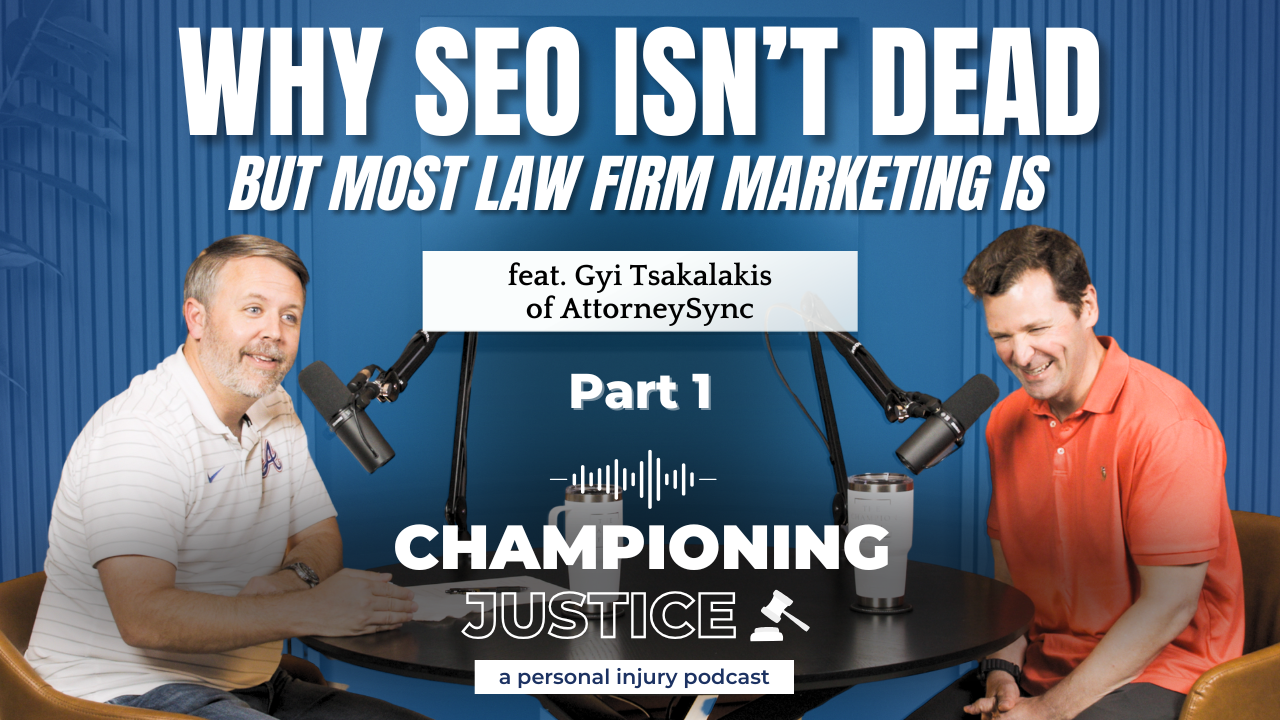
The following is a transcript of Episode 30 (Part 1) of Championing Justice. You can listen to the full episode here, or watch it on YouTube.
Darl:
So thank you for listening to the Championing Justice Podcast. My name is Darl Champion. I am the founder and owner of The Champion Firm. We're a personal injury law firm in Georgia. Today, I am honored to have Gyi on our podcast with us and I didn't even ask you yet how I properly pronounce your last name: Tsakalakis?
Gyi:
That's very well done. We get a lot of different pronunciations. Even in my family, they pronounce it differently.
Darl:
What would you prefer?
Gyi:
Tsakalakis is great.
Darl:
Perfect.
Gyi:
That's what I go with. Tsakalakis. That's what I learned. I took Greek in college, but it wasn't until college I actually learned how to properly pronounce my last name.
Darl:
Interesting.
Gyi:
Yes.
Darl:
Awesome. This is the inaugural AttorneySync bake off. Cookie tasting. We've got samples here of cookies. So, drum roll, we will announce who made those cookies.
So the winner, all three people picked Gyi's cookie, a first time baker over the cookie from a professional bakery. And that was not a scientific test, but I'm going to draw a lot of conclusions from it. Which is mass produced cookies aren't good, just like mass produced settlements are not good. We need more small batch. Whatever industry it applies across the board, it applies to SEO, right?
Gyi:
Sure.
Darl:
We don't want the cookie cutter--no pun intended--cookie cutter SEO. We don't want the cookie cutter personal injury, the cookie cutter medical practice. We don't want the cookie cutter bakery.
Gyi:
Who wants cookie cutter?
Darl:
So Gyi comes in here and bakes cookies for the first time ever. And that was totally spontaneous, by the way.That was not planned. That was, "Hey, let's just have some people try some cookies." And not to brag on myself, but I'm pretty good judge of cookies.
Gyi:
Well, that's why I made the cookies. Because I understand that you're a cookie connoisseur. So if you're coming to The Champion Firm, you got to bring cookies.
Darl:
I was impressed. And so I compared Gyi's cookie. So Gyi, we're not going to name the other bakery because...
Gyi:
We don't want to cache the other bakery. It's a local bakery in Detroit, which I wanted to support local business, which is another thing for us.
Darl:
Well, Gyi was convinced that his cookies weren't going to be good.
Gyi:
I was worried.
Darl:
So he brought the bakery's cookies as backup. And so I tried both of them and I'm like, Gyi's cookie is phenomenal. It's way better than the bakery one. And so I thought, let's see if this is just me or have other people. And everybody who tried it picked Gyi's cookie. So we will continue this unscientific yet scientific experiment later.
So Gyi is the owner of AttorneySync. Gyi is an expert in digital marketing. He's somebody who I listen to his podcast, Lunch Hour Legal Marketing with Conrad. It's very entertaining.
Gyi:
Thank you. Thanks for listening.
Darl:
Great banter.
Gyi:
Appreciate it.
Darl:
It's always good. But you're also a critic of the marketing industry.
Gyi:
I am.
Darl:
And I respect that a lot because I'm a critic of the personal injury industry. And I think that's probably why we get along so well is we both might be somewhat cynical about some aspects of our own industries and it's an honor to have you on. Thanks for coming down. Thanks for bringing the cookies.
Gyi:
Honored to be here. So we're going to have a lot of fun and I'm glad that the cookies didn't kill anybody because it's my first time.
Darl:
Well, if I keep eating them, they will kill them because they were that good. I'm going to keep eating them. Slow down. And Gyi and I are also going to the Atlanta Braves game tonight, or as he'd like to call it the Detroit Tigers game. Detroit's in town. So we decided to plan this trip around when he could come down and catch the tigers at Truist Park.
Gyi:
Thanks for having me. Glad to be here.
Darl:
Should be a fun game.
Gyi:
Yes.
Darl:
So I thought this would be a great discussion to just kind of let it flow and let it take on whatever direction it goes. But before we do that, why don't you tell us a little bit about who you are, about how you got into digital marketing and talk a little bit about your experience as a lawyer.
Gyi:
Sure. And apparently I'm a baker now, but I was originally--
Darl:
If this marketing thing doesn't work out...
Gyi:
I guess I'm going to fall back on, once the AI takes over, which we can talk about, we'll see how well the AI makes cookies.
So I started out, I actually thought I was going to be a computer science person.That's what I started going to school for. And this is way before computer science was super cool and turns out maybe it was a good pick not to because computer science people are in trouble right now because AI is doing the coding. Quickly realized I didn't want to do that didn't want to sit in a dark room and write code. Back then it wasn't as exciting as it seems to be today.
And so I'm in the middle of college and I decided, "Hey, what's a practical degree I can go get? " I became a philosophy major and wouldn't trade it for anything. Love my philosophy degree, but not a big market for philosophers.
So went to law school, practiced law at a small plaintiff's firm for hardly a career, like a year. And part of being a baby lawyer, they were like, "What should we do to market the firm?" So I went out, talked to lawyers and a lot of lawyers said, "We're not going to use the internet to market the firm." And I was like, "That doesn't seem right to me. " And that was kind of the genesis of AttorneySync, which I founded in 2008.
Darl:
Excellent. Let's talk a little bit about history of internet marketing. So 2008, trying to think back. So I had graduated law school. I was in the second year of my clerkship trying to think about what the internet looked like back then. I don't think iPhones existed.
Gyi:
Before iPhones. So there was no mobile search.
Darl:
Facebook was around. No mobile search.
Gyi:
No mobile. There's still multiple search engines at the time. Social media was just kind of brand new.
Darl:
Was Yahoo the biggest one then?
Gyi:
That's a good question. I don't know who was biggest, but Yahoo, Lykos, AltaVista, I think were still around. Maybe Netscape was gone maybe, but--
Darl:
When did Google come around?
Gyi:
Well, officially it was like 97, 98 between somewhere there because I remember the Google folks came to Michigan when I was there and we were talking about bubble sort and all this kind of search stuff. And so that's what I was studying. I was studying computer science, but it certainly wasn't the marketing vehicle that it eventually became.
Darl:
Right, right. And back then internet marketing was probably a lot easier. It wasn't as much competition.
Gyi:
It was.
Darl:
You just stuffed some keywords and--
Gyi:
Keyword stuffing and nickel clicks, the good old days.
Darl:
And it's funny, talking about how quick industries change, you talked about computer science. I mean, it seems like it was 10, 15 years ago, everybody was like, "That's the high dollar degree. You need to do that. " And now people are like, "That may not be the best thing ever."
Now it's like actually the blue collar trade jobs that are never going to go away. You're always going to need those. The philosophy degrees, the humanities, those are the types of things that people are going to want because AI can replicate so many of those other things. And SEO's changed a lot.
Gyi:
A ton.
Darl:
We've got mobile search now. We've got social media. We've got the way that Google is kind of serving up search results. When you started AttorneySync, what was your vision? What were you hoping to accomplish? Was it to have a big SEO agency or a big marketing agency?
Gyi:
No. In fact, we were very much ... We actually started out doing pay per lead lead generation to the total attorneys model and there was a question of whether lawyers could even pay for leads because it's technically maybe fee sharing with non-lawyers. Google filed Amicus briefs. Everybody was a huge deal and we were tiny, so we were like, "We can't do this. We can't fight this fight."
And so we pivoted to agency model. But my view really was like, because when I went out and researched what was available, I was like, "It's not so great." And I was like, "We could do this better." So our whole thing has kind of been transparency and accountability around marketing.
Marketing can still be speculative. You got to try new stuff all the time. And so you can't hit home runs every single time. But my goal was really just to be like, "Hey, let's try to educate lawyers about how this stuff actually works and then go execute campaigns and prove to them that the money they're spending is actually working for their business."
Darl:
How has AttorneySync grown over the years? It went from obviously just you to what do y'all look like now?
Gyi:
Yeah. So we're a totally distributed team. We actually were co-located in Chicago, 2008 to 2015 or so, but we started realizing that the ability to have talent from all over the country by being remote was a huge competitive advantage for small business.
And so we have a full-time team of account directors and strategists. We work with really firms all across the country, mostly plaintiff side personal injury, but any direct to consumer practice we'll work with assuming there's alignment in strategic thinking and stuff because as you know, I'm sure you've heard from a lot of your lawyer friends, lawyers have all sorts of different ideas about what works, what doesn't work, what's ethical, what's not ethical.
And so my whole goal is to try to educate as many lawyers as I can about how I think this stuff works and what we've seen work and then let them go and make informed decisions about it.
Darl:
So I'm going to ask you some questions...
Gyi:
Yes, hit me. Cross-examine.
Darl:
I see this a lot: Is SEO dead?
Gyi:
Well, that's the thing is, so it's like, what is SEO? If it's people going to search engines and looking for information or trying to find lawyers, it's absolutely not dead. In fact, and we partner with this company called Near Media. They do consumer research and user behavior testing.
And every time we do this, every time we run these studies, Google is still king. And so there's a lot of hype around Google's dead and everybody's going to ChatGPT and these other surfaces. And it's true. There's more fragmentation than there's ever been in information retrieval, but at the end of the day, and I think most of our clients' data reflects this that it's still a mostly Google game.
Darl:
What do people even mean? Because I see that a lot. SEO is dead. What are people even referring to? Is it like the old way of doing SEO is dead? Because that is correct, right? I mean, people are not being found the same ways all the time.
Gyi:
Yeah. I think what they're really trying to push is this ... So because there's an information gap, average local law firm has no idea about search engines or information retrieval or generative engine optimization, all this stuff. And so the industry, our industry, tries to create this fear, uncertainty and doubt.
And so they say things like SEO's dead, Google's dead, so they can sell you GEO services, generative engine optimization services. And so that's kind of been the game with SEO forever though, right? The SEO guys were pedaling SEO snake oil when SEO was first coming out. And so it's like this moving target so they can get people to continue to buy this stuff.
And don't get me wrong, there's definitely differences with the way these technologies work, with the strategies and tactics, but instead of trying to make it so convoluted and difficult and proclaiming the death of everything, we should just be talking about what we see working and how people can evolve to make it work for their businesses in my opinion.
Darl:
So what does work?
Gyi:
So the short version is like a lot of the same stuff that's always worked, which is funny because even though there's more funding shift--
Darl:
It's the hard stuff.
Gyi:
It's the hard stuff. You know what it really is? It's getting people to say positive things about you all over the place online. And if you think about that and you're doing it genuinely, you're not trying to astroturf Reddit, that's hard because you got to deliver remarkable client experiences.
You got to deliver remarkable experiences to everybody who touches your brand because every single one of those people is someone who might go and write a positive review or go say something nice about your firm or share something with a friend on social media and that's the stuff that these machines are getting trained on.
And so the more that you show up in those places with positive sentiment, the better you're going to do.
And sure, there's things you can do to optimize your content. You can be more explicit and make your pages more retrievable and all that kind of technical stuff. But at the end of the day, it's really about getting mentioned by all sorts of different people all over the place.
Darl:
So you mentioned Reddit. I've seen a lot of these fake Reddit posts, and I think that's what you meant by the astroturfing of Reddit, these people going onto Reddit and acting like they were a former client of a particular firm. Is that agencies that are pushing that? Is that law firms doing it internally? Is it both?
Gyi:
Both. It's both. And that's their thing too, is that everybody likes to blame the agencies, but there is no shortage of lawyers that are doing this stuff right on their own.
I'm still a licensed attorney in Michigan, even though I haven't practiced in forever. I'm just like, how do you look at that? And it's just an obvious rules for professional conduct violation. It's an obvious FTC violation.
Darl:
Nobody enforces the rules.
Gyi:
No one's enforcing them. Nobody's home. And we've talked about trying to go to platforms to get people to take them down. And again, I don't want to come across as self-righteous or holier than thou, but--
Darl:
It's okay. I'm self-righteous all the time. Feel free.
Gyi:
Well, the people I think about are, one, you think about someone who's trying to make a very difficult decision in trying to find a lawyer and they don't know what to make out of anything. It's hard enough to try to discern quality between one lawyer and the next lawyer in an ethical way.
And then on top of it, now you've got all this astroturfing fake reviews and you're just like, "This isn't fair." And then I think about the poor lawyers who are like, they're trying to do a good job, they're trying to do good work, serve clients, and they're getting crushed because people can scale spam the internet.
Darl:
Yeah. Well, you mentioned, coming back to Reddit, we get cases occasionally from Reddit and it's not anything that we've pushed out there, but there's some Reddit thread, posts, I don't know what you call them. And somebody asked about a personal injury lawyer in Atlanta recommendation, several people recommended us and people still go to that and call us off the list.
Gyi:
That's GEO right there. That's generative engine optimization.
Darl:
Maybe they're calling some of the other people on the list, but we just got a really, really good case from there. It's a really good one. And that came from everything that we had done for those people as well, which is I was having this conversation with somebody recently is everything you do is marketing.
Gyi:
That's right.
Darl:
I see people cut corners on attorneys. They cut corners on paralegals or whatever.
To give you another anecdote, somebody from South Georgia was up in Atlanta and they went out to dinner and it turned out that their waitress was a former client of ours and they somehow just started talking about, "Oh yeah, I know Darl up here, he's an attorney." And they're like, "Oh, they were our lawyers." Fortunately, that person had great things to say about us, not that person being the lawyer, but the client.
And if you think about it, that is one example that's offline marketing, of course. Maybe that person left us a review, but let's say that person didn't have a great experience with us. Well, then she tells that lawyer. Well, that lawyer's view of us might be tainted. That might affect what that lawyer recommends to other people.
So all of this is kind of like this flywheel effect that everything you do and so if you go in the positive direction, everything compounds in a positive way, but if you go in the opposite direction, everything goes the other way.
So I'm going to tell you, and I think that you and I have a lot of alignment on this, which is why I think we get along so well is I think that there's so many lawyers that they want the easy fix. They want the easy solution, the easy button that's just our society now.
Gyi:
Who doesn't?
Darl:
Yeah. Of course. You can order something on Instacart. I need some strawberries at 10 o'clock at night. Boom, there it is. They kind of expect the same thing with SEO and it's a really, really long game.
Let's talk about the long game and how long that can take. When I started my firm 12 years ago, a lot of people would tell me, "Hey, you've got kind of a new site. It's going to be 12 months before you even see any results." You can tell me that I'm crazy for saying this, but I tell people now, even if you've got a site that's kind of been going for a while, you need to give it two years to kind of give it some time to not only let them do the work, but see if it produces any results.
What do you tell new lawyers or lawyers that might be a new client?
Gyi:
Well, I'm super annoying because my answer is that it depends.
Darl:
Classic lawyer answer.
Gyi:
Yes. But if you think about it, it makes sense because if you have a ... I always try to measure the gap from where they are today to what they're trying to accomplish.
So I'll just make an easy example. Let's say that you're like, this is not the way to think about SEO, but just for the purposes of our conversation, let's say that you are trying to rank for a car accident lawyer near me or something. If you're in the second spot, the work that you need to do to get to the first spot is a lot less than the work and the time it's going to take is a lot less than it's going to be if you have a brand new site.
If your site is de- indexed altogether, you have no presence online at all, it's going to take a lot more work to be able to get that site to compete with someone that's ranking.
And so the timing is, I think generally people probably say the same thing. I think we probably say the same thing, 12 months, two years, but I try to contextualize it versus the gap that they're trying to close versus the competitive landscape. There's all sorts of things you can do to try to measure that. Like what's your keyword visibility?
And if there's tools like Ahrefs and Semrush, let's show you keyword gap analysis and this is where your competition shows up where you don't. And we're seeing a lot of that with the AI stuff too.
But at the end of the day, it's like you got to look at what the competitors are doing, what the landscape looks like, and that should inform where you are. And my big message too is like, don't get obsessed about one channel, like diversify your approach. To your point, we get people all the time, they're like, "I need cases tomorrow." I'm like, "Well, guess what? SEO's not going to be your jam. Try something else."
Darl:
Yeah. I think what I've seen a lot of is I've seen a lot of lawyers who, not only are they looking for the quick fix, but they're looking for SEO to put all their eggs in that basket. And I think that's a major mistake.
Gyi:
Huge mistake.
Darl:
The advertising world has changed so much. I mean, we're in a highly competitive metro in Atlanta, you're in Detroit, you were in Chicago before that. I mean, the way people are finding lawyers is very, very different. And I think one thing that a lot of people overlook is how quick I think some people are willing to hire advertising lawyers as compared to maybe 20 or 30 years ago. It's ubiquitous. It's everywhere.
And the people that might've thought, "Hey, I'd never hire Morgan & Morgan or some other advertising firm," they're the first people they call right after. So you've got to compete with that.
But I think you mentioned not putting all your eggs in the basket and diversifying. I think that that's just marketing in general because it's not just, "Hey, I'm going to use SEO to get cases." But if you don't have good customer service, then those people aren't going to refer people to you. They're going to leave a bad Google review. Reviews are a ranking factor still, I assume.
Gyi:
Yes.
Darl:
Yeah.
Gyi:
Absolutely. Well, and you made a good point earlier, your advertising just amplifies what you're doing at your firm. So if you're not providing great experience and you go out and advertise... There's a great example in Chicago. Big firm that spends a lot of money on billboards and radio and TV, everybody knows their name and if you do a search on their name, you see they've got a three on their Google business profile with hundreds of people saying, "This lawyer doesn't return my calls." They can't get ahold of them. They're just in it for the money. All that kind of stuff.
And so I always start with, and I tell firms this all the time, I'm like, "If you don't have your intake and your experience fixed first, don't waste your time on advertising. You're just going to tell the world that you're not providing a great experience."
Darl:
People probably get super annoyed with all my sports analogies, but I think of this similar to baseball. So everybody hates the Dodgers, right? They're like, "Oh, they can just buy a championship." But you can't really buy a championship. Look at the Mets, look at the Phillies. You have to actually do all those other things well, like evaluate talent, develop talent. If you do that, then the money just amplifies everything you're doing. But if you're not doing that, you can't just keep burning through cash.
And I see a lot of parallels there with how law firms operate. There are some law firms in this city, in Atlanta, that are really good operationally. They have a lot of stability. They've had the same people there for years, they have a great culture. And then you have other people you look at, go look at their Glassdoor reviews for their employees, go look at their Yelp reviews, look at their Google reviews. They're terrible, but they're just burning through so much cash on advertising.
And that is somewhat of the dichotomy on personal injury is you can kind of do that in a way because the upside is there on so many cases. But if you want to build a long-term sustainable business, you have to get your house in order and operate properly.
Gyi:
Yeah. And if you're going to play that game, just keep in mind that your cost per case is going to continue to go through the roof because you're competing in a space that's just becoming more saturated.
Because you think about it, how media buying works. These firms, they call up the outfront media or outdoor media, or if it's TV, whatever it is, and they're like, "How much is so- and-so paying you? Well, I'll pay you a little bit more than that." And then they call them back and they'll say, "I'll pay you a little more than that."
Darl:
And that's how PPC works, right?
Gyi:
That's right.
Darl:
And it's doing it through the algorithm, serving that up.
Gyi:
Here's what's really interesting though. And this I think also supports the point that you're making, which is even in what the marketing people would call like a non-brand PPC search, so 'car accident lawyer atlanta,' studies that we've done, they demonstrate that those people still choose law firms that they recognize.
So we watch them use Google and they're talking out loud and they'll say," Oh, I know that firm. "And a lot of times it's because something they did in the community, maybe they did a charity thing, maybe they had somebody that used that firm before. And so even people that are paying for those $150 a click, $500 a click, whatever it is, the choice end up being made for a firm that actually is doing that brand community outreach, whatever you want to call it. And so that's why it's not a either or. You have to be thinking both.
And I was going to say, if you have to pick one, if you're really twisting my arm, I would say double down on brand, double down on your relationships with former clients, referral sources, local community. Because when everybody's got these billboards up and people are driving by and people are getting banner blindness and ad blindness because it's like ads everywhere, when people start having this, when they're thinking about like, " Well, who do I know that does this?" They turn to the people that they always have, the people they know and like and trust and that's never changing.
Darl:
So I have kind of some interesting stories about brand recognition. I've had multiple people in Atlanta from various sources, attorneys, clients, people asking for jobs for job interviews say that they've seen our ads on TV or our billboards, and we have neither.
Gyi:
Right. Isn't that crazy?
Darl:
We have neither, right? I interviewed somebody, well, it wasn't really an interview, it was a law student down in Macon but he lives in Atlanta, grew up in Atlanta and he wanted just to kind of talk about my experience at the law school and he's like, " Yeah, we've never met, but I've seen your billboards." And I didn't correct him, but I don't have any billboards.
But what he's probably seen is me someplace else. Maybe it's on social media, maybe Instagram, wherever, maybe it's just at the law school because a lot of the stuff that we do with the law school and he's just associated that. And that's something that is a lot better than the billboard.
It is interesting too because in Atlanta, you might've seen the Glenda Mitchell billboards. If you kind of pay attention, you'll see them. They're everywhere. They're now in Alabama and South Carolina too. And she's kind of made her TikTok account kind of making fun of that, how the billboards are everywhere and it's funny, but you'll talk to some people and they're like, " Who's Glenda Mitchell? "Even though the billboards are literally everywhere, they don't pay attention because they're driving down the road and so they don't see them or the people that are on daytime TV. A lot of people don't watch TV anymore.
Gyi:
Again, with the research we've done is, and because it's proprietary and we're broadcasting a lot, I can't share the number, but it is astonishing in major markets where there's saturation and you ask somebody name a personal injury lawyer in your community and they can't name one.
Darl:
That's amazing.
Gyi:
It's wild.
Darl:
Well, and I think the one thing, to kind of name Morgan & Morgan, the one thing that they have done though is they have saturated everything everywhere. I mean, I see them sponsoring the state high school championship player of the game, they're there, they're on buses, they're on billboards, TV, but they're spending a lot of money too.
And this is the one area where I feel like small firms can really differentiate themselves is they think about it and I don't know the specific numbers, but I know they advertise they have over a thousand lawyers. If they're spending $400 million a year nationwide on advertising, that's $400,000 per lawyer. Each lawyer has to make up that in fees just to cover their advertising costs. A small firm like mine could have a lawyer generate $400,000 in fees and it'd be maybe not totally profitable, but we're not losing money.
So you can build a firm that's focused on client service and delivering personal attention, personal service that those firms really can't.
Gyi:
Well, that's the thing that I think about too is really important for if you're a lawyer and listening to this, you got to start with what you're trying to build.
So many firms come to us and they're like, maybe they want a big case and they're like, "We want to dominate our market."
Darl:
Happens all the time.
Gyi:
Right? Dominate the market.
Darl:
Everybody wants to dominate their market.
Gyi:
And I'm like, do you? I'm like, "Can you dominate your market?" I'm like, "What's your infrastructure look like? What's your capacity? How many lawyers do you have? What's your intake? Can you answer the phone 24 hours a day, seven days a week?"
Because guess what happens? You can go and spend all this money, drive a bunch of attention and not answer the phone and then get negative reviews online because no one's answering the phone and you've got waste in your advertising campaigns and yada, yada, yada.
And again, I think the other thing too is just like you got to really reflect and ask yourself, "Is this what I want to build? Is this the type of business that I want?" Because there's always trade offs, just like the cookie business, right? I only made nine cookies. The other local bakery, they're knocking out hundreds and thousands of cookies all the time, but there's trade offs.
And my thing is not necessarily, at least in the cookie context, because we could argue it's different in the personal injury context, but--
Darl:
It's every industry though.
Gyi:
It's like, what do you like? What do you want?
Darl:
What kind of restaurant do you want? Do you want to be the Michelin star great experience, great food, or do you want to be McDonald's?
Gyi:
That's right. And again, I try to keep an open mind and say," I'm not trying to put a value on one versus another. If that's what you're trying to build, just know that there's trade offs.
This is what the competitive environment's going to look like. If you want to do the homemade cookie thing, then go in that direction, but be mindful about what you're building because the worst thing is that you end up building something that wasn't part of your vision and now you've got--We see lawyers burned out because it really wasn't what they were trying to do and now that the firm is consuming them.
So anyway, I think it's an important thing that your strategy should be dictated by the vision for your firm, not vice versa.
Darl:
Yeah. We were talking off camera before we got on about Great Clips, right? I mean, you can make a ton of money by opening a Great Clips franchise or a bunch of Great Clips franchises. They're the largest haircutter in the world probably. But do you want to be that or do you want to be this really boutique salon?
And I think a lot of lawyers, when they get a big settlement, I hear that all the time, by the way. I thought that was just an Atlanta thing, but they're like, "Hey, I want to dominate the market." I mean, here's the thing and I'm not suggesting that Morgan & Morgan is always going to be dominating all markets. I mean, there was a time when everybody was like, "Man, is anybody ever going to supplant Walmart?" And now guess what? Amazon's there, but it's going to be tough.
They have built such a massive firm with all their advertising that it's hard to compete with them from a brand recognition standpoint in terms of just how many eyeballs are you getting on your ad. So why try to compete with that? And that's just kind of my argument to people is, why throw up a bunch of billboards? Why get on the radio? Why do all those things?
Gyi:
Yeah, right. And I always come back to this is focus on the legal services consumer. Some people are going to, no matter what you do, you can make the best cookies in the world, you can give them the best experience. They have a knee-jerk subconscious reaction that when they think they need a lawyer, they're going to call the billboard lawyer. There's nothing you can do about it.
But my whole thing is like, okay, let's find the people that aren't hiring lawyers that way or give those people a reason to, even though they have that knee-jerk reaction to say, "The first lawyer that comes to my mind is this lawyer, but I'm going to choose this other lawyer."
I think we're so hyper-obsessed by getting found and getting known, but it's really more important to get chosen. And so even if you're not the first one in Google, guess what? If someone sees you further down the page and they've got some kind of connection to you because of something that you did, they're going to choose you. And so that's been kind of my rant recently is is like it's much more important to be chosen than it is simply to be known.
Darl:
But how many times do you have lawyer and I'm sure you've had this in the past where clients call you up and say, "I just Googled car accident lawyer, whatever, and so- and-so is ahead of me." I hear that a lot though and I think it's just shortsighted.
I think some of it too is a jealousy thing. The lawyers, and I will say this too, you have no idea what it looks like under the hood at other law firms.
Gyi:
Totally.
Darl:
We handle some legal malpractice cases and some of the firms you would think like, "Oh, they must be doing huge cases. They're advertising everywhere." They're not. You'd be shocked at some of the stuff that goes on and how they're actually built and the types of cases they're handling, but people don't see that. They might just see the one billboard or whatever and they just associate it with that.
I've been very honest about this in the past, there was a time that I thought I would never get online cases. I just thought it wasn't for us, but we started using y'all. We'll give a plug here for AttorneySync. Thank you. We are an AttorneySync client. I don't know if I'm required to disclose that as a conflict of interesting. You're the on news, right?
Gyi:
We're very grateful to support you.
Darl:
I'm not suggesting that we only got cases when we started using you, but y'all have been phenomenal and we've definitely seen an uptick, but there was a time where we were kind of questioning what really makes sense for us.
And I think the one thing that I would tell people is the stability is very important. I was guilty of this for a long period of time when I started my firm of bouncing around to different agencies and I think that's just common, but really just kind of pick and choose the one that you want and kind of stick with it. Obviously it's like if you hire an employee, you might figure out quickly they don't work out. That doesn't mean stick with them just for the sake of it, but do kind of plan to stay with somebody for a year or two. I think that's at a minimum, but the longer, the better.
But to your point about how are people finding lawyers, people are still finding lawyers online. People find us online. I was convinced that even if people found us and chose us, it wasn't going to be for a big case. We had three seven figure settlements this year, first quarter that came from our website.
Two were med mal cases, which is an area where I felt like smaller firms can compete in because it is more of a niche, but one was a motor vehicle case. And so to kind of analogize this to another industry, we see a lot of plumber billboards and electrician billboards. I don't hire them. They might be great electricians or plumbers, but clearly some people do. I go online and I search and people still do that for lawyers.
Gyi:
They do. And I think one of the things the internet has done and social media has done is it's really democratized information to a large degree where legal services consumers, they've got choices.
And so we see in our research, a person that is confident that their family has a case, it's a catastrophic injury case, they're shopping around. Lawyers hate it. They can't stand it, but it's so important to recognize those intake experiences when you talk to them on the phone, like that whole experience that they have, that's the difference maker because they're interviewing you. Sometimes they're interviewing two, three, four different firms.
Darl:
Most underrated job in the law firm is intake.
Gyi:
Absolutely. Absolutely.
Darl:
I mean, especially on a personal injury firm where one single case can make the difference. I have a few points to make about that.
You mentioned getting chosen. Even before you get to intake, you got to convert it into a call or an inquiry because you might show up, but you might be background noise. I mean, I'm a big Chappelle Show fan even though it's been around forever, but I don't know if you remember the one where it was like if the internet was a real place, and he did the skit and he walks around and people are coming up to him.
I kind of feel like that, like the internet is like when you get off the cruise ship and everybody's coming up to you trying to sell you something or you're in the mall and all the people come up to you and want to give you a massage or sell you the... I hope they do the massage thing at other places, by the way. I hope that's not an Atlanta thing. People are going to be like, "What mall is Darl going to where they're coming up trying to give you a massage?" But they have the litle chairs in there and they're like, "Oh, sit in here. I'll give you a massage."
But it's like that. How are you going to cut through that noise? So you've got that and then you've got the call. I'll share with, and I think you know this from us working together, but I don't know that all our listeners know this. We invested a lot in intake a few years ago.
We kind of tried a couple different people. I mean, for a long time we didn't have a dedicated person. It was just kind of like if the person called--Leticia is shaking her head off sight like, "Oh my God, I remember those days." It was brutal. I mean, it was like a fire drill every time somebody called. We were like, "An internet case! Let's call!" Nobody really knew what we were doing. We didn't have a script. It was so bad.
Now looking back on it, it was embarrassing, but we hired an intake person. Didn't work out, but a lot of times when I've created a new role the first--and if anybody in the firm is listening, it doesn't mean that you're not going to work out if you are the first person in this newly created role--but a lot of times when I create a new role, the first person I hire for that role doesn't work out. It's because I don't really know what they're going to do and what the great fit is. And that was kind of that way with intake.
After that didn't work out, Leticia and I talked and I was like, "We need somebody super personable, energetic, bubbly personality that's going to just communicate really well with people." We did that. We came up with a process. We trained them. We went through a multi-week training where there were multiple training sessions and I'm happy to share if anybody wants to reach out to me who we used for that, but that was important.
And so if somebody looking for a lawyer on a $5 million case finds you but doesn't click on your website, it's not really good. But if they click on your website and call but don't like the experience when they talk to you, that's not really good. Or if they don't like you when you come in, it's not really good.
So there's so many steps and I think people kind of put the SEO at the top as the most important thing and it's like it might be, I mean, yes, you have to get found, but it might be the least important thing.
Gyi:
100%. I mean, again, that's why we're grateful to work with firms like yours because it is such a partnership between generating, whether it's traffic, visibility, whatever it is, and converting that because here's our classic story, right? We're looking at all of our leading indicators because if we don't have insight into a post call conversion, we don't know.
So we say, look, the leading indicators we have, your positions are up, your traffic's up, it looks relevant to us. The keywords we're bidding on, the landing pages, it all looks relevant to us, but if you have missed phone calls or you're botching intake, where we hear it is, the firms will say, "These leads are unqualified." And we're like, "You don't even know you didn't even pick up the phone."
And I think for folks that are listening to this, I think one thing tactically, if we give people a tactical recommendation, use that intake data to inform your strategy. I mean, think about it. People are calling you, it's the language, they're describing their problems, they're describing their issues, they're asking questions. That should all be part of your marketing strategy because you're responding to the questions and the demand for information that your potential clients have.
And yes, technology can support a lot of this stuff. There's ways to integrate intake sentiment with media buying, but a bare minimum, you should be using what people are saying on the phone when they call you to inform your content strategy so that you can create content that's responsive to the questions and issues.
And look, we're lawyers, we're guilty of it. We talk in lawyer, but people don't talk in lawyer. They talk in like, "I can't pay my bills. My person in my family was killed. I don't even know what to do. I don't even know if I need a lawyer."
So anyway, I think that's a really powerful way to inform strategy that I think a lot of firms still miss...
Stay tuned for Part 2 of Darl's interview with Gyi Tsakalakis...