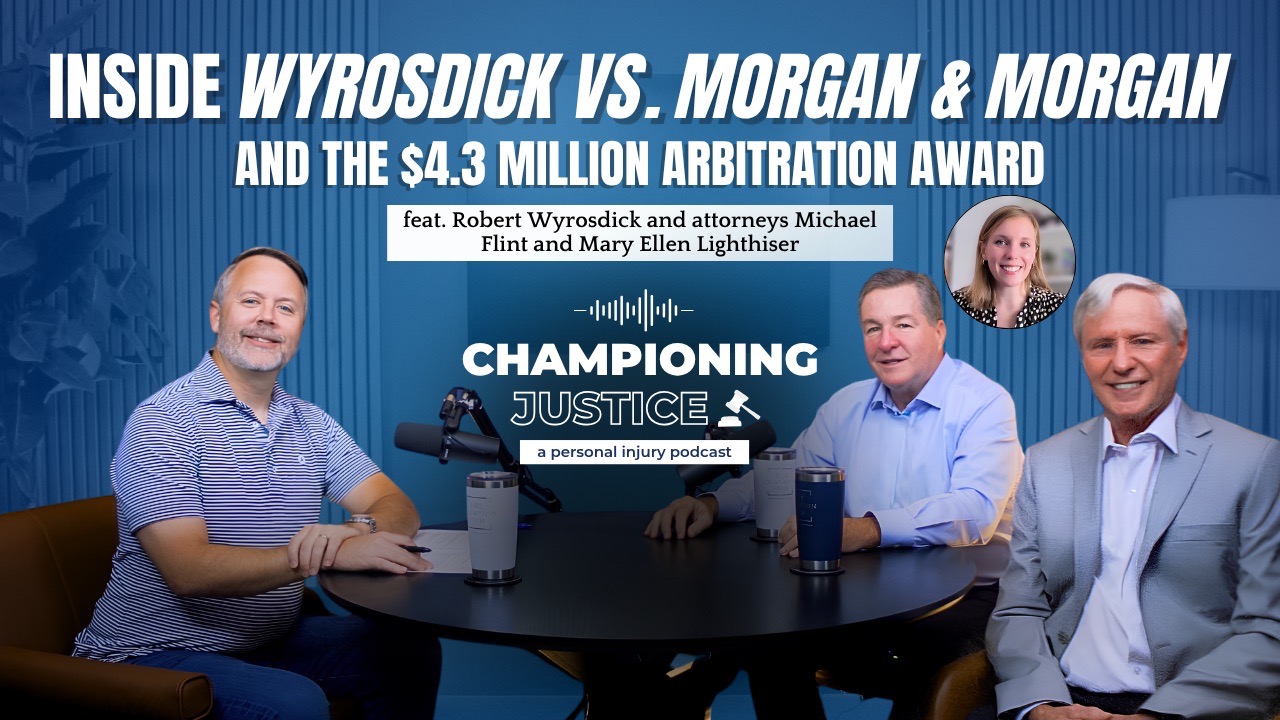
The following is a transcript of Episode 33 of Championing Justice. You can listen to the full episode here, or watch it on YouTube.
Darl:
On this edition of the Championing Justice podcast, we are going to be talking about Wyrosdick vs. Morgan & Morgan.
This is a case where there was an arbitration award of over $4 million against Morgan & Morgan, where one of its lawyers settled a case without its client's consent.
On this episode, we have the plaintiff, Robert Wyrosdick and his attorneys, Michael Flint and Mary Ellen Lighthiser. Thank y'all for joining us.
Robert:
Good to be here.
Michael:
Thank you for having us.
Mary Ellen:
Glad to be here.
Darl:
All right. So let's talk about this case. And before I get into what exactly happened, I want to learn a little bit about you, Robert. Tell us just a little bit about your background and just who you are, where you're from.
Robert:
Okay. Well, I'm originally from Columbus, Georgia, and I grew up there and graduated from high school from Hardaway High School and went to South Florida just right out of high school and lived there for about five years, got married and didn't work out. So I ended up moving back to Georgia around 1996 and been here ever since. But I'm a woodworker.
Darl:
Yeah. Yeah, so tell us about... you live in the Atlanta area, right?
Robert:
Yeah.
Darl:
In Marietta.
Robert:
In Marietta.
Darl:
And you've seen a lot of Morgan & Morgan ads.
Robert:
Yeah. Pass the billboard every two or three blocks. Yeah.
Darl:
When was your car wreck?
Robert:
It was March 15th, I think, 2023.
Darl:
Yeah, 2023. And just tell us briefly what happened in that wreck.
Robert:
Well, I was on Chattahoochee Avenue at Taylor Street getting ready to make a left turn. I was just sitting still. Cars were coming down Chattahoochee Avenue, and I was going to try to avoid some of the traffic at the light at Howell Mill Road, so I was going to cut Taylor Street. I was just sitting there when all of a sudden I got rear-ended, I mean, really hard.
And so I kind of shook it off a little bit, got out of the vehicle, and the gentleman that was driving the truck, he steps out. His headlights are all hanging off the front of the truck and it's all built up and the bumper's all twisted into the tires and I'm like, "Wow, that was a hard hit." I realized just how hard it was until I saw his truck.
Darl:
And this is a box truck?
Robert:
It was a delivery box truck for Reese Supply that, as I was telling you earlier, it was a sign supply company that I used to do business with.
Darl:
Oh, interesting.
Robert:
And so I thought it was kind of ironic or whatever.
Darl:
It wasn't targeted.
Robert:
No, but he just immediately started to apologize. "I'm so sorry, sir. My brakes failed."
Darl:
Oh my goodness.
Robert:
I was like, "Well, that's not good. What happened?" He said, "Well, I tried pumping the brakes and he wouldn't stop. And actually I'd been telling the guys at the shop for the last week that the brakes were not working right." And I was like, "Really?” I mean, you just don't put somebody in a truck.
So I thought maybe he was just telling me that maybe because he didn't want to get a ticket for whatever. Yeah, blame somebody else. And then we kept on talking. It was about 45 minutes before the police ever came, seemed like anyway. And he was stuck to his story. It was like, "Yeah, this is what happened and I've been telling so-and-so at the shop."
Darl:
Did you go to the hospital?
Robert:
I didn't. I didn't go. It shook me up. I could feel that my neck was starting to tense up, stiffen a little bit, but I didn't feel like I needed to go to the hospital. Probably should have. The next day I went to my doctor because I hurt all over. Every inch of my body was aching.
And so I went to see my primary care doctor and he checked me out good and said, "Didn't seem like anything's broken, but you've got some injuries." And he prescribed me some medication. And so I started the medication and it helped a little bit, but I knew that it was something more than just a little bit of whiplash, whatever.
Darl:
Were you planning to hire an attorney at that point? At what point in this process did you think to get an attorney?
Robert:
Not at that point. Because I'd been rear-ended before and they weren't that bad and I just got over it. I'm not going to just get an attorney just because I think that I'm injured, but I was really feeling this.
And I talked to some people and some family said, "Maybe you need to call somebody because these injuries can sometimes last for years." And in my age, I don't heal like I used to.
So somebody said, a friend of mine said, "Call Morgan & Morgan. I heard that they're pretty good." I'm like, "Well, I've seen their ads. They talk like they're good." So I gave them a call.
Darl:
So one of my questions I had was how did you pick Morgan & Morgan? And it sounds like it came from...
Robert:
Came from somebody that... my accountant.
Darl:
Did you fire your accountant after this? Well, actually this might've been the best thing that happened.
Robert:
No, he wants a finder's fee.
Darl:
So tell me about this kind of referral. Was this your accountant had a personal dealing with them or he just thought like, "Hey, they're everywhere."
Robert:
Well, actually, I think he said that he knew somebody that had a claim with him or something that he said he felt like they did him okay. So I'll give him a call.
Darl:
So this dynamic is interesting to me because, and I think, Mike, how long have you been practicing?
Michael:
Since ‘94, so however long that is.
Darl:
So you've seen an evolution in advertising of lawyers and just how prevalent it's become. And there used to be a stigma associated with it. And I graduated from law school in 2007, and in law school I interned at a plaintiff's firm down in Macon, and I just remember there being that kind of distinction between, well, these are advertising lawyers, these are the trial lawyers. And there were the clients who would never hire a "billboard lawyer."
Michael:
Back of the phone book lawyer.
Darl:
Yeah.
Michael:
My father was a lawyer and Mary Ellen's father who's still living is a lawyer. They were friends. They went to Emory back in the '70s, and both of them, that generation, they despised advertising lawyers.
Darl:
Well, the Supreme Court case about attorney advertising, I think that came out in the '70s, if I'm not mistaken.
Michael:
That's probably right.
Darl:
Maybe the '60s or '70s. I can tell you, Robert, just from knowing a little bit about your background, and you mentioned I'm not a litigious person, you would've been in that category that would've never hired a billboard lawyer, right?
Robert:
Right.
Darl:
And so that's kind of what curious...
Robert:
I never really liked seeing their ads either. But you know...
Darl:
But you picked them.
Robert:
Yeah. Yeah.
Darl:
So for lawyers out there like myself that aren't on billboards, I'm always curious about what we can do to differentiate ourselves from people like that that are everywhere. And it sounds like it's just that it's so prevalent that they're just everywhere that it sort of plants a seed in your mind that you just can't get out.
Robert:
And that's what it is. It's subconscious. I think you're just driving by and you see these things and it's like, well, they got to be good. They're the biggest and they claim they're the best.
Michael:
We found out during the course of the proceedings that they spent $500 million in advertising in 2025 and that they intend to spend $600 million this year in advertising.
Darl:
Yeah. I saw an ad or a podcast interview with John Morgan where he was on with a guy named Grant Cardone. It kind of gave insight into John Morgan's thinking.
Michael:
He's a billionaire.
Darl:
He is a billionaire, but a lot of his financial interests are in different companies. It's not just the law. I mean, he's in everything and he's a business person. And so this is just another business. And that's the interesting part about the way they treat people is they're really no different than any other large corporation.
And we'll get to that in a minute when we get to the contract and everything and the arbitration provision. But how long after the accident did you reach out to Morgan & Morgan?
Robert:
It was a couple of weeks. It wasn't right away.
Darl:
When you called them, did you meet with an attorney? Did you just speak to somebody and they sent you...
Robert:
I just called them. I called one, #Law, I think is the number, and I had got an intake guy on the phone and he says after explaining the accident and he wanted the police report and all the information, but I talked to him and then he would say he would pass it on to an attorney.
And then I got a call from an attorney. It wasn't the gentleman who took my case or the one that handled the case. And then I just assumed everything's just proceeding. And then I got a call one day from Mr. Aitken who said, "I'll be representing you."
And my wife and I were driving down the road, had him on the speakerphone and he introduced himself, said, "Corey Aitken with Morgan & Morgan, and I'll be handling your case for you. You're in good hands." I said, "Well, thank you, sir. Look forward to getting this thing settled." And he said, "I'll be getting back in touch with you." Well, that was it.
Michael:
Turns out, Darl, that in the entire time that Morgan & Morgan represented Robert, he never went to their office. The first time he ever met a Morgan & Morgan person was at the arbitration hearing in person.
Darl:
Interesting.
Michael:
And everything was done by text, email, DocuSign, and phone calls.
Darl:
And the attorney, you had this sort of initial kickoff call with the attorney. Was that the only call you ever had with him or was there anything...?
Robert:
That was it. That was it from him.
Michael:
Well, after the controversy about the settlement, you talked to him again, right?
Robert:
Yeah.
Michael:
So that first call was before the complaint was filed, and then the next time he talked to him was after the case had been dismissed by Morgan & Morgan after they'd settled it without his consent. So the entire time the case was pending, he never spoke with an attorney.
Darl:
So they answered discovery and everything for you.
Michael:
Through a paralegal, who had no paralegal training, was his only contact person during the time that litigation was pending.
Darl:
Gotcha. Did y'all ever find out how many cases that your attorney had at any given time?
Michael:
Mary Ellen knows that.
Mary Ellen:
Yeah, I don't know that we have the real answer to that. They gave us a range. I know that each case assistant or case manager had 80 plus cases and there were two per lawyer. So they said it was a minimum of a hundred. My guess is it was closer to 150 to 200, but I couldn't get a true straight answer about what exactly.
Michael:
140 came out. It was somewhere 140 or more.
Mary Ellen:
Yeah, right. I think it was they said at least a hundred, and I got the most direct answer about this really from the case managers and the paralegals who said how many cases they would have, and then there's a couple of them. But yeah, I think it's more like 150.
Darl:
My understanding is they sort of assign cases based on case type and case severity. And for example, they'll have a pre-litigation attorney group. All they're doing is kind of high volume pre-lit. And I'll tell you, I interviewed somebody from there for an attorney position here and he had 400 to 500 cases at any one time.
Mary Ellen:
Yeah, I should clarify. We were talking about Summit attorneys. They call their litigation team Summit. So the Summit attorneys is what I'm talking about, and we didn't really get any discovery on what the pre-litigation side is, but I would guess it's substantially more.
Michael:
Yeah, they're completely separate. It has to be flipped to lit, they call it. So this guy was supposedly a trial attorney and he had 140 or more cases, which I can't imagine trying to keep up with that many cases.
Darl:
Yeah, no, that's insane. And so I think from reading the briefs, what I've gathered is because your case involved a commercial vehicle, it was a box truck and there was significant property damage that yours sort of got put on a separate track.
Michael:
There was $11 million in liability insurance available and he had a positive MRI. They have a checklist and it got checked off, signed off on by this guy, Evan Rosenberg, who's a big wig in the Atlanta office as a quick to lit case because of those things. It was in a Gwinnett, which is a good plaintiff's venue, positive MRI, clear liability, big coverage. And so it never hung around in the pre-suit silo for very long.
Mary Ellen:
Funny enough though, although that quick to lit form, and that was a big piece of evidence for us, because they said that a high value case was 250 plus. So we leaned heavily on that and the fact that Evan Rosenberg had at least signed it and had allegedly signed off on it.
But when we deposed him, he was like, "Oh, they probably just signed my name. That was probably an administrative person who did that." So I mean, the takeaway from this is the lawyers are really the figureheads here. The entire case from soup to nuts is being run by administrative people with really not a lot of training.
Michael:
And there were a lot of facts like that, like sign your verification for your interrogatory, send it back, we'll notarize it. We've never met you. We've never seen you. And that was their open practice was to notarize things after the fact.
Darl:
That's not how notaries are supposed to work.
Michael:
It invalidates the jurat if that comes out.
Mary Ellen:
And no one at the firm seemed to know that. Every time we deposed them over it, they're like, "Yeah, that's just how it's done."
Darl:
Geez. Well, one of the things I think that y'all found out in the discovery of the lawsuit was the involvement of these non-attorney case managers. And I think I saw a quote about something of “thrown to the wolves.” Where did that come from?
Michael:
Mary Ellen was taking the deposition of, what was the guy's name?
Mary Ellen:
Joe Johnson was his name, and he was the case manager. He'd never had any kind of... I think he'd worked at one firm before, but briefly, no kind of previous legal training or anything like that. And he said when he was there, it was just. I mean, “thrown to the wolves” was completely—I did not elicit that from him. He gave that up.
Michael:
So they hired him, they put him in there, they gave him all the files. They didn't tell him what to do or how to do it and just said, "Go."
Darl:
Interesting.
Michael:
So he said, "We were kind of thrown to the wolves and figured it out ourselves." That ended up being a quote that the Fulton County Daily Report used out of context, but because it sounded cool.
Darl:
It's a great quote. So you're represented by Morgan & Morgan, you're going along with your medical treatment. How did it get to the point that they settled your case without your consent?
Robert:
I was waiting to hear back about having a deposition taken, and that was the last time I had actually talked to anybody. And that was the lady who had been the person I'd been in most communication with throughout the whole thing, Mrs. Bronson.
Darl:
And she was, I assume, do they call them case managers if they're in litigation?
Michael:
She was a legal assistant or litigation assistant.
Mary Ellen:
Actually the paralegal, although she didn't have any paralegal training, but no, she was actually the paralegal.
Darl:
They just kind of like knight you, paralegal. "I hereby declare you paralegal."
Michael:
I guess.
Darl:
Okay.
Robert:
And so I was waiting to hear from her, hear back from her, and I had called a couple of times just to see and, "Oh, we'll let you know. Mr. Aitken's handling everything and we'll get back with you." And so I never heard anything about the deposition. And then...
Michael:
Well, from the phone logs, you could tell Robert was anxious about giving the deposition. He kept calling to find out the status. So there were a bunch of calls, of voicemails...
Robert:
Yeah, because I wanted to be sure I could be available for whenever it was scheduled. And she did tell me it could be within a few weeks or maybe a month or whatever. It seems like that was kind of what she was telling me. Then I never heard back from her. And then I started getting these documents to sign that was emailed and I was like...
Michael:
They emailed him a settlement agreement and release and, "Sign this." Nobody called him. Nobody said anything.
Darl:
So you're thinking, "What am I agreeing to here?"
Robert:
Exactly. At the time, I just assumed it was like, "Well, maybe I signed something, just had given them the permission to do this, settle it without my permission or my consent." And I was like, "No. Maybe it was in that fine print somewhere, but I don't remember seeing that."
So I talked to somebody. I talked to my nephew, he's not an attorney, but he's got some knowledge about these things. He said, "Don't sign nothing. Don't sign nothing." And then a couple of days later, before we actually communicated about this with me and Mr. Johnson, I did finally talk to him.
Darl:
Who was Mr. Johnson again?
Michael:
He was the case manager. His job was to get all the medical bills together, put together the settlement package and the breakdown and get it all to the finish line. So he didn't get involved till after the case had been.
What happened is they sent an offer of settlement and Liberty Mutual accepted it within less than two weeks, which is unheard of. Morgan & Morgan's known for ridiculously high demands. So they jumped at it and then dismissed. So the case was dismissed. The check was there, and Mr. Johnson got involved at that point. His job was to get him to sign off on it.
Darl:
Interesting. So they sent an offer of settlement, I believe it was for $45,000. Yes. And so this was news to you?
Michael:
Actually, I don't think he found out about the offer of settlement until we got involved. Until we got the file. Fortunately for all of us, he was building built-in cabinets at my mom's place. She moved into an assisted living, not assisted, senior living place.
And Robert was doing work for her and asked her because she had been married to a lawyer and her son was a lawyer. He's like, "Let me ask a question." And so my mom called me while Robert was there. That's how we ended up getting together.
Darl:
Interesting.
Michael:
And it was in real time when they were trying to get him to sign. And so we were able to...
Darl:
Put the brakes on.
Michael:
Well, and get him to ask a few questions, and then we got involved and got the file. I called the managing partner and Corey Aitken, the lawyer, and talked to him. I said, "Look, this guy says you didn't have consent. I want to know what's going on." So we were involved as it was happening.
Darl:
What was their position on that when you raised that?
Michael:
Aitken didn't... I talked to him twice. The first time he didn't remember anything. And I said, "Well, I've gotten some of the file from the managing partner. Do you want me to send it to you and maybe it'll refresh your recollection?" And he said, "Yes."
So I sent it to him and he immediately, that same day emailed, "Okay, this refreshes my recollection. Let's talk again." I called him. I had a conversation with Mr. Wyrosdick and got his consent. So they knew there's no documentation. Everybody knew that from the beginning. There was no document, no email, no text message.
Darl:
No contemporaneous note in the file, right?
Michael:
Nothing. Nothing. They use Litify system as their case management system. So that turned out to be a great fact for us because he staked out that it happened in a phone conversation before we got going. And then later on when we got the phone records, the only possible conversation it could have been was the 28-second call.
Darl:
Yeah. Tell us about the 28-second call.
Michael:
Well, anybody who's watched this podcast and listened to Robert talk knows that there's no such thing as a 28-second call with Robert.
Robert:
No.
Michael:
But because they had staked out this position, and it was the only position that other than doing the right thing and saying, "You know what? I forgot to get the consent or I didn't get consent."
Darl:
Did y'all get that from Robert's phone records?
Michael:
We got it from both. We got his cell phone records, but Morgan & Morgan has a call log of every call, and they show whether it was outgoing or incoming, and it shows how long the call was. And so this was a 28-second call.
Now, it also turns out that the voicemail greeting is 30 seconds. So if you left a voicemail and we had two or three that was 70 seconds long, the actual voicemail was 40 seconds.
And so we were 90% sure, and I think the arbitrator agreed that it was an incoming call from Robert on January 4th, the first or second business day after the holidays, to a guy who has 140 plus cases, and he claims that he answered, and that he knew what the case was and got consent all in 28 seconds. Do you remember who he was? To a guy he hadn't talked to since June or July.
Darl:
Yeah. Which is ridiculous, right?
Michael:
Absurd.
Darl:
The idea that you could get informed consent, because it's not just consent.
Michael:
Also, explain to him what an offer of settlement is and what you might net and why they'd arrived at 45. I mean, just absurd.
Robert:
I would've had some questions and I would've had some like, "Well, wouldn't you counter offer? I mean, explain this to me." I was like, "No, it never happened."
Mary Ellen:
When Robert found out that an offer of settlement was sent, and I think this is an important point because he actually told Robert, and I'll turn it over to him to speak to this, but he told Robert that this was an offer from the insurance company, and he said, "When the insurance company makes an offer, it's usually their highest and best offer."
Robert:
Yeah. When I finally did talk to him and asked him...
Michael:
After the case was over.
Robert:
After the case was over. I asked him, I said, "Wouldn't you normally counter if they offered? I mean...," he said, "Well, first of all, we didn't feel like the case warranted... We felt like it was a very, very good offer, and we felt like it was the best offer we could get for you under the circumstances. We didn't want to drag it out, and then you not get even this much."
They were like, "We're trying to get you the most out of this, and this is the best we think we can get for you." And he did apologize for not calling me to tell me that he had settled the case.
He said, "That is on me. I apologize, but we really felt like this was the best we could do for you." And so...
Darl:
I assume they disputed that.
Michael:
We were fortunate enough to... I mean, I could have been a witness in the case because I was talking to him in real time when these conversations were happening. And I talked to Robert, I had him send me an email narrative of what had happened, and it was always very consistent that Corey Aitken had said that, "That's on me, that's my fault. I should have called you, but it's a good offer," and so forth.
No doubt in my mind that happened because I was talking to him in real time, and Corey Aitken said that he was lying about that and that that didn't happen. He also said that Robert told him he was finished treating, and it turned out, unfortunately, for Corey Aitken that two hours after this 28-second alleged phone call, Robert had an appointment with a chiropractor or the doctor. So we knew he wasn't finished treating.
And if you talk to the man when he's on his way to the doctor or a couple hours before he's going to the doctor and ask him if he's finished treating, he's probably going to tell you, "No, I actually have an appointment today."
Darl:
Right. And part of what came out was that at least there was a theory that there was a motive on that attorney's part to settle the case because he was leaving the firm and wanted to bank the settlement.
Michael:
Right. At the time, they've changed it now, but they have a big case committee where if you're going to settle any case back then in Atlanta or anywhere, I guess, if you're going to settle a case for less than policy limits and it's $50,000 or more, it has to go through the big case committee.
In order to get this thing turned around, Aitken had decided to go back. He was at Nugent ("one call, that's all"), came to Morgan & Morgan, and he was going back to the Nugent firm. And so we believed that he was trying to settle as many cases as he could, and he knew if he tried to settle it for more than 50, they were going to ask him questions like, "Why haven't there been any depositions?" There were questions that were asked later after the fact by the managing partner anyway.
Darl:
Right. It would've gotten closer scrutiny.
Michael:
So he was trying to slide it in at the last minute under the radar so that he could get his commission on it. There are a lot of emails between Aitken and Joe Johnson, the case manager, about a list of the status to bank checks in that month right before he was leaving.
Darl:
Interesting. Yeah. I imagine that just regardless of people leaving, it probably just happens because they're incentivized from their pay structure.
Michael:
Right.
Darl:
Because they get a percentage, I assume, of cases they resolve.
Michael:
That's right. But only once the money comes in.
Darl:
So if there's a settlement below $50,000, that means it doesn't go to the big case committee.
Michael:
Right.
Darl:
That's interesting because it's sort of like you can define what is a big case by what you ultimately settle it for. So you could settle it for $49,999 and it doesn't go to the big case committee.
Michael:
That's right.
Mary Ellen:
Well, that's no longer. They changed it after this. It's now in Atlanta specifically ...
Michael:
And in Arizona. It's every case now that's not policy limits has to go through the big case committee.
Darl:
This sounds like an insurance company.
Michael:
It does.
Darl:
I have not done defense work. I did it for six months. You know my story.
Michael:
Yeah. The three of us all cycled through the same firm, same unnamed firm at one point, Mary Ellen and Darl and I.
Darl:
Yeah. Just from being on this side of things though, my understanding is there are internal committees and insurance companies that evaluate cases over time.
And I think it's interesting that Morgan & Morgan has sort of borrowed that on the plaintiff's side. And they're sort of running. I kind of tell people this too, it's almost like they are run. They're like the plaintiff's version of an insurance company and how they process claims.
Michael:
They have a structure and right now they're making a huge investment in AI. I don't know if you saw that article recently.
Darl:
I did see that. They're building their own AI program. So now the attorney with 140 is probably going to have 240.
Michael:
Right. And the AI will identify cases to settle at what value and you'll lose the whole art of practicing law. It's just going to be cycled through software. But yeah, you're right. I hadn't thought about that. That's a good point. It's run much more like an insurance company as far as just resolving cases just on the other side.
Darl:
It is almost like an assembly line manufacturing process too. They sort of break up the pieces of the case. And I get to some extent there is an efficiency to do that. We have people that request medical records just because that is one of the most painful things as anybody who's requested medical records knows.
But the bigger these firms get, the more they sort of pigeonhole people into very discreet tasks. And I always tell people that might work if you're building a widget, but people are not widgets. And so you've got to handle that.
But the other thing that we're going to get to here is the arbitration itself. So you realize something's amiss and that you didn't settle the case, you didn't give consent to settle. And just for people listening, we've got listeners all across the country and attorneys all across the country that listen, and I assume it varies by state, but at least in Georgia, your attorney is your agent, your parent agent and has the authority to settle the case.
And so if the attorney agrees to a settlement, at least as between those parties, the plaintiff and the defendant, there's a settlement. If the client hadn't given consent, the client might have a claim against the attorney for malpractice, breach of fiduciary duty, breach of contract.
And it sounds like that's what y'all did here. Y'all had no argument to break up the settlement itself. Your remedy was to go after Morgan & Morgan.
Michael:
Right. And that would've been the case in any unauthorized settlement. But here, they not only had settled the case, they had dismissed it with prejudice before he ever knew anything.
Darl:
Interesting.
Michael:
The case had been dismissed with prejudice in February.
Darl:
So you definitely had no recourse on that case.
Michael:
Right. All his conversations about the settlement and fee reductions and how it happened occurred after the case had been dismissed with prejudice.
Darl:
And so when clients call us, we don't know, for example, with nursing home cases if there's an arbitration agreement. So we'll ask to see the admission paperwork. Did you already know that there was going to be an arbitration clause?
Michael:
We got the engagement agreement from Robert and saw it early on.
Darl:
And it's a long one.
Michael:
It is. And so we spent a lot of time trying to figure out whether we wanted to challenge it, but we knew pretty early. We just actually, because of the publicity from this case, we've been inundated with people unhappy with Morgan & Morgan.
Mary Ellen and I can't work on anything else other than returning these phone calls and emails. And none of the people realize there's an arbitration agreement, even though they've all DocuSigned it. I haven't talked to one yet who knows there's an arbitration agreement in there.
Darl:
Yeah. And that's sort of a big issue with arbitration across the board, I think. But look, I mean, I'm an attorney and when I sign stuff, I'm not reading every line. I mean, I just don't. You can't. When you're downloading software or something, you get these lengthy terms of service.
And so I think we've just sort of been, it's been ingrained. It's almost like a habit. And so you get the DocuSign contract, you're like, "I just want to hire them to be my lawyer. They're going to do right by me."
Mary Ellen:
Well, I'll say too, I don't think even if you'd read it, a lot of people don't know, even sophisticated people don't know, what arbitration is and what it entails and what you're giving up. I'm certain people don't look at the fee sheet for arbitration so that they know how much you have to pay to even file an arbitration claim.
And so even if you see it in there and you read it and you, at least in theory, understand it, you need a lawyer to tell you what it means and what you're giving up. And it also waives class action lawsuits. It waives appeals, which kind of bit Morgan & Morgan in this one.
Michael:
Also, if you're injured in a crash or an accident and you're hiring a law firm, you're not thinking about, "Hey, someday I may have to sue my law firm." Especially for the people, you're protecting your constitutional right to the jury trial. I mean, we had fun with that.
Darl:
Yeah, he has a billboard on 75 right here that says "Protecting America."
Michael:
You could see a Morgan & Morgan billboard from the hearing room at Nelson Mullins.
Darl:
Y’all remember the... what was it? Six degrees of separation for Kevin Bacon or whatever? And there's the guy that could say everybody's been in a movie with Kevin Bacon. It's sort of like that with Morgan & Morgan. There's a radius where you're within a certain...
Michael:
So they did a feature and I was interviewed on WSB and right before it went to commercial, it said, "Closed captioning brought to you by Morgan & Morgan." And then there were two political ads and a Morgan & Morgan ad, and then it came back to the Wyrosdick case and interviewing me after all that Morgan & Morgan stuff. They're the biggest sponsor of the news.
Darl:
Interesting. Well, I think the arbitration clause is interesting too.
I filmed a video on this a couple years ago that we put up on our YouTube channel about how that contrasts with what they actually say on their website, because they have a lot of stuff on their website that talks about how arbitration clauses are bad. It's corporations trying to get around their misconduct and that sort of thing.
Michael:
They also say in that section that most clients aren't aware of them, don't read them.
Darl:
Yeah.
Michael:
And then they turn around and they use them.
Darl:
And then they turn around and use them. And that's the thing for me that drives me absolutely crazy is they've got this for the people messaging, but everything they do is contrary to for the people. They're a corporate bully.
I mean, they are a large corporation with a thousand plus attorneys, thousands of employees, huge advertising budget. They're not looking out for the people. They're looking out for what makes sense for their business model. So if they can throw an arbitration clause in there and make people waive class actions, which is also interesting because they have an arbitration class action practice at their firm.
I just saw something on LinkedIn where somebody was hiring for it and how important it is to fight for consumer rights, but Morgan & Morgan clients couldn't jam together.
Michael:
Cannot aggregate claims. It's right there in the arbitration agreement.
Darl:
So you realize there's an arbitration agreement, you know you're going to have to go to arbitration. I've never been to arbitration on a legal malpractice case. I've only had ones that have been filed in court. Do you have to get an expert affidavit in arbitration?
Michael:
No, you don't. The rules of evidence don't apply. It's pretty informal, which in this case it was good for us, but I'll give a plug. We did get an expert anyway because we handled it just like we would handle it if it was in court.
Darl:
I think you had Jon Pope. Excellent trial attorney.
Michael:
Jon Pope. I was going to give a plug to Jon Pope. It took me a minute.
We've known each other since we clerked for Willis Hunt when he was on the Supreme Court back in the '90s when we were both in law school and he didn't want to do it at first and the arbitration agreement offended him so much. I think that that's what tipped it to where he decided to do it. And he did a great job, gave a great deposition for trial or for hearing.
Darl:
Excellent lawyer. I think it would be helpful to just kind of know how an arbitration works in a case like this. You file what was called a notice of claim.
Michael:
Right, and you have to pay a pretty big fee when you do it. The other side doesn't even have to answer it. You can answer, but if you don't, it's just considered denied.
Darl:
Is that the way all arbitrations typically are under uniform rules or that's because their agreement specified that?
Michael:
No, so it specified AAA. It didn't specify the number of arbitrators. It was just the commercial arbitration rules at AAA. And once you get in there, it's all by their rules and their fee structure.
So you file the notice of claim and then they send a list of potential arbitrators and they run conflicts on it and then you try to agree on an arbitrator. We ended up agreeing on one and he recused and then we agreed on Erika Birg who ended up being the arbitrator in the case.
Darl:
And they'll never agree to her again.
Michael:
I wouldn't think so.
Darl:
Yeah, that's sort of the problem with arbitrations is they get to pick the person deciding it.
Michael:
Well, if you can't agree, then you strike the ones and then AAA picks them. And that happens a lot. I thought it was unusual that we were able to agree on two different ones.
Our biggest fear in arbitration, and I've had this experience, I've had several, Mary Ellen and I've had two or three together. I've probably had 10 or 12 over the years.
And your fear is, especially in an injury case or a business tort case like this, is that arbitrators want repeat business and they also, you're in the room, it's informal, you're a single arbitrator, you're always concerned that no matter how well you present your case, that they're going to kind of split the baby or have a result that doesn't offend or hit somebody too hard because they don't want to be somebody.
And Erica may regret it now because of all this publicity. I mean, her picture was on this guy, Rafi Law. Do you know Mike Rafi? He did a thing about our case on his YouTube channel mispronouncing Robert's name, never giving Mary Ellen and I any mention of credit, trying to get his own slamming Morgan & Morgan looking for business.
But he showed a picture of her that's why they mentioned that. But yeah, arbitrators are concerned about repeat business. So it's another reason I think that for Morgan & Morgan, they know 12 jurors are going to be pissed off at these facts.
Darl:
Do you get to do discovery? Is it limited discovery? How does that work?
Michael:
It's limited discovery and not a whole lot of mechanisms to compel third parties to do anything. We filed a motion to compel. It was granted, but you don't have the hammer that you would have under the Civil Practice Act.
Mary Ellen:
We got requests for productions, but no interrogatories. She granted a motion to compel at one point.
I want to also point out though how expensive this is for the claimant. They have to completely front this or the lawyer who takes the case has to front this.
But just to file the initial claim, we paid $3,800 with the initial claim and then had to pay another $6,500 a month or two later. Over the first six months, I want to say we had $30,000 in fees that we had to come up with.
Michael:
So Mary Ellen and I, it's just the two of us at our litigation practice. So essentially Robert had to find lawyers who were willing to take on this giant personal injury firm and front the money. I think by the end of it, we had $75,000 out of pocket in it plus all that time.
Mary Ellen:
It's just incredible because of course that's going to be a massive deterrent. I mean, who can afford to do that?
And obviously for a lot of these claims that, again, like Mike said, we've had a lot of people calling, but you have to sort of weigh the potential recovery against the amount of those just immense fees that you have to front. And so it's really a protectant for them, and I'm sure it works that way constantly.
Michael:
I think if it wasn't because Robert was working with my mom and was able to get me on the phone, I don't know that if he'd cold called me, I would've considered the case, especially when I found out about the arbitration agreement.
So probably if you've got a hundred Morgan & Morgan clients who are upset with something that happened and they go try to get a lawyer and don't know who to ask and you're a guy and you're looking at it and you're like, "Man, I'm not going to deal with this." I think it's a huge barrier to entry for somebody to make a claim against them.
Darl:
What were some of the things y'all learned in discovery about their operations and how they pursue these cases?
Mary Ellen:
A lot of what we're telling you right now, the big case committee, of course, the complete lack of training that they received.
Funny enough though, when we initially asked for the training materials and employee manuals and that kind of thing, their first response, they told us they didn't exist. Not even an objection. They just said, "We don't have any responsive documents," which of course you do.
Darl:
That's one of those things where the absence of it, you may just be like, "Okay."
Mary Ellen:
Yeah, but they did. They did. They had them. And what would happen is every time we take a deposition, somebody would say, "Well, there was a slideshow that we watched and that was really all the training." Oh, there's a slideshow.
Darl:
A slideshow that you didn't have because they denied it.
Mary Ellen:
Right. Told that it didn't exist. So we got a lot of that. We found out a lot about their, for example, client experience team, that they have two sides of it. They've got one that their entire job is to just troll the internet and respond to negative reviews and reach out to people. We were given some false information about that as well.
And then the other side of that team is really just about following up about complaints with client communication. That's such a common issue with their clients. They have an entire group that's just about facilitating communications with clients.
Darl:
It's one thing to spend $500 million a year on advertising. It's another thing to actually work the cases. And if you've got, what do they have, a thousand attorneys or so?
Michael:
I think that's right.
Darl:
Yeah. And it's like what, 500 grand per attorney they're spending on advertising on average, something like that. That might be how it works out.
Michael:
Sounds about right.
Darl:
So I mean, just for them to sit in a seat, they've got to produce that much in revenue. I always tell people that's kind of the interesting part of the economics of a plaintiff's practice versus a defense practice, because you would never have a defense practice or any kind of corporate practice where it costs that much money just for marketing to put a butt in the seat and to pay that much.
And so they've got to generate that much in fees just to cover their marketing cost, and then you've got the overhead and all the other stuff and then the profit. That's why they have to load them up with so many cases.
Michael:
Right. And we got some information on how well they do, at least in Atlanta, which is confidential, put it this way. The expense of the advertising pays off handsomely for them.
Darl:
Yeah.
Michael:
I mean, it really does. It was mind-boggling how much money they make.
Darl:
Yeah. And it pays off for them when you're loading up these people with lots of cases and having all these complaints. And so some of the things they did in discovery to try and throw up roadblocks, I think one of the things, y'all had to file a motion to compel, I believe, that got granted and they had to produce some other materials.
Did y'all find any other incidents of this happening where they had settled a case without consent?
Michael:
Yes. They produced three letters from lawyers making claims against them with similar fact patterns. And then we found in public record a couple of cases where people tried to defeat the arbitration agreement.
So we were able to find those because they were filed in court, one of them being in Savannah, the case that's up on appeal now. And then we went, Mary Ellen and I spent an inordinate amount of time on Yelp and Google and the Better Business Bureau looking for complaints of similar things.
And the one thing I will say, two things they did in discovery to frustrate us and didn't end up helping them, lots of the documents we got were after we'd taken the deposition of the person that we would've used the document for. That was a pain.
And then the client experience team that Mary Ellen mentioned, and it's the typical somebody puts a negative review on Yelp and then the client experience team responds to it, kind of like a negative review of a hotel or whatever. "Oh, we're so sorry. Please reach out." And they give an email address for the Morgan & Morgan client experience team.
Mary Ellen pursued that doggedly, and they went to great lengths to make sure that we never actually got to take the deposition of the person who knew where the bodies were buried.
And so we were able to prove to the arbitrator that they had stonewalled us on that and we were never able to do the discovery. I don't know what the discovery would've found, but the fact that the arbitrator realized they had done that to us really hurt them, I think.
Mary Ellen:
Oh yeah, absolutely. And there's this great moment at the arbitration as well when Greg Bosseler referenced having found out about a prior incident.
Michael:
He's the managing partner for Atlanta.
Mary Ellen:
I'm sorry. Yeah, the managing partner. He referenced having found out about a prior incident that was referenced in a Yelp review that we had brought up, but he had claimed to know nothing about it at his deposition, and the client experience team representative that we deposed had claimed to know nothing about it at her deposition.
They had never produced any kind of backup documents. Like I said, because the client experience team does follow up on all these reviews, there should be what's called a ticket, a client experience team ticket for every kind of follow-up.
And so we asked for those and they said, "Oh, there are none." Then we actually sought sanctions for that, and the arbitrator denied and said she didn't like doing discovery on discovery. We're like, "All right, well we'll bear this out."
But then at the arbitration, Mr. Bosseler referenced that he did know about this and they had fought it out and there was a client experience team ticket and they just didn't give it to us.
I think that was insulting, I would think, to her as well because she had taken their word that they had done what they said they had done and they hadn't.
Michael:
And three or four times during the arbitration, they would defend things that they stonewalled us about during discovery and then they would defend and tell their story and like, "Well, no, that was somebody we had consent and that was a mistake or misunderstanding or whatever."
So we never got a chance to learn anything about it, and they claimed not to know anything about it, that nothing exists, nothing to see here. And then in the hearing, conveniently, they remember, "Oh no, that was nothing. Let us explain." Interesting. I didn't think it was a good strategy at the time, and the arbitrator obviously didn't buy it.
Darl:
How many days was the arbitration?
Mary Ellen:
Oh geez.
Michael:
It was five maybe total.
Mary Ellen:
The reason it's hard to say because we had, what, two and a half days, and then there was an objection.
Michael:
They tried to disqualify the arbitrator mid-hearing, and this is really interesting, something I learned about arbitration after all this time. If a conflict comes up during the arbitration, and it turns out that Liberty Mutual attorney, in-house attorney Bob Casey, or not in-house, but do you know Bob?
Darl:
I know Bob.
Michael:
Okay, so Bob testified, and everybody knew that Liberty Mutual had been the insurer. They're the ones who accepted the offer of settlement, the whole deal. The arbitrator realizes that Nelson Mullins does some business with Liberty Mutual, and she discloses that, over discloses, I think.
They realized at this point already that that day hadn't gone well for them, and so they moved to disqualify her.
There's an emergency motion, there's a conference call, there's some committee up in New York for AAA, and we had to brief it, and then it went for a day or two, so we had to suspend, and by the time it got resolved and they lost the motion to disqualify her, we didn't have enough time to finish that week, and so we had to reschedule, and with everybody's schedules and everything, it delayed months, which actually turned out to benefit us because we found some good stuff in the interim.
Mary Ellen:
Yeah, we just kept looking at the case.
Michael:
When you get into trial mode, you're learning things that maybe you should have learned six months ago, but you were in trial mode in another case. So you're in trial mode.
So when we debriefed and we had this pause, Mary Ellen and I made a laundry list of things we'd learned in the first three days to go investigate, so we were loaded for bear with some things that we didn't know when we came back.
And so it was frustrating because the delay was so long, but it really benefited us. And the key, all the Morgan & Morgan lawyers were cross-examined after the break in the second phase.
Darl:
I see.
Mary Ellen:
Three more days after that break. So I don't know, five and a half, six total.
Michael:
Well, then we came back to do closings on a separate day, so it was probably six days.
Darl:
And Robert, you testified at the hearing, is that right?
Robert:
Yes, I was first one.
Darl:
How long was your testimony? Was it the whole day, just a few hours?
Robert:
I think it went until about 12 o'clock.
Michael:
Yeah, I think it was a half day.
Robert:
About half a day.
Darl:
I assume their position was that that 28-second phone call was what gave them settlement authority.
Robert:
That was what they were hanging their hat on.
Darl:
How did you feel treated by the arbitration process and by Morgan & Morgan's attorneys?
Robert:
Well, they were very good. I mean, as far as, they were just doing their job, I guess, to try to make me look like the guy that's lying about the whole thing. So no, I wasn't happy with the way I was... It wasn't the most comfortable situation to, you know...
But Mike said I did okay, so there was some times I could have done better.
Darl:
I assume that the argument that y'all made was the consent didn't happen. There's no way you can give consent that just didn't happen. But also there's no way that that would be adequate consent to get it in 28 seconds.
Michael:
And that's what Jon Pope harped on a lot as an expert, how important that conversation would've been to settle.
Darl:
Yeah, you're giving up your claim for forever.
Michael:
Well, to settle that early when you're still treating, when there's that much insurance available and you have a clear liability case, you need to have a really serious conversation and then document that you had that conversation and that somebody just, "I want the money now. I don't care. I understand," kind of thing, not a 28-second call.
Mary Ellen:
Their story was that Robert called, that he said, "I want to settle my case." Corey said, "How much do you want to pocket?" He said, "15,000." And Corey said, "Okay, I think we'd have to offer about 45,000." And he said, "Okay," and they hung up.
Michael:
In 28 seconds.
Mary Ellen:
The whole thing is ridiculous.
Darl:
I mean, I would be embarrassed to make that argument. How did they make that argument?
Michael:
I told Mary Ellen when we got their pre-hearing brief, I said, "They're going to stick. They're going to embrace the lie. They're going to go down with that lie."
And even when we got there for openings, Mary Ellen gave our opening, it was excellent. And then Bryan Grantham gave the opening for Morgan & Morgan. I kept telling him, I said, "They've got to change course. They've got to admit that it didn't happen, that they were mistaken, that he was thinking of a different case and just fall on the sword and take the consequences. It's the only way they don't get slammed."
And he got into the opening and he embraced the lie and then basically turned it back that he had buyer's remorse and that he was really the one lying. They never came out and said he was lying, but they said he was lying.
Darl:
Yeah.
Michael:
I texted Mary Ellen and I was like, "They're going to run with it." I mean, I was thrilled.
Darl:
Yeah.
Mary Ellen:
I really thought they were going to back down.
Michael:
Yeah, so they were going down with that lie. But one thing in the last thing we were talking about, about how Robert felt about how he was treated, something to know, and you probably know this, especially after reading the briefs, if you're a Georgia lawyer, I don't know in other states, but if you're a Georgia lawyer, you can get negligent infliction of emotional distress without an impact in a breach of fiduciary duty case with a lawyer.
And there's a case out there, it's Warren Hinds’ case. Warren came and testified in our case on similar transaction. Can't remember the name of the case, Mary Ellen. It's Joel and Associates maybe?
Mary Ellen:
Something like that.
Darl:
It sounds familiar. I might have read it in the brief.
Michael:
It was Warren's case, but in law school, I did my moot court thing on negligent infliction of emotional distress and the impact rule. I thought it was hard and fast, but there is an exception, and it's still good law for emotional distress.
So if you look at the arbitration award, he got a quarter million dollars for emotional distress basically for the way they treated him after the dispute over the settlement authority arose.
Mary Ellen:
Just real quick, as a very dorky clarification. So it wasn't negligent infliction of emotional distress as a separate tort that we got. It was emotional distress you are entitled to recover as an item of damages in exchange for an intentional tort.
So because we had both fraud and breach of fiduciary duties, if you can show that that is an intentional tort and that happened, then you're entitled to recover emotional distress.
Darl:
Then you don't have to show the impact and that sort of thing.
Michael:
Anyway, it was a very unusual exception to be able to recover that.
Darl:
No, it is. I've got a case, I'll tell you about it later, a case involving an advertising firm where we've got an emotional distress claim involved. Is the emotional distress claim, that's based on them, of course, settling the case without your consent and everything, all the emotional distress that flowed from that?
Michael:
The stress from being adverse to the world's largest personal injury firm, them taking advantage of you, and then telling you you're lying, dragging you out, making you hire a lawyer, and then making you litigate it for all of that.
The best witness on that was Robert's wife who testified she was the last one to testify, I think, or next to last. She walked through the toll that it took on him of having to deal with all this. Everything from the time they sent the offer of settlement and dismissed his case until the day she was sitting there, the arbitrator was entitled to award emotional distress damages, and we needed those to get higher because the punitive damages have to be a rational multiple of the compensatory.
So we had to crank up the compensatories as much as we could to get the punitives. And that ended up being a really strong part of the case because he and Kim made a compelling case for how rough it was on him to be questioned and belittled and called a guy who was trying to basically renegotiate a settlement that he had agreed to.
Mary Ellen:
I did that questioning and Kim, I love this, brought in one of their golden retriever dogs that they were training.
So Kim and Robert train and I guess foster golden retrievers for Golden Retriever Rescue. So she brought a dog in, so that was helpful, little prop, but it was helpful to hear from...
Michael:
She was petting the dog during the testimony.
Mary Ellen:
Yeah. It was helpful to hear from Kim because Robert is a positive, upbeat guy. He's not dramatic. He's not going to tell you the toll that it had on him, but Kim would, and Kim got up and told us exactly the change that she saw in him over the past couple of years and the sleeplessness and the anxiety and how she could see a change in the man that she loved and how heavy this was on him.
And that was helpful because nobody wants to do that for themselves. No one wants to get up and say how difficult it has been, but it had been.
Darl:
Did Morgan & Morgan's lawyers give a number to the mediator that they thought would be a fair award?
Michael:
They basically asked for a defense verdict.
Darl:
Okay. And y'all asked for a number, and I'll read what the award is here. I've got the award from the arbitrator:
$450,000 for compensatory damages, $250,000 for emotional distress damages under count three, which was the breach of fiduciary duty count, $413,180.33 for attorney's fees and costs, and $3,150,000 in punitive damages.
And then Morgan & Morgan got assessed the arbitration costs because the prevailing party shifts the cost to the losing party.
Michael:
Correct. That is correct.
Darl:
And this is kind of eye-opening. That total was over $37,000 just for the arbitration, administrative fees and expenses.
Michael:
That was just our portion of the arbitration cost that Mary Ellen and I had fronted.
Darl:
Oh, interesting.
Michael:
Our expenses were included in the 400 number for depositions and for Jon Pope and all of that. But that 30 whatever times two is how much we had paid AAA between us and Morgan & Morgan, and they had to pay our half.
Darl:
And we have a cap in Georgia of $250,000 for punitive damages, and there's some exceptions to it. I assume the arbitrator found that there was...
Michael:
Specific intent. I think breach of fiduciary duty is sort of specific intent.
Darl:
Sort of goes hand-in-hand.
Michael:
Right. And the numbers that she awarded, and Mary Ellen and I have kicked ourselves since, but the 450 and the 250 are the numbers that we asked for. And maybe we should ask for more.
Darl:
I don't know. I had a jury one time give me more than I asked for, and I'm like, "Maybe I should ask for more." I kind of felt like it was like, "Does my client think that I'm brilliant because I got more than I asked for or that I didn't ask for enough?" I get it.
Mary Ellen:
A point I want to make too about the attorney's fees, because this is kind of a fine distinction. We sought attorney's fees under two bases.
We had a § 13-6-11 bad faith attorney's fee, and then we also just had the contractual claim for attorney's fees. For purposes of punitive damages, as you likely know, there's a constitutional kind of guideline about what ratio of actual damages to punitive damages you're allowed to have.
And most courts say that it can't be over nine or nine point something. They don't want an over double digit ratio. So we were very careful about that. But an important distinction about those attorney's fees is when the actual damages can include 13-6-11 attorney's fees, but they cannot include contractual attorney's fees.
So we wanted to make sure that the arbitrator understood that she needed to make a specific finding that those attorney's fees were being awarded under § 13-6-11 and not just the contract.
Because if it was just under the contract, then we wouldn't have been able to use that number in the multiplier for the punitive damages.
Darl:
And after this, there was no right to appeal.
Michael:
There's no right to appeal. You can challenge. The arbitrator gave them 30 days to pay. And so after the 30th day, if they had not paid, they have 90 days to challenge it in court, to challenge the award.
The grounds for challenging an arbitration award are very difficult. It's fraud, ignoring the law completely. Manifest disregard for the law. And a really important thing here is this is what's known as an unreasoned award.
So at the beginning when you initiate the arbitration, you have to choose two big things or if you're going for a lot of money, it costs more to file a big. And so we wanted to go for big money, so that costs more. You have to pick between one and three arbitrators.
Obviously three arbitrators cost a lot more than one. We decided to go with one, they agreed to go with one. And then you have to decide, do you want a reasoned award or an unreasoned award?
So the unreasoned award is what you see there, which is pretty bare bones, makes it much harder to challenge later on.
Darl:
Who gets to decide whether it's reasoned or unreasoned?
Michael:
We agreed.
Darl:
Oh, okay.
Michael:
But if we didn't agree, then I'm not sure how that's decided. I think that if you want a reasoned award, you'd have to pay for it. Interesting.
Darl:
It takes more time to draft.
Mary Ellen:
I'm sure it's in the rules. Yeah, the AAA rules lay all this out.
Michael:
But that would've been much more expensive. I thought Morgan & Morgan should have asked for a reasoned award just so there might be something in there that would give them a chance to challenge it in court to try to negotiate down later on. But they weren't thinking about losing, obviously.
Darl:
Yeah. Well, the other problem is they don't want stuff in court, right? I mean, that's their whole point.
Michael:
Well, and so they waited till the 30th day to pay, but I had made it very clear we'd already calculated the per diem of what the interest was. And we said, "We're not going to wait 90 days for you to decide whether to challenge us or not. We'll file a confirmation action on the 31st day and then it'll be public record."
And I think they were hoping that we wouldn't go public with this, but of course, arbitration awards are not confidential. So they paid on the 30th day.
Darl:
Yeah. No, and I think that there's an important distinction here in some lawyers that hold press conferences versus others. I mean, this is something that's important for the public to know. I mean, there is a public interest in knowing what's behind the curtain.
I mean, if they're making these representations to the public and people are going there, and especially because of the nature of the attorney-client relationship and what's happening there, more people need to know, which is why I'm having y'all on the podcast because I think it's important.
And then of course they pay the award and then they go in the news media and say that they accepted responsibility.
Michael:
Which I have to use in the next one. I want that CEO of Morgan & Morgan to be a witness and I want to use his words in all the press coverage that was. Because it says, "We didn't do anything wrong and we accept responsibility for our mistake." I can't wait to ask him which is it.
Darl:
No, and here's the other interesting thing about Morgan & Morgan and their position, because I see this from defendants a lot, especially corporate defendants. They'll say, "Oh, well, we've sold X number of products and there's been no other injuries or this is a low injury rate."
I represented a lady one time that fell at a hotel in Atlanta and there were like 22 other falls on this same walking surface, which is a lot in a slip and fall case. But they talked about how many millions of people have come through there and this was such a small percentage. That's essentially what they did here.
I mean, they're like, "Well, we process this many cases a year and this is just a small sampling." Of course, we don't really know. I mean, it's kind of like with the slip and falls, I've always tell people you don't know how many people fell and just got up and walked away.
You don't know how many people in your position just thought, "Hey, I don't have any recourse. I don't have any options."
Michael:
Well, and I think if we could have gotten to the right person at the client experience team and really seen those records, it might be a lot bigger number than what they wanted to admit.
Mary Ellen:
We're getting some kind of idea of it based on the calls that we're getting now, and we can't take all of them.
Michael:
It is insane how many people have reached out.
Mary Ellen:
But I wish I knew what then what I know now.
Darl:
Yeah. I mean, obviously without getting into attorney-client privileged communications, but just roughly how many potential clients have reached out to y'all over the last several months?
Michael:
Two since we've been sitting here.
Darl:
Interesting.
Michael:
Which is insane.
Mary Ellen:
It's got to be still happening.
Darl:
Do you think it's over a hundred total?
Michael:
Yes. Yes.
Darl:
Over a hundred.
Michael:
Easily. And we're still calling them. I haven't called them all back yet and it's been going on since early in the month. I feel bad just trying to do it as it's continuing.
Mary Ellen:
We would neglect all of our other cases if we were to call all them back.
Darl:
Well, Mary Ellen, just for the record, y'all are defending a case we're on. We were emailing with y’all.
Michael:
We do more defense, way more defense work than we do... We're kind of an unusual group because we do a lot of defense work, but we also do plaintiff's work.
Darl:
Is this going to flip?
Michael:
Well, we may become against the for the people.
So one thing funny about this is defense lawyers who are hardcore defense lawyers and hardcore plaintiff's lawyers, the true believers, they don't agree on very many things.
I'm not going to name any names, but I've gotten so many emails and text messages and Mary Ellen has from both sides about how much they've enjoyed the shade and fraud of I mean, it's something. I mean, I'll say one name I will, Jim Butler, who I don't even know, emailed me about it and he thought it was great.
Darl:
Well, and one of the things that I try to do this on social media is get the word out. And I post about some of the things that I see, one of which I posted yesterday was the expenses they charge clients. They're billing back clients for "long distance telephone calls," which is not a cost they're incurring. They use a voiceover IP system, I assume. It's a program called Dialpad, and it's even listed as a "soft cost."
And so they're monetizing every part of their overhead that they can. And then they also charge their client's interest for it at 1% a month, which is way higher than whatever any bank is charging. Banks don't charge them 12% a year for borrowing that money.
So they make a long distance phone call, they're making money off that, and then making money off the interest, and then they're nickel and diming the heck out of their clients.
Michael:
They also delegate dealing with the liens and negotiating down the liens and trying to maximize the client's recovery. They delegate that down to the case managers and assistants. The lawyers, from what we were able to see, don't get involved in that at all.
And you know and I know that you need to be involved in that, especially if it's eating up most of the recovery because you can make a big difference depending on the type of lien.
Mary Ellen:
The expense issue that you mentioned, I've had several calls about that as well. It's one of those things where it's horrible, but you go back to these $30,000 plus dollars of expenses that you have to front to sue them over it. They know you're not going to do that. They know that they can...
Darl:
And you can't band together in a class action.
Michael:
Right.
Mary Ellen:
No, you can't do that, right. So they're making a bet on these expenses and that no one's going to come after them for it because it would be too expensive to do that. And the bet is mostly paying off.
Darl:
I got contacted by a lady who's, and she's given me permission to share her story without sharing her name, but her husband had passed away in a wreck and they were charging her 40% on a $50,000 policy, which for a pre-suit settlement with a case like that is to me just absurd.
But when we got the expenses, there was the 25 cents for the long distance telephone call. There was this kind of junk expenses, but then they were going to pay back a hospital lien.
And I told her, I said, "You don't have to pay back a hospital lien on a wrongful death claim because that's a debt of the estate. There's no estate that's even been set up." Well, she went back to Morgan & Morgan and got the $3,000 mistake removed and they didn't pay it back.
But that's a mistake that I caught just for free to help this lady out. It's like, "What are you charging 40% for? What are you getting?" It is literally about them making money.
They have monetized as much of their practice as they can and they've commoditized the clients and it is about making as much money from Morgan & Morgan as possible.
Michael:
Well, and they've accepted things like this happening as a cost of doing business. And the way that they deal with it is in 99.9% of the cases, they never admit wrongdoing, but they're like, "Well, let's talk about it. And then what about if we reduce the fee to a third?"
In Robert's case, before we had him fire them and got the file and then filed the arbitration, they had last ditch cut the fee in half to 20% to try to get him to sign. They never said, "Let us make it right. We made a mistake." It's just the managing partner's a personable guy and he'll listen, he was nice to Robert. They had a very pleasant conversation.
He goes, "Well, what about 20%?" I think that they buy their way out of these things, like the mistake you just mentioned. They buy their way out of these things by negotiating the fee or funding a little bit of money, but they never, unlike what the CEO said to the press, they never admit a mistake and own it that I've seen.
Darl:
Before we wrap up, and we can start with you, Rob, what do you wish people knew about Morgan & Morgan, just based on your experience with them?
Robert:
Well, I hope that this has... It looks like it's having a major impact on, I think, how they're going to... The publicity of what's taking place right now hopefully will have an impact on the way they do business and not just treat people just like they're a commodity, like we were talking about. So I hope that it changes the way they operate.
Darl:
Mike and Mary Ellen, what do y'all think the public should know about your sort of peek behind the curtain and how this operation's run?
Michael:
It's not the legal profession as what I was raised in. My father taught me her father and the mentors that I've had and the experience I've had is we're better than this. And the clients deserve a lawyer who actually meets them, cares about them, stays in touch with them and tries to maximize the value of their case and tells them the truth.
And from what I've seen from Morgan & Morgan, and I will say these hundred plus inquiries that we've had since this publicity, they're not just in Georgia. I've gotten them from California, Reno, Nevada, Ohio, New York, Massachusetts, all over the country people are reaching out. And so it is endemic and it's not a legitimate law practice. And I suspect that most of the other firms who are similarly constructed are the same. I don't know that, but I do know about this group.
They're not professionals. There's some good lawyers there. I don't doubt that, and they get some good results, but for the average client of Morgan & Morgan, you're not hiring a professional who takes their fiduciary duties seriously and works up your case. So I wouldn't recommend them. That would be a hard no.
Darl:
Mary Ellen, anything to add to that?
Mary Ellen:
Yeah. I mean, I think my takeaway is more directed at lawyers than the general public, but we got to remember our cases are not about us.
This is not your case. It is your client's case every time. We have one of the very few professions, maybe the only one I can think of, that we are the conduit between the general public and a basic constitutional right. And the access to justice, the access to the court system is a basic constitutional right.
We do have to make money doing it, but you’ve got to remember that it's not your rights that you're asserting, it's your clients. I would just encourage lawyers not to get so caught up in the business aspect of this calling, of this profession, that you forget about the fact that the rights that you're championing are not yours. They are your clients.
Darl:
Wow. Very well said.
Michael:
I'll say that the veil dropped a little bit during the hearing. They were almost too honest, but Corey Aitken admitted that he had made a decision that Robert's case wasn't worth more of their efforts and their expenses. Those could be better concentrated on other cases.
So he had made a firm centered decision about Robert's case without talking to Robert. I was shocked when he said it under oath, and they tried to walk it back later on. But yeah, they're looking at it as a commodity of theirs rather than a case where they're the fiduciary taking care of the client.
Darl:
Wow. Well, this has been very eye-opening. Thank you for joining us, Robert. And of course, Mike and Mary Ellen, thank you so much for the work you did on Robert's case. You got them a fantastic result.
I mean, this is a remarkable, remarkable result. Thank you. You don't need me patting you on the back to tell you that, but y'all did a fantastic job, very proud to be colleagues with you in this profession and the way that y'all practice law and keep up the good work. It sounds like there might be more cases to come. Maybe there'll be a future podcast episode about something like that.
Michael:
We would love that. Thank you for having us.
This is kind of like the old cartoon with the sheepdog and the coyote punch the clock and they go at each other all day, but then at lunch they sit together and then they drive in together and they're friends because after this is over, we go back to, Mary Ellen and I are adverse Darl in a case, the jail medical case.
Darl:
We are.
Michael:
So we're buddies right now and then we'll be friendly adversaries as soon as we walk out of here.
Darl:
Well, I enjoy working with y'all and enjoy hearing your take on this case. And just from sitting through this, y'all are sounding more and more like plaintiff's lawyers.
Michael:
I've always enjoyed the plaintiff's side more than the defense side. And since we don't represent insurance companies anymore, I don't care that I say that out loud.
Mary Ellen:
We're lawyers in general. I don't think that you should approach it differently as a plaintiff or a defendant.
Like I said, it's not your rights, it's your client's rights, and that's not different. That's not different as a defense lawyer as a plaintiff's lawyer.
Michael:
25% of what we do is business litigation.
Darl:
I need to keep that in mind. I have people ask me about that all the time, but it sounds like y'all might be developing a niche practice here.
Michael:
I don't know if the momentum will run out or if it'll increase, but it hasn't slowed down and this will probably contribute to it.
Darl:
It's going to increase. And one of my predictions in the future of the legal profession on the plaintiff's side is you're seeing such a competition to get cases, and it's an arms race that really Morgan & Morgan has fueled it.
So yesterday I was down at the Georgia Supreme Court watching Matt Cook's oral argument on the runner case that he's got up there. Part of the reason there's so many runners, and it's getting worse, is because it's harder to get cases because of the advertising.
So you've got lawyers, some lawyers doing unscrupulous things to get cases, but then the lawyers that are advertising are having to increase their budget too. And when you increase your marketing budget, you cut on operations, you hire more people, a lot of overseas labor. And look, I mean, we have remote people that request our medical records for us because it is a very difficult job.
It's hard to find people here that want to do it, quite frankly, but they're hiring people in other countries to essentially be their case managers, and they're hiring them at $5 an hour in the Philippines or less. Some of these firms are doing that. They're having more AI involved.
And so as you see marketing increase, marketing budgets increase, the operations budgets are going to get cut and you're going to see more lawyers loaded up with more cases, you're going to see more AI, and I think you're going to see a lot of legal malpractice cases coming from that business model.
Michael:
Mary Ellen and I generally would not take a legal malpractice case, and I don't intend to take more of them. We've always called this a breach of fiduciary duty case. The legal malpractice was incidental and the cherry on top, but we took it because it was a breach of fiduciary duty case, and we knew that could get us to the punitive damages if we did it right.
The case runners problem is interesting. I had never really thought about it or run into it much, but of these hundred plus inquiries that we've had, a significant number of them have been non-Morgan & Morgan people upset with their lawyers.
But three different people I spoke to when I asked them how they found the firm, they're like, "Oh, they called me." Interesting. And I was like, "What do you mean?" Somehow they found out I was in the accident and they called me.
Darl:
Were these Morgan & Morgan potentials or other...
Michael:
No, it wasn't Morgan & Morgan. It was other firms, and I don't remember. I probably wouldn't name the name anyway. I don't remember who they were, but I was struck by that because I never really thought about it.
Darl:
It happens a lot.
Michael:
Right.
Darl:
Yeah, it happens a lot. Thank y'all for joining us. This has been just a fantastic episode. It's hard to believe we talked for an hour and 45 minutes.
Michael:
Fantastic.
Darl:
That flew by.
Well, this was awesome, guys. Really appreciate it.
Mike and Mary Ellen, if there are listeners that have a potential case, whether it's Morgan & Morgan or another similar firm, what's the best way for them to reach out to you?
Michael:
Email is probably the best because my cell phone voicemails are full.
Mary Ellen:
Yeah email would be best.
Michael:
If you go to LinkedIn or the website and have the email address, if you email us, we will respond.
Darl:
We'll put it in the caption and put y'all's contact information so that people can reach out to y'all.
Michael:
I will say that we don't have the manpower or the resources, but if somebody was interested in joint venturing a class action and challenging the arbitration agreement, because I think it's against public policy, and I don't think it has not been challenged on preventing the aggregation of claims, somebody should look into it.
We have special knowledge that might be helpful, but it would have to be an outfit with a lot of resources. But that could be a gold mine, honestly. So if you're interested…
Mary Ellen:
Yeah. And we need to hire somebody too. So if anybody wants a job…
Michael:
Yeah, we need lawyers, so send us a resume.
Mary Ellen:
Yeah, if anybody wants a job, definitely email me.
Darl:
Well, thank y'all. Now after this episode, I'm going to go back to fighting with y'all on our case.
Michael:
Fantastic.
Robert:
There you go.
Darl:
So thank you to our guests for joining us, and thank you for tuning into this episode of the Championing Justice podcast.
Please follow us on Spotify, Apple Podcasts, and YouTube so you can see our latest episodes when they go live.