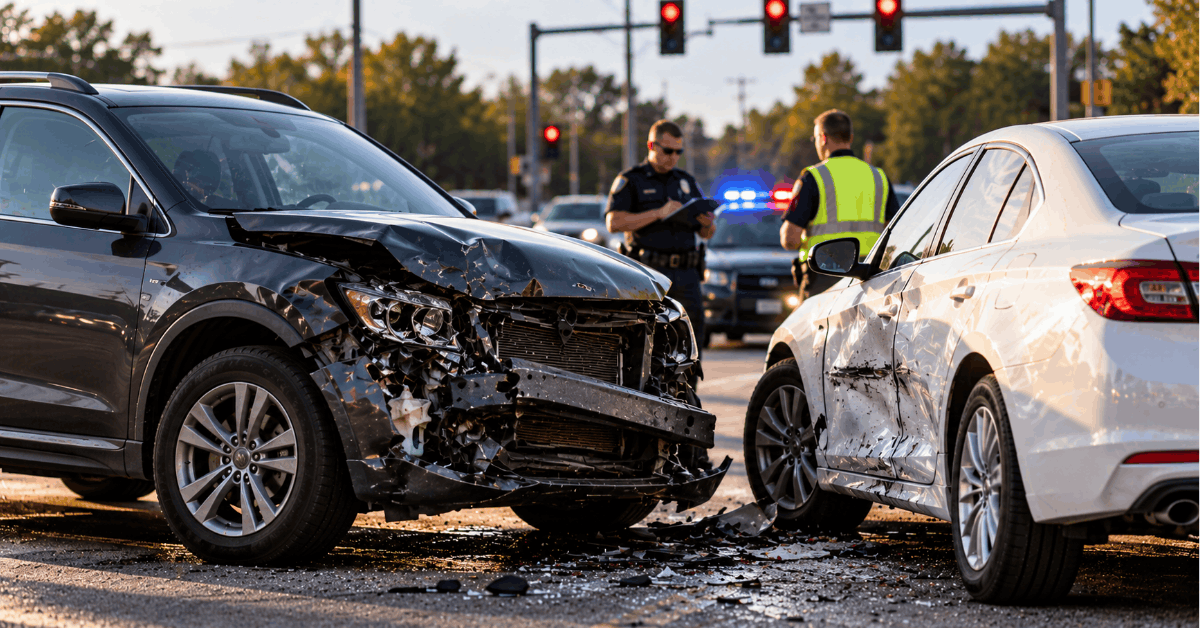
Georgia allows you to recover money after an auto collision if you were partially at fault, but only while your share of the blame stays under 50%. This rule, called modified comparative negligence, lowers your award by your percentage of fault. At 50% or higher, you collect nothing.
Because a few points can decide whether you are able to claim monetary damages, the fault percentage is the most contested number in many Marietta injury claims. At The Champion Firm, our car accident lawyers can test the fault story the insurer has already started telling.
How Does the 50% Bar Rule Work in Georgia?
The rule comes from Georgia's apportionment statute, O.C.G.A. § 51-12-33. It directs the court to reduce your damages in proportion to your fault. It blocks any recovery once you are 50% or more responsible for your own injuries.
Your payment drops by your percentage of fault. If a jury values your losses at $100,000 and finds you 20% at fault for the collision, the court subtracts $20,000. You receive $80,000.
A small increase in your share of fault can make a big difference near Georgia's 50% cutoff. Using the same $100,000 verdict example, your payment changes like this:
- 10% at fault: you receive $90,000
- 30% at fault: you receive $70,000
- 49% at fault: you receive $51,000
- 50% at fault: you receive nothing
- 75% at fault: you still receive nothing
Look closely at the gap between 49% and 50%. One percentage point separates a recovery worth more than half the verdict from no payment at all, which is why insurers pay so much attention to that line.
Who Determines Fault in a Car Accident in Georgia?
Who decides fault changes as your claim proceeds. Early on, an insurance adjuster assigns a percentage based on the crash report, photos, and recorded statements. If the case reaches court, a jury makes the final call.
Several people offer an opinion on fault before any final number exists. Depending on how far your claim goes, those voices can come from:
- The officer who writes the crash report
- The at-fault driver's insurance adjuster
- Your own insurer, if you file under your policy
- A mediator helping both sides reach a deal
- A judge or jury in Cobb County
Your police report can affect how an adjuster views fault, but the officer arrives after the crash and relies partly on driver and witness accounts. Officers from the Marietta Police Department and Cobb County Police Department may also issue traffic tickets, which adjusters consider when reviewing your claim. You can challenge blame attributed to you in a report with physical evidence, video, or data the officer did not review.
Multi-car crashes call for apportionment of fault in Georgia. The jury divides 100% of the blame among everyone who contributed, even drivers who were never sued, and each defendant pays only its own share. Figuring out those shares in Marietta car wreck cases takes a real investigation, since every driver's insurer will point at someone else.
How Do Insurance Adjusters Use the 50% Bar Against You?
Insurance companies may treat Georgia's fault rule as a weapon for shrinking or denying claims. Every percentage point an adjuster adds to your side lowers their payout, and reaching 50% lets the insurer close the file without paying anything.
An adjuster will not announce a plan to raise your fault share. The effort shows up in quieter requests and comments:
- Recorded statements: The adjuster asks friendly questions about your speed or where you were looking. Any guess you offer can later be treated as an admission.
- Evasive action arguments: The insurer claims you had time to brake or swerve, even when the other driver pulled directly into your path. Arguments like that turn a clear-cut wreck into a contested one.
- Seat belt questions: Since April 2025, under Senate Bill 68, Georgia law allows evidence that you were not buckled up when fault and damages are divided. A judge can still keep that evidence out if it would unfairly sway the jury.
- Gaps in medical care: A delay between the crash and your first doctor visit gives the insurer room to argue something else caused your injuries. Adjusters also point to missed appointments as a sign the injury was minor.
An adjuster can raise any of those points without a shred of proof that you drove carelessly. Sending the adjuster’s questions to a personal injury lawyer instead of answering them yourself takes most of those openings away.
Mistakes That Push Your Fault Share Toward 50%
What you say and do during the first week after a crash can affect how the insurer assigns fault. The insurer may review your phone statements and online posts long before you file a lawsuit.
Even an honest mistake can give the insurer a reason to place more blame on you. Watch for these common missteps:
- Apologizing at the scene or saying you never saw the other car
- Guessing your speed during a recorded call
- Posting photos or comments about the crash on social media
- Giving the officer and the adjuster different versions of events
- Signing a medical records release with no time limits
- Repairing or scrapping your car before anyone inspects it
Social media posts are the easiest of the list to fix today. Setting your accounts to private and not posting until the claim ends makes it harder for casual comments to land in an adjuster's file.
What Do Shared-Fault Crashes Look Like in Marietta?
You may face a dispute over fault when heavy traffic and confusing lanes contribute to your crash. Near the Big Chicken, turn lanes and shopping center exits crowd the area around Cobb Parkway (US 41) and Roswell Road. Similar conflicts can arise near the Interstate 75 ramps at Roswell Road (GA-120) and in stop-and-go traffic along the Barrett Parkway shopping corridor.
Imagine you're traveling along Whitlock Avenue about 15 miles per hour over the limit. Another driver turns left across your path without yielding, which causes your collision.
Georgia law requires left-turning drivers to yield to oncoming traffic close enough to pose a danger. The turning driver may bear more blame, but your speeding could reduce your award if it helped cause the collision.
Your share of fault depends on the evidence. A jury would want answers to questions such as:
- How fast was each car moving?
- Was the oncoming car visible when the turn began?
- What signal did each driver face at impact?
- Did parked vehicles or trucks block sight lines?
- Was either driver using a phone?
Change one answer and the percentages can flip. A turning driver with a green arrow, for instance, may owe nothing, leaving the speeding driver with most or all of the blame.
Fault in rear-end collisions points to the following driver in most cases. Suppose another car hits you on South Marietta Parkway while one of your brake lights is broken.
The other driver may argue that the faulty light made your braking harder to notice. A jury could assign you some fault if the broken light contributed to the crash, while still placing most of the blame on the other driver for following too closely.
What Evidence Proves You Were Less Than 50% at Fault?
Beating a 50% accusation takes proof collected early and from more than one source. In Marietta, the work starts with the crash report from the Marietta Police Department or the Cobb County Police Department, then expands to records the insurer has no reason to share.
Some of the most useful proof belongs to strangers, government offices, or the vehicles themselves. Sources that can help in Marietta fault disputes are:
- Event data recorders: Most newer vehicles have a black box that stores speed, braking, and seat belt use for the seconds around a crash. Downloads from cars and commercial trucks involved in I-75 wrecks can confirm or contradict the other driver's account.
- CobbLinc bus video: CobbLinc buses use many of these same roads, and any onboard cameras may capture your crash or nearby traffic. To get the footage, you may need to submit a formal records request to Cobb County or seek a subpoena.
- City traffic records: The City of Marietta Public Works Department maintains the city's traffic signals, and the city runs red-light cameras at several Cobb Parkway intersections. Signal timing data and any saved camera footage can show who had the right of way.
- Witnesses and scene evidence: Skid marks and debris get cleared within days, while bystanders scatter once the road reopens. Statements taken soon after your collision count for more than accounts pieced together months later.
Some systems record over old footage on a set schedule. A preservation letter sent in the first weeks asks the owner to hold onto video and data before it is gone.
Can You Sue If You Were Partially at Fault?
Yes, you can file suit in Georgia as long as a jury could find your share of the blame below 50%. Marietta crash cases are usually filed in the State Court of Cobb County or Cobb County Superior Court, both located near Marietta Square.
A lawsuit can change how an insurer values the fault question. In one Marietta case, an insurer refused to make any offer after a left-turn crash, claiming our client was 50% at fault for failing to take evasive action. However, the insurance company paid its full policy limits after we filed suit in that contested-fault left-turn claim.
Past results do not predict how a different claim will end. They do show that an adjuster's fault estimate is only an opening position, and a jury may read the same facts very differently.
Marietta Shared-Fault Crash FAQs
Fault findings reach beyond the injury claim itself, touching traffic court, your own policy, and even the people riding in your car.
It can, because pleading guilty, or skipping court after posting a cash bond, may be treated as an admission of fault in your injury case. Georgia allows a nolo contendere, or no contest, plea in many traffic cases, and that plea generally cannot be used against you in a civil case.
Neither driver can collect from the other, because each one hits the 50% bar. Both drivers would have to cover their own losses through their own policies.
Yes, collision and medical payments coverage pay no matter who caused the crash, up to your policy limits. Using them does not stop you from pursuing the at-fault driver for the rest of your losses.
As a passenger, you usually share no fault for a crash because you do not control the car. An insurer may still argue that you share blame if you rode with a driver you knew was impaired.
Yes, the same rule applies to anyone hurt by a driver, including people walking or riding bikes. Crossing outside a crosswalk or biking at night without reflective lights can give the insurer room to argue for a share of fault.
Most Georgia injury lawsuits must be filed within two years of the crash. Claims against a city generally require written notice within six months, and claims against a county generally within 12 months. If a CobbLinc bus was involved, the notice rules depend on who operated it.
Challenge a Marietta Fault Split Before It Costs You Your Claim
The percentage of fault an adjuster assigns is an opinion, and getting it below 50% takes an investigation built on records the other side has no reason to hand over. Call The Champion Firm at 404-495-3716 or request an appointment online for a free and confidential case review. We can walk you through how the other side is dividing the blame and what evidence may change it.