The Georgia Supreme Court issued a significant decision recently on medical malpractice cases.
More than 15 years ago, the Georgia Supreme Court issued the Nestlehutt decision, which held that the cap could not be applied to pain and suffering and loss of consortium damages because the jury decided those claims at the time the 1798 Georgia Constitution was adopted.
Recently, medical defendants in Georgia have argued the cap can still be applied to wrongful death claims because wrongful death claims did not exist in 1798.
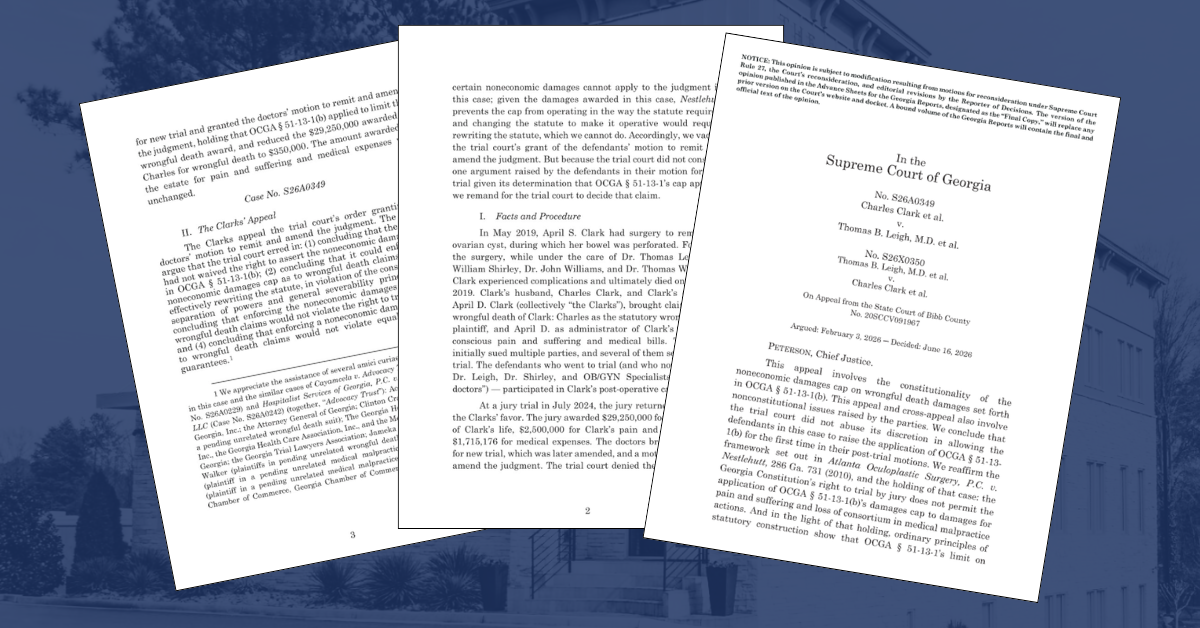
The Supreme Court recently issued its decision in Clark v. Leigh, which presented the issue of whether the medical malpractice cap could be applied to wrongful death damages.
The Court held that the cap could not be applied to the wrongful death portion of the verdict based on the facts, but it did not address the broader constitutional question. Instead, it focused solely on statutory construction:
"And after doing that construction, we conclude that the cap statute's damages cap is not capable of being applied in a case like this one, where a jury's verdict includes noneconomic damages for a cause of action to which the right to trial by jury applies (the estate's medical malpractice claim for pre-death pain and suffering) — even if that verdict also includes damages for a cause of action to which the right allegedly does not attach (the wrongful death claim that is the subject of the defendants' argument)."
In Clark, the verdict included both wrongful death damages and the estate's damages for pre-death pain and suffering. The verdict form even separated them out, so there was one award for wrongful death damages and one award for the estate's damages.
Nevertheless, the Supreme Court held that the caps statute, as written, could not be applied because the statute did not allow the Court to carve up the verdict and apply the statute the way the defendants wanted it to apply.
The Supreme Court has still not addressed the specific question of whether a wrongful death only case could be capped, or if a caps statute that applies only to wrongful death damages could be enforced.
But this much is clear: The medical malpractice cap cannot be applied to any damages if pain and suffering damages are awarded.
The practical takeaway: In every wrongful death medical malpractice case, get an estate set up and work on proving up damages for pre-death pain and suffering.
What do you think of the decision? Join this and other legal conversations with me on LinkedIn.
Related:
Cardiology Malpractice Lawyers Georgia
Delayed Cancer Diagnosis Attorney in Georgia