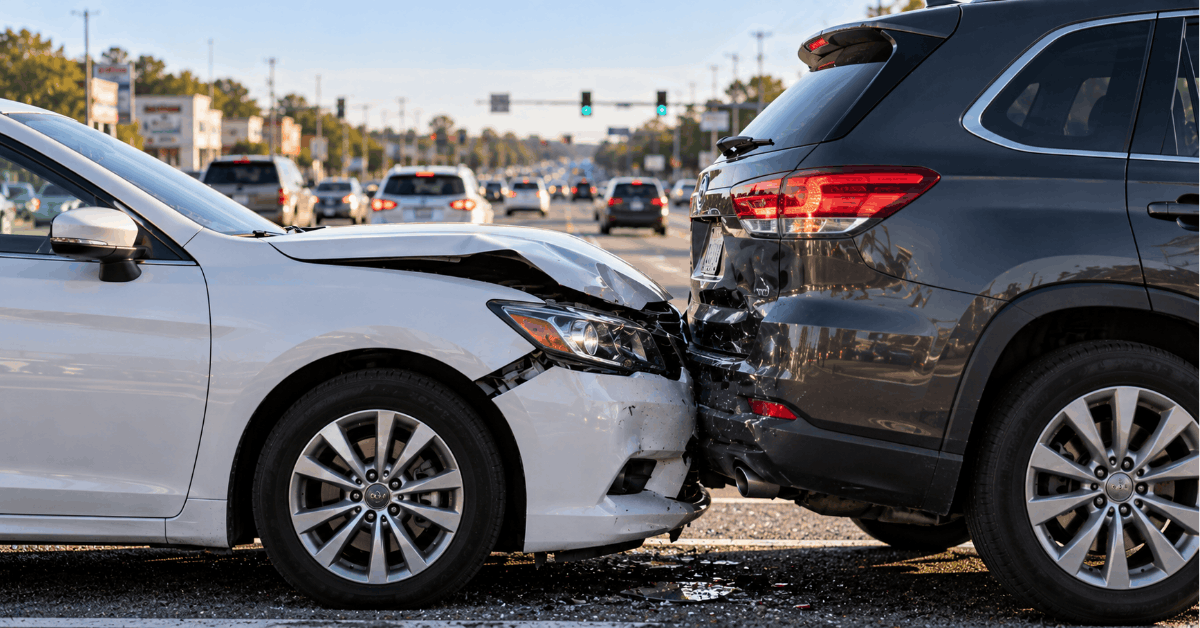
In most rear-end collisions on Cobb Parkway, Georgia law points first at the driver in the back. This following driver is required to leave enough room to stop, so police and insurers often start from the idea that the rear car caused the wreck.
The facts can still change that answer, and they also decide how much the other side has to pay. Clear fault does not stop an insurer from fighting the rest of the claim. A car accident lawyer at The Champion Firm can help you prepare for that fight by gathering the crash report, medical records, and witness accounts early.
Who Is at Fault in a Rear-End Collision in Georgia?
Georgia's following-too-closely law says a driver may not follow another vehicle more closely than is reasonable and prudent. The rule asks drivers to think about their speed, the traffic around them, and the condition of the road. When one car hits another from behind, the trailing driver's spacing is the first thing anyone questions.
Fault in a Georgia rear-end collision starts with the rear driver. Georgia courts have said a rear-end crash alone does not prove the rear driver was careless, so a jury still looks at what both drivers did.
The front driver can end up sharing the blame or even taking most of it. Conduct that can shift fault forward includes:
- Brake-checking a driver on purpose
- Brake lights or taillights that did not work
- Changing lanes into a small gap and braking right away
- Rolling backward or reversing into the car behind
- Stopping in a travel lane without hazard lights
Georgia lets you recover damages as long as your share of fault stays under 50%, though your award drops by that share. A front driver found 30% responsible for a broken brake light, for example, would still collect most of the money from the rear driver's insurer.
Proving one of those exceptions takes more than your word against the other driver's. Dashcam video, data from the cars' onboard computers, and a photo of a dead brake bulb taken at the scene give a jury something solid to weigh. Without that proof, the starting assumption against the rear driver usually holds.
What Causes Most Rear-End Crashes on Cobb Parkway?
Cobb Parkway combines fast through traffic with constant turning, which leaves little room for a late reaction. Most rear-end wrecks along the corridor trace back to a short list of driver choices:
- Phone use: Under the Hands-Free Georgia Act, drivers may not hold a phone while driving. Phone records can show whether the rear driver was typing or scrolling at the moment of impact.
- Tailgating: Drivers who hug the bumper ahead have no time to react when a light changes at the next intersection. Commercial trucks need even more space, since a loaded rig takes far longer to stop than a car.
- Sudden braking: Shoppers slowing to find a turn into a strip center catch trailing drivers off guard. The rear driver still has to leave enough room for those stops, which happen all day on a retail corridor.
- Impaired driving: Alcohol and drugs slow reaction time, and drunk driving crashes can involve a rear driver who never touched the brakes. In Georgia, a driver who caused a wreck while impaired can face punitive damages with no cap on the amount.
More than one cause can show up in the same collision. A tailgating driver who also glanced at a phone gives the insurer very little to argue about.
Speed adds to every one of these problems. Drivers racing to beat the next light between Marietta's busy intersections cover more ground before they can react, and a harder impact can mean worse injuries for the people in front.
Why Do Rear-End Wrecks Cluster Along Cobb Parkway in Marietta?
Several Cobb Parkway intersections combine merging, turning, and sudden stops. Where the North and South Loops of Marietta Parkway meet US-41, drivers merge, change lanes, and slow for ramps within a short span. Near the Big Chicken at Roswell Road, visitors looking for the landmark share the lanes with locals heading to work.
Farther north, the Bells Ferry Road intersection can back up at rush hour, and drivers who misjudge the line of stopped cars end up in the trunk of the car ahead. Claims from these spots depend on showing how far back the rear driver was when traffic stopped.
Traffic on the parkway also swells for reasons that start miles away. The biggest sources of extra cars are:
- Braves games and events at Truist Park and The Battery Atlanta
- Students and staff heading to the Kennesaw State University Marietta Campus
- Freight trucks that may use US-41 as an alternative to Interstate 75
- Delivery vans making stops at shopping centers
- Holiday shoppers heading to retail centers along the corridor
Event traffic can create some of the worst stop-and-go stretches, since backup can form well short of the stadium.
How Do You Get a Cobb County Car Accident Report Online?
The crash report is the first record most insurers ask for. Which agency writes it depends on where the wreck happened, since the Marietta Police Department covers city streets and the Cobb County Police Department handles unincorporated parts of the county.
Cobb County Police posts accident report instructions that send involved drivers to its Police 2 Citizen system, with reports ready in two to three business days. Marietta crash reports are sold through BuyCrash, and you will need the case number the officer gave you at the scene.
Mistakes in the report can follow your claim for months. Check these details carefully:
- Your name, address, and insurance information
- The direction each vehicle was traveling
- The officer's diagram of the collision
- Witness names and phone numbers
- Any citation issued and to whom
An officer usually will not change an opinion about fault, but the department may be able to fix factual errors such as a wrong plate number or road name. Ask about a correction or an added report as soon as you spot a problem.
What Happens After You File a Claim?
Most claims start with a demand sent to the at-fault driver’s insurer, backed by the crash report, your medical records, and repair estimates. A personal injury lawyer can prepare that demand and respond when the insurer pushes back. If the insurer will not offer a fair amount, the next step is a lawsuit in Cobb County’s State Court or Superior Court, which hear civil cases in downtown Marietta.
During the lawsuit, both sides exchange evidence and question witnesses under oath. Many claims settle during that stage or at mediation, before a jury ever hears the case.
What Are Common Injuries From Rear-End Crashes?
The force of a rear impact throws the head forward and back, which is why neck injuries top the list. These injuries can show up at every speed, even when the cars look fine, and they include:
- Whiplash and other neck strains
- Herniated or bulging discs
- Concussions from striking the headrest or window
- Shoulder and back sprains
- Wrist and hand injuries from bracing on the steering wheel
- Facial injuries from airbag deployment
Symptoms from soft-tissue and head injuries can take a day or more to appear. Getting checked soon after the crash creates a medical record that ties the injury to the collision. Following the treatment plan matters too, since insurers point to skipped visits as proof the injury was minor.
Insurers also argue that light vehicle damage means light injuries. One of our clients was rear-ended while turning right onto Cobb Parkway, and the other driver’s insurer used her minor bumper damage to dispute how badly she was hurt. The case settled weeks before trial after we lined up testimony from her treating doctor.
What Can You Recover After a Rear-End Collision in Marietta?
Georgia lets injured drivers and passengers recover money for the losses a crash caused. Some losses come with a receipt, and some do not. The main categories are:
- Medical bills: You can claim the cost of emergency care, follow-up visits, and therapy. Future treatment a doctor expects you to need counts too.
- Lost wages: Pay you missed while recovering can be recovered. If the injury limits your work long term, lost earning ability is part of the claim as well.
- Pain and suffering: A Georgia jury can award you money for physical pain and the ways your injury affects daily life. Bills cannot measure these losses, so your testimony and accounts from people close to you help show their impact.
- Property damage: The rear driver's insurer is generally responsible for repair costs or the value of a totaled car, plus a rental while yours is in the shop. Georgia also allows a diminished value claim for the drop in your car's resale value after a wreck, even once repairs are done.
Insurers price these losses using your records, so keep every bill, pay stub, and repair estimate in one place. Use a journal to document pain levels and missed activities to help prove the losses that never come with a receipt.
A driver who flees the scene does not end your claim. If police later identify the driver, that driver’s insurer is generally still responsible, and your own underinsured motorist coverage can help when their policy is too small. If the driver is never found, your uninsured motorist coverage may pay instead, though Georgia has specific proof rules for those claims.
One of our clients was stopped on southbound Cobb Parkway when a tailgating driver hit him from behind and fled, and police later identified the driver. Our client’s injuries eventually required neck surgery, and we recovered a settlement from both the at-fault driver’s insurer and the underinsured motorist carrier in that hit-and-run rear-end claim. Every claim has its own facts, and an earlier outcome cannot tell you what yours will bring.
Cobb Parkway Rear-End Crash FAQs
Paperwork, car repairs, and filing deadlines keep going while you heal, and small missteps with any of them can cost you money.
Yes, Georgia gives you four years to sue over damage to your vehicle but only two years for personal injuries. Most people resolve both together, so the two-year deadline is the one to watch.
You can file a claim without one, but a report makes it much stronger. Georgia law requires drivers to report any crash that causes injury, death, or at least $500 in property damage.
Every driver who failed to stop in time can share the blame, and a jury divides fault among them by percentage. If you were in a middle car, you may have a claim against the driver behind you while facing a claim from the car you were pushed into.
The driver's employer or the rideshare company's insurance may cover your losses if the driver was working at the time. Those commercial policies can have much higher limits than a personal auto policy.
Yes, being fully stopped makes it hard for the rear driver to claim you caused the crash. Make sure the report and your photos show that your car was not moving and where it was in the lane.
Yes, and your own collision coverage can pay for repairs if the other insurer is slow to respond. Take clear photos of the damage from every angle before any work starts.
Rear-Ended on Cobb Parkway? Start Your Free Case Review Today
An insurer’s first offer after a rear-end crash can show up before anyone knows the full cost of your injuries, so hold off on signing until you know what the claim is worth. Families who prefer Spanish can work with us directly. Hablamos español. Call The Champion Firm at 404-495-3716 or schedule an appointment online for your free and confidential case review.